Did you know that over 80% of small-scale farmers worldwide depend on a single annual or biannual harvest for their entire livelihood? This “all eggs in one basket” approach is the primary reason why farming is often viewed as a high-risk gamble rather than a stable business. The “Challenge” of traditional crop farming is the agonizing “waiting period” between sowing and harvest, where expenses continue to pile up but no revenue is generated. The “Pain Point” is the sudden financial shock caused by a bad monsoon, a pest outbreak, or a crash in market prices, leaving the farmer with zero liquidity.
The ultimate solution is the Integrated Crop-Dairy-Poultry Model. By combining these three distinct but biologically linked enterprises, a farmer creates a “Circular Economy” on their own land. This system ensures that the farm produces something to sell every single day, every week, and every season. This article provides a comprehensive guide to building this resilient triple-threat system. You will learn the core fundamentals of resource cycling, the economic impact of multiple income streams, and a 5-step implementation plan to ensure your farm generates a stable monthly income.
Understanding Crop, Dairy, and Poultry Integration: Key Concepts
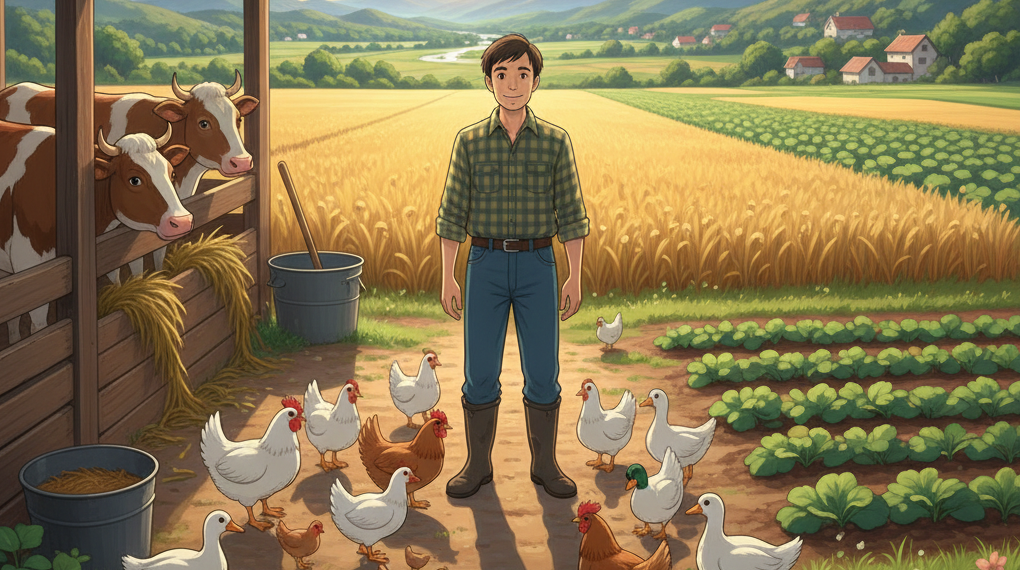
The Crop-Dairy-Poultry integration is the most balanced form of an Integrated Farming System (IFS). Historically, these were treated as separate industries—one person grew wheat, another managed cows, and a third raised chickens. However, modern relevance has proven that these three are more productive when they live together. In this model, the Crops provide fodder and grains, the Dairy cows provide milk and heavy manure, and the Poultry birds provide eggs, meat, and high-nitrogen fertilizer.
Think of this integration like a three-speed transmission in a vehicle.
- Poultry is the “Fast Gear”: It generates daily cash flow through eggs and has a very short 45-day cycle for meat.
- Dairy is the “Steady Gear”: It provides a consistent, high-value daily income from milk.
- Crops are the “Power Gear”: They provide a massive, lump-sum payout at the end of the season.
Technically, the “magic” happens through Biomass Conversion. Instead of buying expensive chemical fertilizers, you use poultry litter and cow dung to feed your soil. Instead of buying commercial feed at high retail prices, you use crop residues (like corn stalks or wheat straw) and grain by-products to feed your animals. By closing these loops, you drastically lower your “Cost of Production” while increasing your “Net Profit.”
Why It Matters: The Top Benefits of Triple Integration
Integrating these three sectors transforms the farm from a vulnerable plot of land into a high-performance business. Here is why it matters:
- Daily Liquidity (Cash Flow): This is the most significant benefit. While you wait for your crops to grow, the sale of Milk and Eggs provides the daily cash needed for household expenses, diesel, and labor, preventing the need for high-interest loans.
- 100% Organic Fertilizer Production: Poultry manure is exceptionally rich in Nitrogen and Phosphorus, while Cow dung adds “bulk” and beneficial microbes to the soil. Together, they create a “Complete Fertilizer” that rebuilds soil health better than any chemical alternative.
- Risk Diversification: If a heatwave affects your crop yield, the cooler barn environment keeps your Dairy and Poultry production stable. This “Multi-Sector” shield ensures you are never without an income.
- Optimal Labor Utilization: In a crop-only farm, labor is needed intensely during sowing and harvest, with nothing to do in between. In an integrated model, farm labor is consistently utilized year-round, making it easier to retain skilled workers.
Pro Fact: On an integrated farm, the cost of fertilizer for crops is effectively Zero, and the cost of animal feed can be reduced by up to 40% by using on-farm residues.
How to Get Started: A Practical Guide for Beginners
You don’t need a massive investment to start; you need a strategic plan. Follow this 5-step actionable plan:
Step 1: Design the “Nutrient Path”
Place your Poultry shed and Dairy barn close to each other, and ideally at a higher elevation than your crop fields. This allows you to collect wash-water and manure easily. Ensure your Manure Pit is covered to prevent the loss of nitrogen to the air.
Step 2: Establish the “Fodder Bank”
Dedicate 20% of your land to High-Quality Fodder (like Napier grass, Alfalfa, or Maize). A cow’s milk production is directly linked to the quality of its “Green Feed.” By growing your own, you ensure your dairy unit is profitable even when milk prices are low.
Step 3: Start the Poultry Unit (The “Fast Cash” Layer)
Begin with 100 to 500 birds (Broilers for quick turnover or Layers for daily eggs). Use the “Deep Litter” system where the birds stay on a bed of rice husks or sawdust. After each batch, this litter becomes a “Power Fertilizer” for your vegetables and grain crops.
Step 4: Integrate the Dairy Unit (The “Fixed Deposit”)
Introduce 2 to 5 high-yielding cows or buffaloes. Use the Biogas from their dung to power your kitchen or farm machinery. The “Slurry” (liquid waste) from the biogas plant is the most potent organic fertilizer available and can be applied directly through your irrigation lines.
Step 5: Implement “Relay Cropping”
Don’t let the land sit idle. As soon as one crop is harvested, sow another. Use the heavy organic manure from your animals to ensure the soil can handle this intensive production. For example, grow Maize (for grain/fodder), followed by Legumes (for soil nitrogen), followed by Vegetables.
Beginner’s Tip: Avoid buying “Fancy” equipment early on. Focus your initial capital on High-Quality Breeds (for animals) and Hybrid Seeds (for crops). Good genetics in your animals and plants will do 80% of the work for you.
Overcoming Challenges and Looking into the Future
The primary hurdle in triple integration is Time Management. Managing three different life-cycles (Birds, Cows, and Plants) requires a strict daily schedule. The solution is Standard Operating Procedures (SOPs)—setting fixed times for feeding, milking, and field checks. Another challenge is Bio-Security; diseases can spread between animals if the farm is not kept clean. Proper vaccination and maintaining a hygienic shed are non-negotiable.
Looking into the future, Precision Integration is the trend. We are seeing “Smart Barns” where sensors track a cow’s health and automatically adjust its feed based on the crop residues available that day. Furthermore, the rise of Carbon Farming means integrated farmers will soon be able to sell “Carbon Credits” because their soil stores so much more carbon than a chemical-heavy monoculture farm.
Conclusion
The Crop-Dairy-Poultry integrated model is the ultimate answer to the uncertainty of modern agriculture. It replaces the “Seasonal Gamble” with a “Monthly Salary.” By allowing your plants to feed your animals and your animals to feed your plants, you create a circle of profit that grows stronger every year.
Call to Action: Today, calculate your total “External Input” costs (Fertilizer + Feed). Identify one way you can replace an external purchase with a farm-made alternative. Start by integrating just one small poultry unit into your existing farm and watch the cash flow change.
The most successful farmer of 2026 isn’t the one with the most land, but the one with the most Integrated System.
Frequently Asked Questions (FAQs)
1. Is this model suitable for a 1-acre farmer? Yes! In fact, it is most effective for smallholders. You can keep 2 cows, 200 chickens, and grow high-value vegetables on 1 acre to earn a better monthly income than a 5-acre grain farmer.
2. How much “Monthly Income” can I realistically expect? On a well-managed 2-acre integrated farm, the Daily Milk and Daily Eggs can provide a net profit of ₹15,000 to ₹30,000 per month, while the Seasonal Crops provide a “bonus” of ₹1 Lakh to ₹3 Lakh every six months.
3. Can I use the same labor for all three sections? Yes. The tasks are spread out throughout the day. Milking is early morning/evening, poultry feeding is twice a day, and crop work happens in between. This makes for a very efficient use of family or hired labor.
4. What if I don’t have enough water for both animals and crops? Integrated farming actually saves water. By using organic manure, your soil holds moisture for 30% longer, meaning your crops need less frequent irrigation, leaving more water available for your livestock.