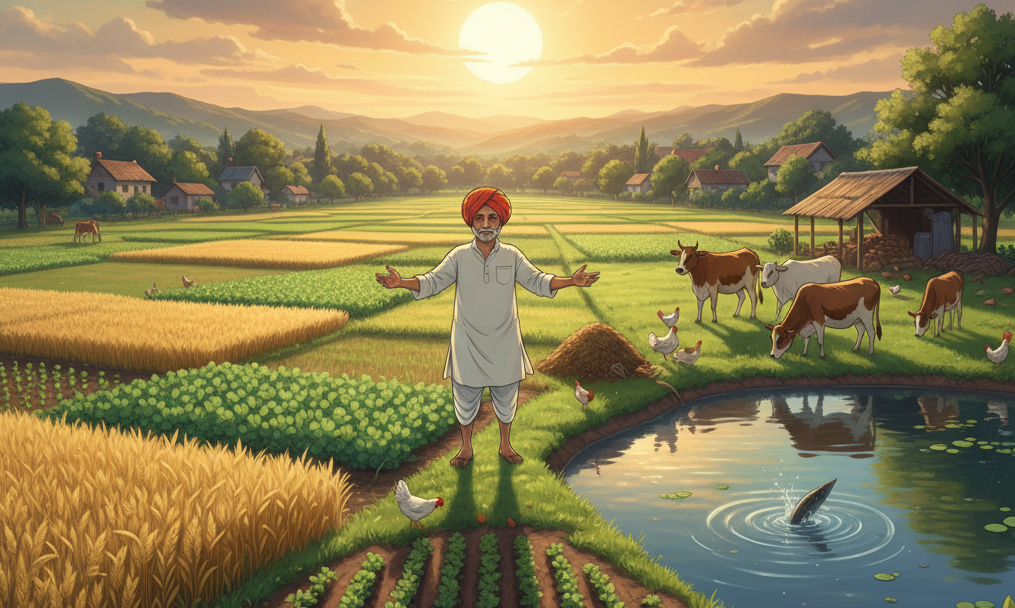
What if your farm could function as a self-sustaining ecosystem where the waste from one section becomes the high-value fuel for another? The shocking reality of modern agriculture is that nearly 40% of small-scale farmers struggle with poverty not because they don’t work hard, but because they rely on a single source of income. The “Challenge” of monoculture—growing only one crop—is that a single pest outbreak, a sudden market price drop, or a delayed monsoon can wipe out a family’s entire yearly earnings. The “Pain Point” is the heavy reliance on expensive external inputs like chemical fertilizers and commercial animal feed, which eat away at the already thin profit margins.
The ultimate solution is the Integrated Farming System (IFS). This is a holistic approach where various agricultural enterprises, such as crop production, livestock, poultry, and fish farming, are combined on a single piece of land to maximize productivity and minimize waste. By creating a “circular” flow of resources, IFS transforms a vulnerable farm into a resilient, multiple-income business. This guide serves as your comprehensive roadmap to understanding and implementing an integrated model. You will learn the core fundamentals of resource recycling, the massive economic benefits of diversification, and a 5-step implementation plan to secure your financial future.
Understanding Integrated Farming: Key Concepts and Importance
At its heart, Integrated Farming is the art of “linking” different farm activities so that they support each other. Historically, this was the way our ancestors farmed—keeping a few cows, some chickens, and various crops together. However, the modern relevance of IFS has exploded as we face climate change and soil degradation. Instead of looking at a farm as a collection of separate plots, IFS views the farm as a living machine where every output has a purpose.
Think of Integrated Farming like a professional sports team versus a solo athlete. A solo athlete (monoculture) is great, but if they get injured, the game is over. A sports team (IFS) has multiple players. If the “Crop Player” has a bad season due to low rain, the “Dairy Player” or the “Poultry Player” can still score points (income) for the team.
Technically, this is based on the principle of Nutrient Cycling. For example, the waste from a poultry shed is rich in nitrogen, which makes excellent organic fertilizer for a vegetable patch. The “leftover” stalks from those vegetables can then be processed into nutritious fodder for cattle. This importance cannot be overstated: in an integrated system, you aren’t just a farmer; you are an Ecosystem Manager.
Why It Matters: The Top Benefits of Integrated Farming
Transitioning to an Integrated Farming System is the most effective way to eliminate “Financial Seasonality” in agriculture. Here is why it matters:
- Year-Round Income Flow: Traditional crop farming only pays you after harvest. In an IFS model, you might get daily income from milk and eggs, monthly income from fish or poultry, and a large seasonal payout from main crops.
- Massive Reduction in Input Costs: When you produce your own organic manure and animal feed on-site, your reliance on expensive shops drops by 30-50%. You are essentially “growing” your own fertilizer.
- Enhanced Soil Health: Constant application of diverse organic wastes (cow dung, poultry litter, fish pond silt) rebuilds the soil’s carbon content, making your land more fertile and better at holding water every single year.
- Risk Mitigation: IFS provides a “safety net.” If a market glut crashes the price of tomatoes, you can feed those tomatoes to your pigs or fish, turning a potential loss into high-quality animal protein that sells for a better price.
Pro Fact: Studies show that an Integrated Farming System can increase a farm’s total net profit by 100% to 200% compared to traditional single-crop farming on the same amount of land.
How to Get Started: A Practical Guide for Beginners
Building an integrated system is a journey of layers. Do not try to start five different businesses on day one. Follow this 5-step actionable plan:
Step 1: Resource Mapping and Site Selection
Analyze your current assets. Do you have a permanent water source? Is there a slope on your land? Place your Livestock Shed at a higher elevation so that the waste can naturally wash down into a Compost Pit or a Fish Pond using gravity.
Step 2: Establish the “Anchor” Crop
Start with your main crop (e.g., Rice, Fruit Trees, or Vegetables). This provides the “Biomass” (waste material) needed to feed your animals. For small landholders, Horticulture (Fruits/Vegetables) is the best anchor because it produces high-quality waste.
Step 3: Add the “Nutrient Providers” (Livestock/Poultry)
Introduce a small number of animals. For beginners, Goats or Poultry are excellent because they require low investment and produce “Hot Manure” that breaks down quickly into fertilizer. Use the space under fruit trees for “free-range” poultry to manage pests naturally.
Step 4: Integrate the “Recycler” (Fishery or Vermicompost)
If you have a water source, a small Fish Pond is a miracle for IFS. You can use poultry droppings to fertilize the pond (growing algae for fish to eat) and use the nutrient-rich pond water to irrigate your crops. If water is scarce, use a Vermicompost Unit to turn animal waste into “Black Gold” for your plants.
Step 5: Implement a Feedback Loop
Monitor your system. If your chickens are producing more waste than your vegetables can handle, consider adding more crops or selling the surplus manure as a secondary income stream.
Beginner’s Tip: Focus on Waste-to-Wealth. Always ask: “What am I currently throwing away, and which animal or plant can eat it?” Successful integrated farming is about closing the gaps where money leaks out of the farm.
Overcoming Challenges and Looking into the Future
The primary hurdle in IFS is the Increased Management Complexity. You are now looking after animals, fish, and crops simultaneously, which requires more diverse knowledge. The solution is to use Automation—such as simple drip irrigation or automatic poultry feeders—to reduce the daily labor load. Another challenge is the Initial Capital for sheds and ponds, but many governments offer “Multi-Enterprise” subsidies to help farmers transition.
Looking into the future, Precision Integrated Farming is the next big trend. We are seeing the use of sensors that monitor the ammonia levels in fish ponds and automatically trigger the irrigation of crop fields. Furthermore, the rise of Carbon Credits means that in the near future, integrated farmers will likely be paid by international agencies simply for the massive amounts of carbon they are storing in their healthy, organic-rich soil.
Conclusion
Integrated Farming is more than just a technique; it is a philosophy of abundance. It proves that a farm doesn’t have to be a place of struggle and debt, but can be a thriving, self-replenishing business. By diversifying your income and recycling your resources, you are building a legacy of resilience for your family and your community.
Call to Action: This week, look at your farm’s “waste pile.” Identify one animal or one secondary crop that could turn that waste into profit. Start small, link your systems, and watch your income multiply.
The era of the “Single-Income Farmer” is ending; the era of the Integrated Agri-Preneur has arrived.
Frequently Asked Questions (FAQs)
1. Can Integrated Farming be done on a very small plot (e.g., 0.5 acres)? Absolutely. In fact, IFS is most effective on small plots. A small “Backyard Model” combining high-value vegetables, a few goats, and a small poultry unit can provide a family with both food security and a steady cash income.
2. Is it difficult to manage so many different animals and crops? It requires better time management, but not necessarily more “hard labor.” Because the systems support each other (e.g., chickens weeding the garden), some tasks actually become easier. The key is to automate what you can and follow a strict schedule.
3. What is the most profitable combination for an integrated farm? In India and South Asia, the Dairy-Crop-Fishery model or the Poultry-Vegetable-Biogas model are highly profitable. The best combination depends on your local market demand—always grow what people in your nearest town want to buy.
4. Does Integrated Farming require a lot of water? On the contrary, IFS is very water-efficient. Because you are using organic matter to build the soil’s “Sponge” capacity and recycling water from fish ponds to crops, your total water requirement per unit of profit is much lower than in traditional farming.
Bhai, ye “Integrated Farming” ka complete guide ready hai! Isme multiple income aur circular economy ke concepts ko bohot ache se samjhaya gaya hai