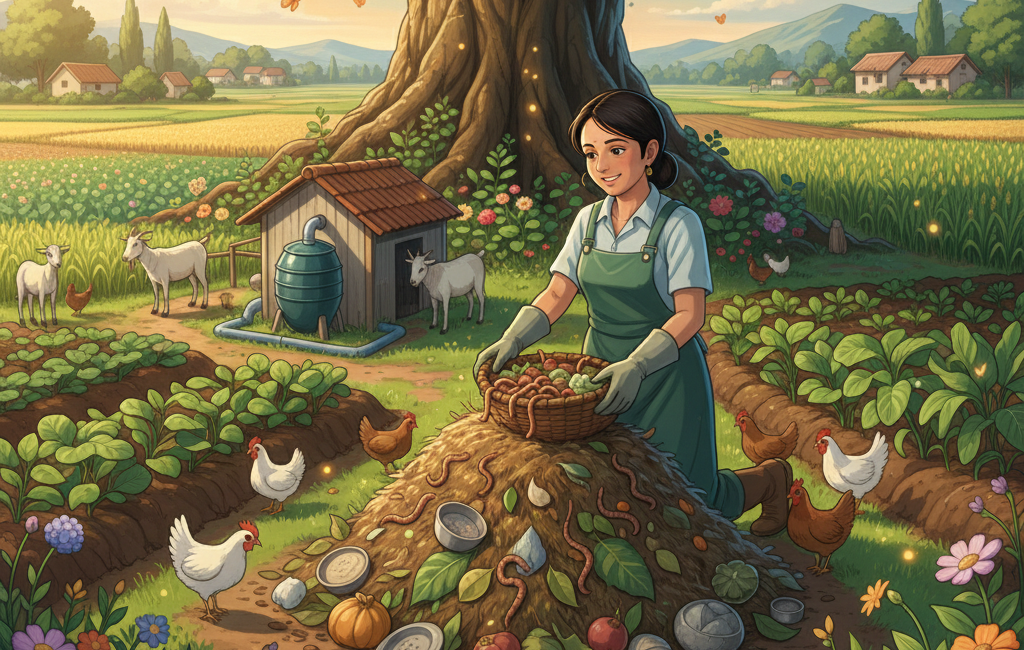
Did you know that the average conventional farm loses nearly 30% of its potential revenue simply by discarding “waste” materials like crop residues, animal manure, and fallen fruits? In an era where input costs for synthetic fertilizers and fuel are reaching record highs, throwing away organic matter is equivalent to throwing away cash. The Challenge for modern agriculture is the linear “Take-Make-Waste” model, which leaves farmers dependent on expensive external chemicals while depleting their soil’s natural vitality. This is the Pain Point: a struggle for profitability caused by high expenses and a single, vulnerable income stream that fails if the weather or market turns sour.
The ultimate solution is the Zero-Waste Farming Model, also known as Circular Agriculture. This system operates on the revolutionary principle that “waste is merely a misplaced resource.” By linking various farm activities, you ensure that every byproduct of one process becomes a high-value input for another. This guide serves as your strategic blueprint for building a self-sustaining agri-business. You will learn the core fundamentals of resource cycling, the economic impact of eliminating waste, and a 5-step implementation plan to create multiple, resilient income streams from a single piece of land.
Understanding Zero-Waste Farming: Key Concepts and Importance
Zero-Waste Farming is a holistic management system that aims to eliminate environmental pollution and maximize economic output by recycling all farm byproducts. Historically, this concept is rooted in traditional peasant farming, but its modern relevance is fueled by the Circular Economy movement. In a zero-waste setup, the farm functions as a closed loop where energy and nutrients are constantly reused, rather than being lost to the atmosphere or groundwater.
Think of Zero-Waste Farming like a high-efficiency city’s subway system. In a disorganized city, people use individual cars (monoculture), which create heat, traffic, and pollution (waste). In a city with a circular subway (Zero-Waste Model), the energy is used to move thousands of people efficiently, the heat from the tunnels is captured to warm buildings, and nothing is wasted. On a farm, this means the “waste” heat and gas from a Biogas Plant powers the kitchen, the slurry fertilizes the Vegetable Patch, and the vegetable scraps feed the Poultry.
Technically, the importance of this model lies in Total Biomass Utilization. Every gram of organic matter produced on the farm—whether it is a corn stalk, a chicken feather, or a cow pat—is viewed as a raw material for a secondary product. This shift in perspective transforms the farmer from a simple “grower” into a “resource manager” who extracts value from every square inch of the property.
Why It Matters: The Top Benefits of a Zero-Waste Model
Adopting a zero-waste approach is the fastest way to “de-risk” a farming business. Here is why it matters:
- Elimination of Fertilizer Costs: By processing animal manure and crop residues into high-quality Vermicompost, you can completely replace synthetic N-P-K fertilizers. This often saves a farmer ₹15,000 to ₹40,000 per acre annually.
- Diversified Profit Centers: Instead of selling only one crop, you sell multiple products: grains, milk, eggs, honey, organic compost, and even processed items like dried fruits. If the price of grain drops, your income from eggs and compost keeps the business afloat.
- Energy Independence: By installing a small Biogas Digester, you can turn animal waste into clean cooking gas and electricity. This removes the “Pain Point” of rising LPG or electricity prices for the farmhouse and farm machinery.
- Soil Carbon Sequestration: Zero-waste methods naturally build “Humus” in the soil. This makes the land more drought-resistant, as soil rich in organic matter can hold up to ten times more water than chemically depleted soil.
Pro Fact: Zero-waste farms typically have a Net Profit Margin that is 40–60% higher than conventional farms because their “Cost of Production” is significantly lower due to internal resource recycling.
How to Get Started: A Practical Guide for Beginners
Transitioning to a zero-waste model doesn’t require a total overhaul overnight. Follow this 5-step actionable plan:
Step 1: The “Waste Audit”
Spend one week documenting everything that leaves your farm as “trash” or is burned. This includes stubble, manure, spoiled fruit, and even greywater from the house. This list represents your “hidden” profit opportunities.
Step 2: Set Up the “Recycling Hub” (Vermicompost & Biogas)
The heart of a zero-waste farm is the decomposition unit. Build a Vermicompost Pit using Red Weaver worms to process dry waste, and a small Biogas Digester for wet animal waste. These two tools turn your “Waste Audit” list into fertilizer and fuel.
Step 3: Integrate “Scavenger” Components
Introduce animals that naturally process waste. Poultry (Chickens/Ducks) are excellent at eating fallen fruits and insect pests, turning them into high-value eggs. Pigs can process almost any kitchen or garden waste into high-quality meat and manure.
Step 4: Implement Vertical and Layered Cropping
Use every layer of your farm. Grow Fruit Trees (top layer), Pepper Vines climbing the trees (middle layer), and Ginger or Turmeric (bottom shade-loving layer). This “Multi-Story” approach ensures that even the sunlight and space are not wasted.
Step 5: Value-Addition on Site
Never sell “waste-grade” produce for low prices. Turn bruised fruits into Jams or Vinegar. Turn excess straw into Mushroom Bedding. By processing these “sub-standard” items on-site, you create a premium product from something that was previously a loss.
Beginner’s Tip: Start with Mulching. Never leave your soil bare. By simply covering your soil with crop residues, you prevent water evaporation and allow soil microbes to turn that “waste” straw into plant food right where it sits. It is the easiest “Zero-Waste” step you can take today.
Overcoming Challenges and Looking into the Future
The primary hurdle in zero-waste farming is the Knowledge Gap. It requires a deeper understanding of biology than chemical farming does. Farmers must learn the “Carbon-to-Nitrogen” ratios for composting and how to manage animal health without heavy antibiotics. The solution is Community Learning—joining FPOs (Farmer Producer Organizations) that share zero-waste techniques.
Looking into the future, Precision Circularity is the trend. We are seeing the rise of Black Soldier Fly (BSF) farming, where larvae can turn tons of food waste into high-protein animal feed in just days. Furthermore, the Carbon Credit Market is preparing to pay zero-waste farmers for their ability to keep carbon in the ground. By 2027, the “Waste” you recycle today could be a tradable financial asset on the global market.
Conclusion
The Zero-Waste Farming Model is the ultimate expression of agricultural intelligence. It proves that we do not need more land or more chemicals; we simply need to be better managers of the resources we already have. By turning “Waste” into “Wealth,” you secure your farm’s profitability, restore the health of the earth, and create a resilient legacy for the next generation.
Call to Action: Today, pick one “waste” item on your farm—whether it’s cow dung or dry leaves—and research one way to turn it into a product. Whether it’s compost, fuel, or feed, start the loop today.
The most successful farmer isn’t the one who buys the most inputs, but the one who needs to buy the least. Start your zero-waste journey now.
Frequently Asked Questions (FAQs)
1. Is Zero-Waste Farming the same as Organic Farming? While they share many similarities, Zero-Waste focuses specifically on the Circular Economy—ensuring no resource leaves the farm unused. You can be an organic farmer and still waste resources; a zero-waste farmer makes sure every byproduct turns into a new income stream.
2. How much space do I need for a Biogas or Vermicompost unit? Surprisingly little. A household-level Biogas plant needs about 2-3 square meters, and a commercial-grade Vermicompost bed can be started in a 10×3 foot space. Even a “backyard farmer” can implement these.
3. Does the Zero-Waste model require more labor? Initially, yes, as you are managing more “loops” (composting, animal care, value addition). however, as the system matures, the natural synergy reduces labor. For example, if chickens do your weeding and manure provides your fertilizer, your field-work labor actually decreases.
4. Can I implement this if I only grow one type of crop? It is harder, but possible. However, the true power of Zero-Waste comes from Diversity. If you only grow wheat, you have a lot of straw but no manure to break it down. Adding just 2-3 cows or a small poultry unit makes the “cycle” work much faster and more profitably.