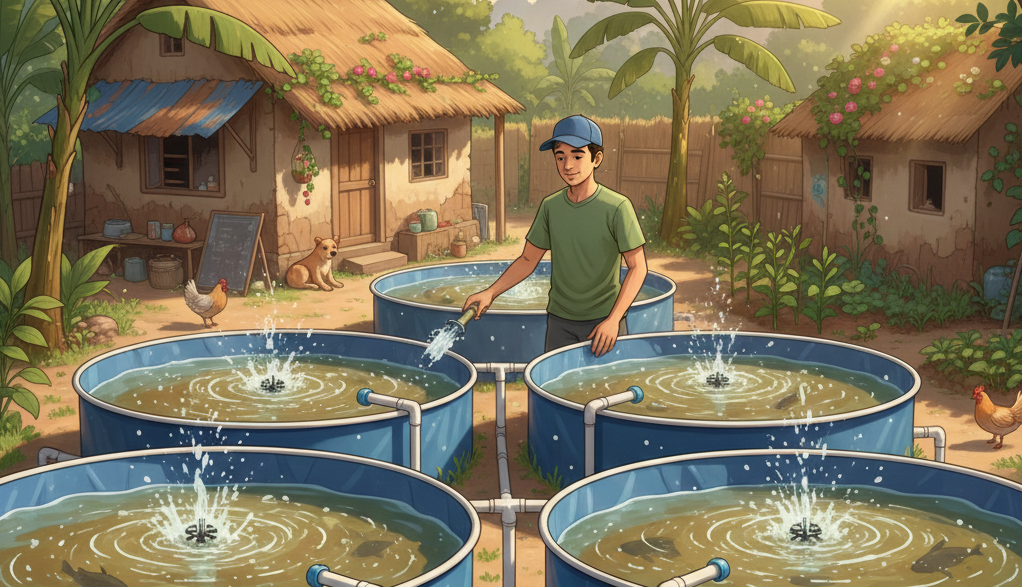
Did you know that you can produce up to 100 kilograms of fish in a space no larger than a standard parking spot? Traditionally, fish farming was synonymous with sprawling earthen ponds and massive land requirements, but the agricultural landscape is shifting. The Challenge for many modern agri-preneurs is the lack of large-scale land and the high cost of rural acreage. The Pain Point is the frustration of wanting to enter the lucrative aquaculture market while being restricted to a small backyard or a peri-urban plot. Many believe that without a lake, you can’t have a fish business.
The ultimate solution is Small Tank Fish Farming, often utilized through Biofloc Technology (BFT) or Recirculating Aquaculture Systems (RAS). By using high-density tanks, you can manage a commercial-grade fish farm in a fraction of the space. This article serves as your comprehensive guide to the small-tank high-income model. You will learn the core fundamentals of tank-based biology, the massive economic benefits of intensive farming, and a 5-step implementation plan to turn your limited space into a high-yielding “aquatic factory.”
Understanding Small Tank Fish Farming: Key Concepts and Importance
Small tank fish farming is the practice of raising high densities of fish in artificial containers—ranging from PVC-lined tanks to concrete cisterns—equipped with life-support systems. Historically, fish needed large ponds because the water relied on natural sunlight and wind to stay clean and oxygenated. In a small tank, the farmer takes total control of the environment. The importance of this model in 2026 lies in its Precision Management, allowing for year-round production regardless of soil quality or external weather.
Think of small tank farming like an intensive care unit (ICU) versus a public park. In a park (large pond), the fish wander, eat what they find, and the farmer has little control over individual health. In an ICU (Small Tank), every “patient” is monitored. The temperature is regulated, the food is delivered directly, and the “waste” is filtered out mechanically.
Technically, the “magic” of small tanks is Biofloc Technology. By adding specific carbon sources (like molasses) to the water, you encourage the growth of “good bacteria.” These bacteria eat the toxic ammonia produced by fish waste and turn it into Protein-rich Flocs, which the fish then eat. This circular system allows you to keep thousands of fish in a small tank without the water becoming toxic.
Why It Matters: The Top Benefits of the Small Tank Model
Transitioning to a tank-based system offers a strategic edge for urban and small-scale farmers. Here is why it matters:
- Extremely High Yield-per-Square-Meter: Because the water is constantly aerated and filtered, you can stock fish at a density 10 to 20 times higher than a traditional pond. This makes it possible to earn a full-time income from a 500-square-foot backyard.
- Minimal Water Consumption: Traditional ponds lose massive amounts of water to evaporation and seepage. Small tanks are sealed environments. In a Biofloc system, you rarely change the water; you simply “treat” it, reducing water usage by up to 90%.
- Zero Dependence on Soil Quality: Since the fish never touch the ground, it doesn’t matter if your land is rocky, sandy, or contaminated. You can even set up these tanks on a concrete rooftop.
- Ease of Harvesting and Disease Control: When it’s time to sell, you don’t need a massive net and a team of workers. You simply lower the water level and scoop the fish out. Similarly, if one tank gets sick, you can isolate it without affecting the rest of your farm.
Pro Fact: In a well-managed Biofloc tank, the bacteria provide “free food” that can reduce your commercial feed expenses by 15–20%, directly increasing your net profit.
How to Get Started: A Practical Guide for Beginners
Building a small-tank fish farm requires a technical mindset. Follow this 5-step actionable plan:
Step 1: Tank Selection and Setup
For beginners, Circular Tarpaulin Tanks (4-meter diameter) are the best choice. They are affordable, easy to assemble, and the circular shape ensures that waste collects in the center for easy removal. Place the tank on a leveled, sand-cushioned base to prevent punctures.
Step 2: Install High-Capacity Aeration
Oxygen is the lifeblood of a small tank. Since the fish are crowded, they will suffocate in minutes without a pump. Install a Ring Blower or a Venturi System that runs 24/7. Always have a battery backup or an inverter, as power failure is the #1 cause of loss in this model.
Step 3: Water “Pro-Biotic” Preparation
Don’t just add fish to tap water. You must “season” the water. Add salt (to manage nitrite), calcium carbonate (for pH), and a Pro-biotic strain mixed with molasses. Wait 7-10 days until the water turns a “brownish-green” color, indicating the biofloc is active.
Step 4: Species Selection (The “Hardy” Varieties)
Not all fish thrive in high density. For small tanks, Tilapia, Pangasius (Catfish), and Anabas (Climbing Perch) are the kings. They are “air-breathing” or highly tolerant of low-quality water, making them perfect for the intensive tank environment.
Step 5: Daily Monitoring of Floc Levels
Use an Imhoff Cone to measure the amount of “floc” (solid bacteria) in the water daily. If the floc is too high, it consumes the fish’s oxygen; if it’s too low, the ammonia will rise. Balancing this “living water” is the key to high income.
Beginner’s Tip: Start with one tank. Mastering the chemistry of a single 10,000-liter tank is easier than managing ten. Once you successfully harvest your first 500kg of fish, use the profit to scale up to a “Multi-Tank” battery system.
Overcoming Challenges and Looking into the Future
The primary hurdle in small tank farming is Electricity Reliance. Because the system is artificial, a 4-hour power cut can kill your entire stock. The solution is investing in Solar-Powered Aerators or high-quality power backups. Another challenge is the Initial Technical Learning Curve; you must become a “Water Chemist” as much as a farmer.
Looking into the future, Smart Sensors and IoT are the game-changers. By late 2026, we will see affordable “Plug-and-Play” kits that monitor ammonia and oxygen levels via a smartphone app, automatically adjusting the blower speed or adding molasses when needed. Furthermore, the rise of Urban Fish Hubs means small-tank farmers can sell directly to local neighborhood groups, keeping 100% of the retail profit.
Conclusion
Small tank fish farming is the “Vertical Farming” of the aquaculture world. It proves that you don’t need a massive estate to be a successful agri-preneur; you just need a smart system and a small patch of land. By controlling the environment and utilizing Biofloc technology, you can generate a high, stable income that is independent of weather and soil.
Call to Action: This week, measure your backyard or available garage space. If you have at least 20 square meters, research a “4-meter Tarpaulin Tank” kit. That small space could be the start of your most profitable business yet.
The future of farming is compact, controlled, and highly profitable. Start your tank farm today.
Frequently Asked Questions (FAQs)
1. How much profit can I make from one 10,000-liter tank? With Tilapia, you can harvest roughly 500kg of fish every 6 months. Depending on your local market price (e.g., ₹120/kg), one tank can generate a gross revenue of ₹60,000 per harvest. After feed and electricity costs, the net profit is usually around ₹25,000–₹30,000 per harvest.
2. Is Biofloc farming difficult for a beginner? It has a learning curve. You need to understand how to test pH, Ammonia, and Nitrite. However, with 2 weeks of proper training or following a structured guide, any beginner can master the basic “Water Preparation” steps.
3. What happens if the power goes out? In a high-density tank, fish can only survive for 30 to 60 minutes without aeration. An inverter or a small petrol generator is compulsory for a commercial setup.
4. Does the fish from a tank taste different than pond fish? Because the water in a Biofloc or RAS tank is constantly filtered and “cleaner” than a muddy pond, many consumers find that tank-raised fish have a cleaner, fresher taste with no “muddy” aftertaste.