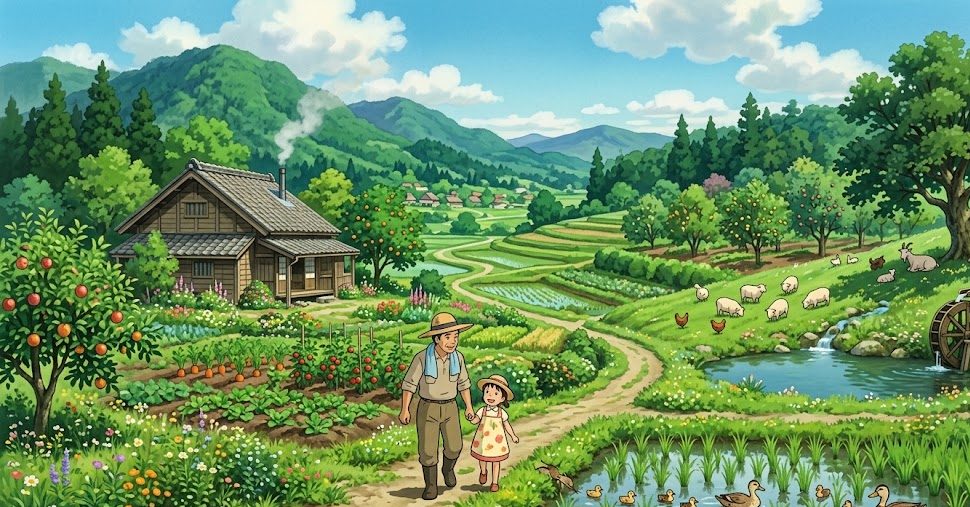
For decades, modern agriculture has leaned heavily on specialization. If you visit a standard commercial farm today, you will likely see miles of a single crop or a massive facility dedicated entirely to one type of livestock. While this industrial approach can produce a large amount of food in the short term, it relies deeply on expensive chemical fertilizers, heavy pesticides, and non-stop mechanical inputs. Over time, this drains the soil, spikes overhead costs, and leaves farmers highly vulnerable to market crashes.
But what if your farm could function more like a natural ecosystem? What if the waste from one part of your farm became the exact fuel needed to power another?
This is the core philosophy behind an Integrated Farming System (IFS). By intentionally combining multiple agricultural activities—like crop cultivation, livestock rearing, aquaculture, and agroforestry—on the same piece of land, you create a self-sustaining cycle. It is one of the most powerful sustainable agriculture methods available today, designed to lower your costs, protect the environment, and drastically increase your total farm income.
What is an Integrated Farming System?
An Integrated Farming System is a conscious, holistic approach to managing land. Instead of treating crops and animals as completely separate projects, an IFS links them together so that the byproduct or waste of one enterprise becomes a valuable input for another.
Imagine a farm where cows graze on cover crops, their manure naturally fertilizes the main vegetable fields, and leftover crop residue is processed into nutritious animal feed. Nothing is wasted, and everything has a purpose. This interconnected loop mimics nature, creating a highly resilient system that improves biodiversity and naturally restores soil health.
1. Core Component Combinations that Work
To build a successful integrated system, you need to choose agricultural activities that naturally support and complement one another. Here are three highly profitable, real-world combinations for beginners:
Crop-Livestock Integration
This is the most common and accessible form of integrated farming. Cows, goats, or sheep graze on harvested fields or dedicated pasture blocks.
- The Benefit to Crops: Animal manure provides a massive injection of organic nitrogen, phosphorus, and potassium, naturally fertilizing the dirt without the high costs of synthetic bags.
- The Benefit to Animals: Leftover stalks, leaves, and cover crops give livestock a diverse, free diet, drastically cutting your commercial feed bills.
Rice-Fish Aquaculture
A brilliant method practiced for centuries, this setup involves introducing specific fish species (like tilapia or carp) directly into flooded rice paddies.
+------------------------+--------------------------------------------------------+
| How Fish Help Rice     | Eats harmful insects, weeds, and naturally stirs oxygen into water. |
+------------------------+--------------------------------------------------------+
| How Rice Helps Fish    | Provides natural shade, shelter, and drops organic nutrients.     |
+------------------------+--------------------------------------------------------+
The fish act as a natural pest control crew, eating weed seeds and insect larvae that would otherwise damage the rice. In return, their droppings fertilize the water, giving the rice plants a massive growth boost. When harvest time comes, the farmer gets two completely distinct streams of income—rice and fresh fish—from the exact same square foot of land.
Agroforestry and Alley Cropping
Agroforestry is the practice of planting high-value trees alongside standard agricultural crops or livestock pastures. In an alley-cropping setup, fast-growing trees are planted in wide rows, and vegetable crops are cultivated in the spaces (alleys) between them. The trees provide windbreaks, prevent topsoil erosion, and draw deep nutrients to the surface, while providing long-term profits through timber, fruit, or nuts.
2. Practical Benefits of Sustainable Agriculture Methods
Switching from conventional monoculture to an integrated system delivers major practical advantages that show up directly on your financial bottom line.
Drastic Reduction in Input Costs
When your farm creates its own fertilizers (manure and compost) and handles its own pest control (ducks eating snails, or fish eating bugs), your reliance on chemical stores drops to near zero. You keep more money in your pocket because your resource loop is self-contained.
Financial Diversification
If a conventional farmer grows only corn, and a late-season drought hits or market prices plummet, their entire annual income is wiped out. In an integrated system, you spread your economic risk. If one crop underperforms, your livestock, fish pond, or orchard harvest steps in to keep your business profitable and stable.
Continuous Soil Restoration
Chemical fertilizers give plants a quick boost but leave the surrounding soil dead, hard, and sandy over time. Sustainable integrated methods rely heavily on organic matter, which feeds beneficial soil microorganisms, earthworms, and fungi. This builds rich, sponge-like topsoil that retains water beautifully and resists drought.
3. Step-by-Step Blueprint to Get Started
Transitioning to an integrated system does not mean you have to buy twenty different types of animals and transform your land overnight. A successful transition requires patient, methodical planning.
- Step 1: Map Your Current Resources: Analyze what you already have. Look at your water sources, current crop types, and any organic waste you are currently throwing away or burning.
- Step 2: Introduce One New Enterprise at a Time: If you currently grow vegetables, start by introducing a small flock of chickens in a mobile coop (a “chicken tractor”). Let them scratch up harvested beds to eat weed seeds and bugs while leaving behind rich manure.
- Step 3: Connect the Loops: Once you master chicken management, look for the next logical connection. Perhaps build a small compost pile nearby where chicken bedding and vegetable scraps can be mixed together into premium potting soil.
Conclusion
Integrated Farming Systems prove that the most profitable way forward in modern agriculture is to work with nature, not against it. By breaking down the walls between crops and livestock, recycling your farm’s waste, and focusing on long-term sustainability, you create an incredibly resilient homestead. It protects your local environment, completely transforms your soil health, and ensures your farming business remains vibrant and financially secure for decades to come.
Frequently Asked Questions (FAQs)
1. Can I practice integrated farming on a small 1-acre plot?
Yes, absolutely. Integrated farming is highly scalable and works beautifully on small acreages. A small plot can easily combine a backyard vegetable garden with a small flock of laying hens, a vermicomposting worm bin, and a few vertical fruit trees.
2. How does an integrated farm handle pest control without chemicals?
Integrated systems use biology to fight pests. For example, ducks are frequently let loose in orchards to gobble up fallen, pest-infested fruit and snails. Similarly, maintaining diverse plant varieties attracts beneficial predatory insects like ladybugs, which hunt down harmful aphids naturally.
3. What is the biggest challenge when starting an IFS?
The primary challenge is the increased need for diverse management skills. Instead of mastering just one crop, you must learn the basic biology, daily care routines, and market dynamics of both plants and livestock simultaneously.
4. Do integrated farming systems require more daily labor?
In the beginning, setting up fences, water loops, and animal housing requires extra physical labor. However, once the cycles are successfully established, the system saves you time in the long run by reducing the hours you spend applying commercial fertilizers and spraying pesticides.
5. Is an integrated farming system completely organic?
While an IFS doesn’t strictly have to be officially certified organic, the core methods are naturally eco-friendly and chemical-free. Most integrated farmers find that because their systems balance themselves organically, they rarely ever have a logical reason to use expensive synthetic chemicals.