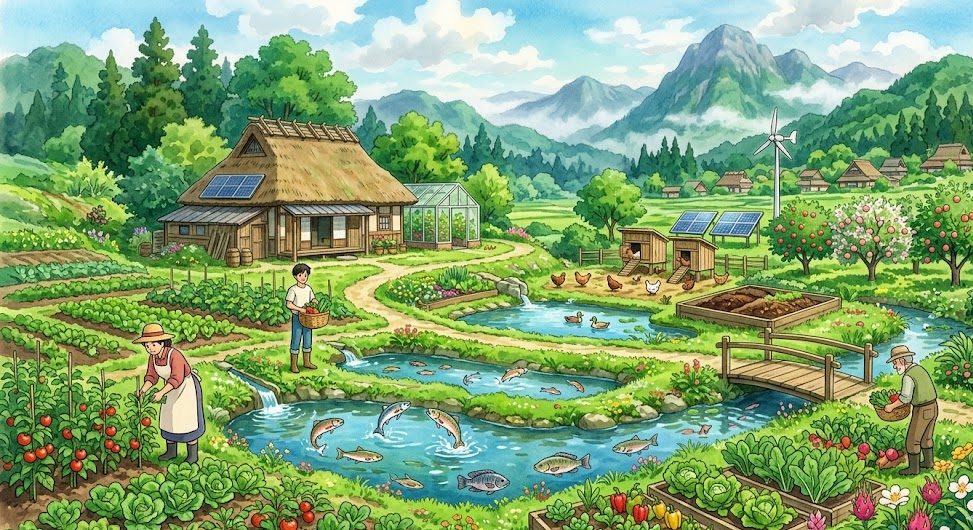
The global food system is at a crossroads. For decades, the agricultural industry has relied on “monoculture”—the practice of growing a single crop over a vast area. While efficient in the short term, this method depletes soil nutrients, invites pests, and leaves farmers vulnerable to market crashes.
Enter Integrated Farming Systems (IFS). This isn’t just a farming technique; it is a biological philosophy. By creating a “Sustainable Synergy” where waste from one component becomes fuel for another, farmers are unlocking unprecedented profits through high-value fish and exotic produce.
This deep dive explores how merging aquaculture with premium horticulture creates a resilient, high-margin ecosystem.
1. The Core Concept: What is Sustainable Synergy?
In nature, nothing exists in isolation. Forests don’t need fertilizers because the waste from animals feeds the plants, and the plants provide oxygen and shelter for the animals.
Integrated Farming mimics this closed-loop cycle. By combining fish farming (Aquaculture) with specialty crop production, we create a symbiotic relationship. The primary driver here is nutrient cycling. Instead of discarding fish waste—which is rich in nitrogen, phosphorus, and potassium—it is filtered and diverted to nourish high-value exotic plants.
2. The Anchor: High-Value Aquaculture
In an integrated system, fish are more than just a protein source; they are “living fertilizer factories.” However, to maximize impact, eco-conscious farmers are moving away from common carp and focusing on High-Value Species:
- Barramundi (Asian Sea Bass): Highly sought after in fine dining for its buttery texture. It is hardy and produces high-quality effluent (waste) for plants.
- Tilapia (Nile or Red): The backbone of many systems due to their incredible growth rate and tolerance to varying water conditions.
- Ornamental Koi & Goldfish: For smaller-scale integrated systems, breeding high-grade ornamental fish can offer a higher “price-per-inch” than food fish.
The Tech: Recirculating Aquaculture Systems (RAS)
To achieve synergy, water must be managed. RAS technology allows farmers to high-density fish in tanks, where water is continuously filtered. The “solid waste” is captured to be turned into compost, while the “liquid waste” (ammonia-rich water) is sent to the crops.
3. The Harvest: Exotic Produce and Specialty Crops
The real profit in sustainable synergy comes from “The Exotic.” Since integrated systems often use greenhouses or controlled environments, farmers can grow crops that don’t traditionally belong in their local climate.
A. Microgreens and Edible Flowers
These are the darlings of the culinary world. Using the nitrogen-rich water from fish tanks, crops like Purple Radish Microgreens, Nasturtiums, and Borage can be harvested in as little as 10–14 days.
- The Synergy: They require very little space and have a massive “Return on Investment” (ROI).
B. Exotic Fruits: Dragon Fruit and Passion Fruit
Dragon fruit (Pitaya) thrives in well-drained, nutrient-dense environments. By using fish-waste compost as a base, these cacti produce vibrant, high-antioxidant fruits that fetch premium prices in urban markets.
C. Saffron and Vanilla
For the advanced integrated farmer, “Black Gold” (Vanilla) or “Red Gold” (Saffron) represents the pinnacle of high-value produce. These crops require precise humidity and nutrient control—parameters that are easily managed within a smart, integrated greenhouse.
4. The Bridge: Aquaponics – The Ultimate Symbiosis
The most refined version of this synergy is Aquaponics. In this system, there is no soil.
- Fish produce ammonia.
- Bio-filters (beneficial bacteria) convert ammonia into Nitrates.
- Plants absorb these nitrates as their primary food source.
- Clean Water is then recirculated back to the fish tanks.
This system uses 90% less water than traditional soil farming and eliminates the need for chemical fertilizers entirely. It is the definition of “Sustainable Synergy.”
5. Economic Advantages of the Integrated Model
Why should a farmer switch to this complex system? The answer lies in Risk Diversification.
| Feature | Monoculture Farming | Integrated Synergy Farming |
|---|---|---|
| Revenue Streams | One (e.g., just Wheat) | Multiple (Fish + Fruit + Flowers) |
| Fertilizer Cost | High (Synthetic) | Near Zero (Biological) |
| Water Usage | High (Evaporation/Runoff) | Low (Recirculated) |
| Market Value | Commodity Prices (Low) | Premium/Exotic Prices (High) |
| Waste Management | Environmental Liability | Biological Asset |
Export to Sheets
6. Implementation: How to Start Small
You don’t need a million-dollar facility to begin. Many “Eco-Preneurs” start with a Backyard Synergy Pilot:
- Step 1: A 1,000-liter fish tank with Tilapia.
- Step 2: A pump that carries water to a “Media Bed” (filled with expanded clay or gravel).
- Step 3: Planting high-value herbs like Thai Basil or Mint.
- Step 4: Using the excess “sludge” from the bottom of the tank to fertilize a few Dragon Fruit vines in pots.
7. Marketing the “Story” (Adsense and Brand Growth)
In 2026, consumers don’t just buy food; they buy a mission. Integrated farming provides a powerful narrative for branding:
- Pesticide-Free: Because chemicals would kill the fish, the produce is inherently organic.
- Water-Wise: Appealing to the environmentally conscious Gen-Z and Millennial demographics.
- Farm-to-Table: The ability to provide fresh, exotic flavors locally.
For those blogging about this, use keywords like “Zero-Waste Farming,” “Aquaponics Business Model,” and “Regenerative Aquaculture” to attract high-paying advertisers in the green-tech and organic food sectors.
8. Challenges and Considerations
Sustainable synergy is not “set it and forget it.” It requires a balance of biology:
- The pH Balancing Act: Fish prefer a slightly alkaline environment, while most plants prefer slightly acidic. Finding the “Sweet Spot” (usually around pH 6.8 to 7.0) is crucial.
- Power Reliability: In a recirculating system, if the pump stops, the fish lose oxygen. Solar backup systems are a mandatory innovation for the modern integrated farm.
9. The Future: AI-Managed Ecosystems
The next frontier of integrated farming is the use of AI to monitor the synergy. Sensors track ammonia levels, plant growth rates, and fish behavior, automatically adjusting flow rates to ensure the ecosystem remains in perfect balance. This reduces the “human error” factor and allows for massive scaling.
Conclusion: The New Green Gold
“Sustainable Synergy” is more than a trend; it is the blueprint for a hungry planet. By merging the world of High-Value Fish with Exotic Produce, we move away from destructive farming and toward a regenerative future.
The farmer of the future is an orchestrator of life, managing a symphony of bacteria, fish, and plants to create a bounty that is as profitable as it is planet-friendly.
Ready to dive in? The best time to plant a tree—or start a fish tank—was twenty years ago. The second best time is today. Embrace the synergy and watch your farm grow beyond the limits of tradition.