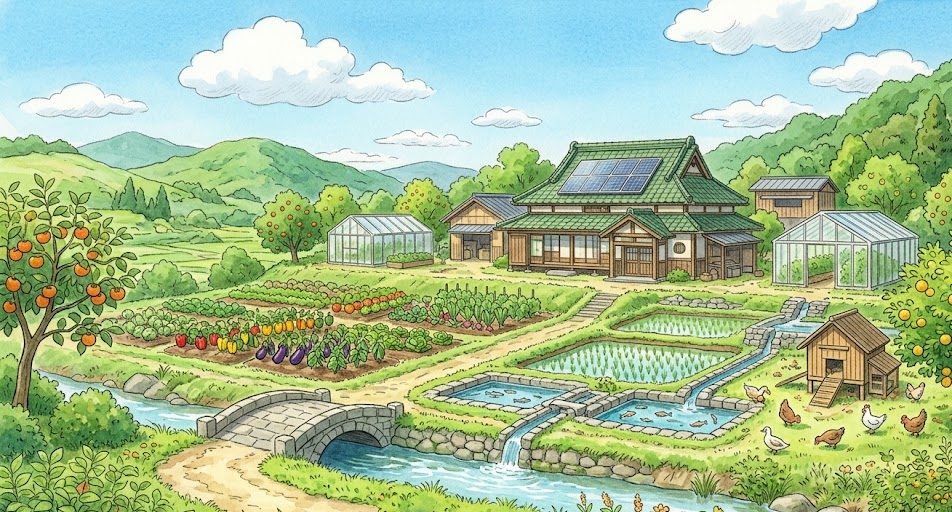
In the modern agricultural era, relying on a single crop or a traditional farming method is no longer enough to ensure financial stability. The “Global Farm” is shifting toward a more resilient model. To truly thrive, farmers must embrace The Diversified Farming Guide—a strategic approach that combines Exotic Vegetable Cultivation, Integrated Systems, and Modern Aquaculture.
By diversifying your farm, you are not just spreading your risk; you are creating a self-sustaining ecosystem where every component supports the other, leading to higher yields and multiple streams of income.
1. The Art of Exotic Vegetable Cultivation
Exotic vegetables like Broccoli, Pak Choi, Cherry Tomatoes, and Asparagus are no longer just for high-end restaurants. The demand for nutrient-dense, unique produce is exploding in local and international markets.
High-Value Market Positioning
Exotic vegetables command a premium price because they are often perceived as “specialty items.” By mastering the cultivation of these crops, you move away from the price volatility of common vegetables. Success in this niche requires attention to soil health and controlled environments—often using greenhouse management or hydroponic setups to maintain the specific micro-climates these plants need.
Precision Growing
Unlike traditional crops, exotic vegetables often require “Smart Farming” techniques. Using sensors to monitor moisture and nutrients ensures that your high-value produce reaches the specific size, color, and taste profiles required by premium buyers. This precision is the hallmark of a master cultivator.
2. Integrated Farming Systems: Nature’s Synergy
The core of a diversified farm is the Integrated Farming System (IFS). This is the practice of linking different agricultural activities so that the waste from one becomes the resource for another.
Creating a Circular Economy
In an integrated system, everything is connected. For example:
- Livestock & Crops: Manure from dairy or poultry farming is processed into organic fertilizer for your exotic vegetable beds.
- Crop Residue: Non-marketable parts of your vegetables can be used as high-quality feed for your animals.
- Healing the Soil: By rotating nitrogen-fixing legumes with heavy-feeding exotic greens, you “heal the soil naturally,” reducing the need for synthetic chemicals and lowering your input costs.
Benefits of Integration
The primary advantage of an integrated system is Resilience. If one market prices drop, the other components of your farm—like dairy or poultry—provide a financial safety net. Furthermore, the reduced reliance on external inputs makes your farm more environmentally sustainable and “Nature-Focused.”
3. Modern Aquaculture: Farming the Blue Frontier
Modern Aquaculture, specifically Fish Farming, is the third pillar of this diversified guide. Fish are one of the most efficient converters of feed into high-quality protein, and when integrated into a farm, they provide a massive boost to productivity.
Recirculating Aquaculture Systems (RAS)
For the modern farmer, RAS technology allows for fish farming in controlled tanks with minimal water usage. This is perfect for “Micro-Farming” setups where land is limited. By filtering and reusing water, you can maintain high stocking densities of species like Tilapia, Catfish, or even high-value Trout.
The Aquaponics Bridge
The ultimate evolution of diversification is Aquaponics—the combination of Aquaculture and Hydroponics. In this setup, the nutrient-rich water from your fish tanks is used to “fertigate” your exotic vegetables. The plants clean the water by absorbing the nutrients, and the clean water is pumped back to the fish. It is the perfect “Smart Technology” solution for a sustainable harvest.
4. The Role of Smart Technology in Diversification
Managing a farm with vegetables, livestock, and fish sounds complex, but Smart Technology makes it manageable.
- Automated Monitoring: Use IoT devices to track water quality in your fish tanks and moisture levels in your vegetable beds simultaneously.
- AI-Driven Insights: Artificial Intelligence can help you predict the best time to harvest your fish or rotate your crops based on market demand and “Climate Intelligence.”
- Innovation Hubs: A centralized digital hub allows you to manage all three branches of your diversified farm from a single smartphone app, ensuring you are always in control of your “Integrated Rural Ecosystem.”
5. Economic Advantages and Scaling
Diversification is a business strategy as much as it is a farming technique.
Multiple Revenue Streams
By producing exotic vegetables, fish, and potentially dairy or poultry products, you have daily, monthly, and seasonal income. This steady cash flow is essential for reinvesting in your farm’s technology and infrastructure.
Building a Premium Brand
A diversified farm that uses integrated, sustainable practices has a powerful story to tell. Premium markets and “Farm-to-Fork” initiatives are eager to partner with farmers who can guarantee quality, traceability, and eco-friendly production methods.
Conclusion: The Path to Agricultural Mastery
The Diversified Farming Guide is the answer to the challenges of 21st-century agriculture. By mastering the cultivation of Exotic Vegetables, implementing Integrated Systems, and diving into Modern Aquaculture, you are building a farm that is efficient, profitable, and future-proof.
The transition from a traditional farmer to a diversified master cultivator requires a shift in mindset. It is about seeing the farm not as a collection of separate fields, but as a single, living, breathing innovation hub. Start small, integrate wisely, and lead the way into the blue and green frontiers of modern agriculture.
SEO Meta Details:
- Focus Keyword: Diversified Farming Guide
- Secondary Keywords: Exotic Vegetable Cultivation, Integrated Farming Systems, Modern Aquaculture, Fish Farming, Sustainable Agriculture.
- Meta Description: Learn how to master the diversified farming model. Our guide covers exotic vegetable cultivation, integrated systems, and modern aquaculture for a sustainable, high-yield farm.