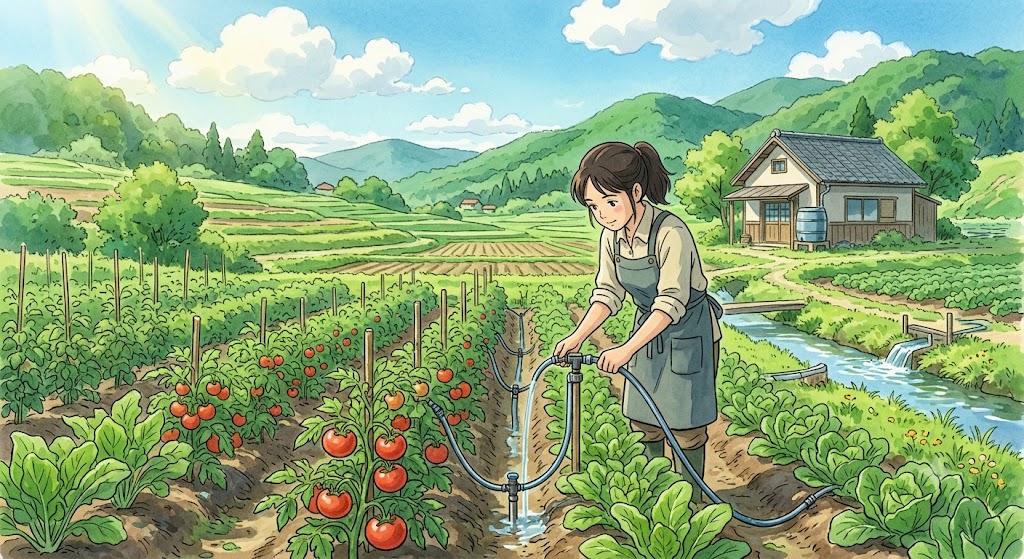
Water is one of the most important resources in agriculture, but it is also one of the easiest resources to waste. Irrigation that runs longer than necessary, leaking pipes, poorly planned fields, excessive evaporation, and watering at unsuitable times can all reduce the amount of water that actually reaches the crop.
Water-saving farming is not simply about using less water. The real goal is to use available water more efficiently while maintaining healthy crop growth and practical farm productivity. This can be achieved through better irrigation methods, healthier soil, suitable crop selection, improved field planning, and regular observation.
For farmers, efficient water management can also reduce pumping requirements, energy use, labor, and unnecessary irrigation costs. The best approach depends on the crop, soil, climate, farm size, available water supply, and irrigation infrastructure.
Start With the Farm’s Water Situation
Before changing an irrigation system, it helps to understand how water currently moves through the farm.
A simple assessment can answer several useful questions:
- How much water is available during the growing season?
- Where does irrigation water come from?
- How often is the farm irrigated?
- Which fields require the most water?
- Does water reach all areas evenly?
- Are there leaks or damaged pipes?
- How quickly does the soil dry after irrigation?
- Does water remain on the surface or drain away quickly?
Keeping basic irrigation records can reveal patterns that are difficult to notice during everyday farm work.
For example, one field may require frequent irrigation because of sandy soil, while another may retain moisture for much longer because of heavier soil. Treating both fields exactly the same can lead to unnecessary water use.
Improve Soil Water Retention
Efficient irrigation starts with the soil.
Healthy soil can store and supply water to plant roots more effectively. Organic matter, good soil structure, and sufficient ground cover can improve the soil’s ability to hold moisture.
Adding suitable organic materials such as well-decomposed compost can contribute to better soil structure. Organic matter can also support soil organisms and improve the movement of air and water through the root zone.
However, soil improvement should be based on actual field conditions. Excessive application of any material is not automatically beneficial.
Regular soil observation and, where appropriate, soil testing can help farmers understand:
- Soil texture
- Organic matter condition
- Drainage
- Compaction
- pH
- Nutrient levels
- Moisture behavior
A field with better soil structure generally gives irrigation water a better opportunity to move into the root zone rather than simply running away from the crop area.
Choose Irrigation Methods Carefully
The irrigation system has a major influence on water efficiency.
Traditional surface irrigation can work effectively in many farming situations, but poor field leveling, excessive water application, and uncontrolled flow can result in considerable losses.
Other systems can provide more controlled water delivery.
Drip Irrigation
Drip irrigation delivers water slowly near the plant’s root zone through emitters.
It can be particularly useful for crops planted in rows, orchards, vegetable gardens, and other situations where water can be targeted around individual plants.
Potential benefits include:
- Reduced evaporation from unnecessary wetting
- More controlled water application
- Lower weed growth between crop rows
- Ability to combine irrigation with certain nutrient-management practices
- Better control of irrigation frequency
Drip systems still require maintenance. Blocked emitters, damaged lines, pressure problems, and leaks can reduce their effectiveness.
Sprinkler Irrigation
Sprinkler systems distribute water across a defined area and can be useful for many crops and field conditions.
Their performance depends on nozzle selection, pressure, wind conditions, spacing, and operating time.
Sprinklers should be checked periodically to make sure they are distributing water evenly rather than creating areas that receive too much or too little.
Micro-Sprinklers
Micro-sprinklers can be useful in orchards, nurseries, and certain specialty crops. They provide localized water application while covering a wider area than individual drip emitters.
The right irrigation system should be selected according to the crop and field rather than simply choosing the most technologically advanced option.
Irrigate According to Crop Need
One of the simplest ways to save water is to stop treating irrigation as a fixed calendar activity.
A crop does not necessarily need the same amount of water every day or every week.
Water requirements can change with:
- Crop growth stage
- Temperature
- Wind
- Humidity
- Rainfall
- Soil type
- Plant density
- Root development
- Crop variety
Young plants may have a smaller root system, while mature crops can require more water during periods of active growth or reproductive development.
Instead of automatically irrigating because a certain number of days have passed, farmers can combine the irrigation schedule with field observations and soil moisture information.
Use Soil Moisture Monitoring
Soil moisture monitoring can make irrigation decisions more precise.
Farmers can use simple manual observations, soil sampling methods, or electronic moisture sensors depending on the farm’s size and budget.
Modern soil moisture sensors can provide information about moisture levels at selected depths. This can help identify whether water is reaching the root zone or whether irrigation is being applied too frequently.
Technology is not required for every farm. Even regular observation of soil condition can improve decision-making when it is done consistently.
The important point is to understand what the crop’s root zone is experiencing rather than judging irrigation only from the appearance of the soil surface.
Water at the Right Time
Timing can have a major effect on irrigation efficiency.
Watering during periods of intense heat can increase evaporation before plants can use the available moisture. In many farming situations, irrigation during cooler parts of the day can help reduce these losses.
However, the ideal timing depends on the irrigation method, crop, climate, weather conditions, and farm operation.
Farmers should also pay attention to wind when using sprinklers. Strong winds can move water away from the intended target and create uneven distribution.
Weather information can therefore become a useful part of irrigation planning.
Use Mulch to Reduce Evaporation
Mulching is a practical technique for protecting soil moisture.
Organic materials such as straw, dry plant residues, leaves, or suitable compost-based materials can be placed around crops where appropriate. Some farming systems also use manufactured mulch materials.
A suitable mulch layer can help:
- Reduce direct evaporation
- Keep soil temperatures more stable
- Suppress some weeds
- Protect the soil surface
- Reduce the impact of heavy rainfall
- Add organic material when natural mulch decomposes
Mulch should be managed according to the crop and local conditions. Poorly handled organic materials can create other problems, so cleanliness, thickness, and placement matter.
Control Weeds Early
Weeds compete with crops for water, nutrients, sunlight, and growing space.
A field with heavy weed pressure may therefore require more water without producing a proportional benefit for the main crop.
Early weed management can help reduce this competition.
Useful approaches can include:
- Timely cultivation
- Mulching
- Manual removal
- Crop spacing management
- Cover crops
- Crop rotation
- Mechanical weed control
- Appropriate herbicide use where suitable
The goal is not simply to remove every plant from the soil surface. It is to prevent unwanted vegetation from becoming a major competitor for water and other resources.
Improve Field Leveling and Water Distribution
In surface-irrigated fields, uneven land can cause significant differences in water distribution.
Low areas may receive too much water while higher areas remain comparatively dry. This can encourage farmers to keep irrigation running longer to compensate for dry sections, increasing overall water use.
Improved field leveling can help distribute water more evenly.
The exact solution depends on the irrigation method and field design. Some farms may benefit from laser land leveling or other precision field-preparation techniques, while smaller farms may use simpler improvements.
Before investing in equipment, farmers should identify the actual distribution problem and estimate whether the improvement is economically worthwhile.
Reduce Water Loss From Pipes and Channels
Water can be lost before it even reaches the crop.
Damaged pipes, loose connections, leaking valves, cracked channels, and poorly maintained irrigation equipment can waste water continuously.
A regular inspection routine can include checking:
- Main pipelines
- Smaller distribution lines
- Valves
- Pumps
- Drip emitters
- Sprinkler heads
- Storage tanks
- Irrigation channels
- Connections and joints
Fixing a small leak may appear insignificant, but repeated losses throughout an entire irrigation season can become substantial.
Collect and Use Rainwater Where Practical
Rainfall is an important part of farm water management.
Depending on local regulations, infrastructure, and farm conditions, rainwater can sometimes be collected from suitable surfaces or stored in farm ponds and tanks.
Rainwater harvesting can help supplement other water sources, particularly when rainfall occurs during periods when storage is possible.
However, storage capacity, water quality, evaporation, construction cost, and maintenance should all be considered before creating a harvesting system.
The objective is to capture useful rainfall without creating an expensive system that provides little practical benefit.
Select Crops and Varieties With Water Availability in Mind
Crop planning has a direct relationship with water management.
A farm operating with limited irrigation should carefully consider whether its chosen crops are compatible with the available water supply.
Farmers can evaluate:
- Crop duration
- Seasonal water requirements
- Local climate
- Soil type
- Expected rainfall
- Irrigation availability
- Market demand
- Harvest timing
Water availability should be considered before planting rather than after the crop has already developed.
In some situations, choosing a suitable variety or adjusting planting dates can help align crop growth with periods of better rainfall or lower water demand.
Protect the Soil From Unnecessary Evaporation
Bare soil can lose moisture quickly under hot and dry conditions.
Keeping the soil protected with crop residues, mulch, cover crops, or an appropriate living ground cover can reduce direct exposure to sun and wind.
Reduced or conservation-oriented tillage may also help some farming systems maintain soil structure and surface residues.
The appropriate approach depends on soil type, crop system, weed pressure, available equipment, and local farming practices.
There is no single soil-management method that works equally well everywhere.
Use Technology Where It Solves a Real Problem
Water-saving farming does not require a farm to become completely automated.
Technology should solve a specific problem.
Useful tools can include:
- Soil moisture sensors
- Automated irrigation controllers
- Weather stations
- Mobile irrigation apps
- Flow meters
- Pump monitoring systems
- Satellite-based crop monitoring
- Farm management software
- Automated valves
- Smart irrigation timers
For example, a moisture sensor may help a farmer understand when irrigation is actually needed, while a flow meter can reveal how much water a particular field is receiving.
The value comes from better decisions, not simply from having more equipment.
Keep Irrigation Records
Simple records can make water management much easier over time.
A farmer can record:
| Information | Example |
|---|---|
| Irrigation date | 12 July |
| Field | Vegetable field |
| Irrigation duration | 45 minutes |
| Weather | Hot and dry |
| Soil condition | Moderately dry |
| Rainfall since previous irrigation | Low |
| Crop stage | Flowering |
| Notes | One section drying faster |
After several weeks, these records can reveal useful patterns.
Farmers may discover that some fields are being irrigated more frequently than necessary or that certain crop stages require closer monitoring.
Good records also make it easier to compare different irrigation methods from one season to another.
Combine Multiple Water-Saving Practices
The strongest water-management strategy is usually not based on one technique.
For example, a farm might combine:
- Soil testing and improvement
- Mulching
- Efficient irrigation
- Weed management
- Weather monitoring
- Crop-specific irrigation scheduling
- Leak inspections
- Moisture monitoring
- Rainwater harvesting
- Regular record keeping
Each practice addresses a different part of the water-use problem.
An efficient irrigation system can still waste water if it is operated unnecessarily. Similarly, excellent soil management cannot completely compensate for damaged irrigation equipment.
The biggest improvements often come from combining several moderate improvements rather than depending on one expensive solution.
A Practical Water-Saving Farm Routine
A simple routine can make water management easier to maintain.
Before Planting
Review water availability, crop choices, soil condition, irrigation infrastructure, and expected weather.
During Crop Establishment
Check soil moisture frequently and avoid excessive irrigation while roots are still developing.
During Active Growth
Monitor the root zone, crop appearance, weather, weeds, and irrigation system performance.
During Flowering and Production
Pay closer attention to crop-specific water requirements because water stress during important growth stages can affect production.
After Rainfall
Do not automatically continue the normal irrigation schedule. Check how much moisture has entered the soil before irrigating again.
After Harvest
Review irrigation records and identify areas where water was overused, underused, or lost.
This creates a continuous improvement cycle rather than treating water management as a one-time project.
Common Water-Saving Mistakes to Avoid
Trying to save water can sometimes create new problems if changes are made without understanding the crop.
Common mistakes include:
- Reducing irrigation too aggressively
- Following a fixed schedule regardless of weather
- Installing technology without learning how to use it
- Ignoring leaking pipes
- Watering the entire field equally despite different soil conditions
- Overlooking weeds
- Applying too much water after rainfall
- Choosing crops without considering water availability
- Failing to maintain irrigation equipment
- Focusing only on equipment instead of overall farm management
Water-saving agriculture should maintain a balance between conservation and crop requirements.
Building a Long-Term Water Management Plan
A successful water-saving system develops gradually.
Start by identifying the biggest source of water loss. If pipes are leaking, repair them first. If irrigation is poorly timed, improve scheduling. If soil dries rapidly, investigate soil structure, mulch, crop cover, and irrigation frequency.
Once the basic system is working properly, technology can be added where it provides measurable value.
Over time, farmers can compare water use, crop performance, labor requirements, and operating costs. This makes it easier to determine which improvements are actually helping.
Final Thoughts
Water-saving farming is about making every unit of irrigation more useful.
Efficient irrigation systems, healthy soil, mulching, weed management, better field preparation, weather awareness, suitable crop selection, and careful monitoring can all contribute to better water management.
The most practical strategy is to understand the farm first and then choose techniques that match its conditions. A small farm does not necessarily need expensive automation, and a large farm does not necessarily benefit from applying the same irrigation strategy to every field.
With consistent observation, maintenance, record keeping, and gradual improvements, farmers can reduce unnecessary water use while creating a more organized and resilient crop-production system.
Water is a valuable agricultural resource. Managing it carefully is not only about saving water today—it is about making farming systems more efficient and sustainable for future growing seasons.