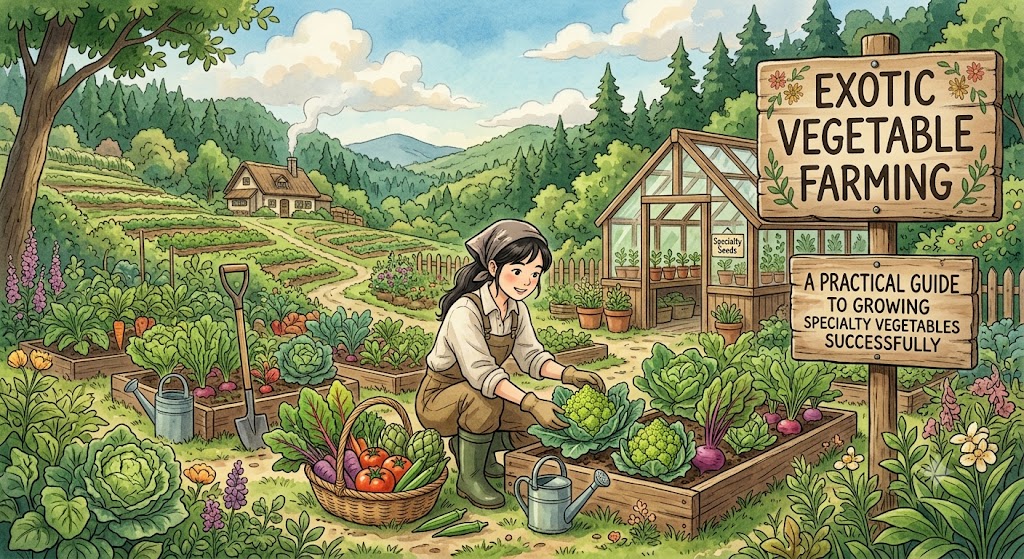
Exotic vegetable farming has become an interesting opportunity for farmers who want to explore specialty crops beyond commonly grown vegetables. Unlike traditional vegetables that are usually produced for broad local markets, exotic vegetables are often grown for specific customers such as restaurants, hotels, supermarkets, specialty food stores, premium retailers, and direct consumers.
The term “exotic vegetables” can refer to vegetables that are less commonly cultivated in a particular region. Depending on the location, examples may include colored bell peppers, zucchini, broccoli, lettuce varieties, kale, asparagus, cherry tomatoes, celery, pak choi, baby carrots, and specialty beans.
Growing these crops successfully requires more than simply planting unusual varieties. Farmers need to understand climate requirements, soil conditions, irrigation, crop duration, harvesting practices, market demand, packaging, and transportation.
The most important principle is simple: identify the market before investing heavily in production.
What Makes a Vegetable “Exotic”?
There is no single worldwide definition of an exotic vegetable.
A vegetable can be considered exotic or specialty simply because it is not commonly grown or consumed in a particular local market.
For example, a vegetable that is common in one country may be considered a specialty crop somewhere else.
Exotic vegetables generally have one or more of these characteristics:
- Limited local production
- Specialized consumer demand
- Different appearance or color
- Unusual variety or shape
- Premium retail positioning
- Restaurant or hotel demand
- Imported or specialty-food association
- Higher production requirements
This creates both opportunity and risk.
A specialty vegetable may attract better prices, but the number of buyers can also be smaller than for common vegetables.
Begin With Market Research
One of the biggest mistakes in specialty vegetable farming is choosing the crop first and searching for buyers later.
Instead, start with the market.
Before planting, farmers can contact:
- Local restaurants
- Hotels
- Supermarkets
- Grocery stores
- Vegetable distributors
- Specialty food retailers
- Catering businesses
- Farmers’ markets
- Direct consumers
Ask potential buyers what they actually need.
Useful questions include:
- Which vegetables do you purchase regularly?
- What quantity do you need?
- What size is preferred?
- What quality standards do you expect?
- How frequently do you buy?
- What packaging is required?
- What delivery schedule is convenient?
- Are there seasonal changes in demand?
This information can help determine whether a crop is worth testing.
Select Crops According to Local Conditions
Not every exotic vegetable will perform well in every location.
Temperature, humidity, rainfall, sunlight, soil type, and growing season can strongly influence production.
For example, some leafy vegetables prefer relatively cooler conditions, while certain warm-season specialty crops require higher temperatures.
Before selecting a crop, examine:
- Average seasonal temperatures
- Frost risk
- Heat intensity
- Rainfall patterns
- Humidity
- Daylight conditions
- Soil drainage
- Irrigation availability
- Protected cultivation possibilities
Local agricultural experts, seed suppliers, and experienced growers can also provide useful information about varieties suited to the region.
Popular Specialty Vegetable Categories
Instead of focusing on one specific vegetable, farmers can consider several broad categories.
Specialty Leafy Greens
Leafy vegetables such as kale, pak choi, specialty lettuce, and other salad greens can be attractive for restaurants and premium grocery markets.
Their relatively short production cycles can make them suitable for planned succession planting.
However, freshness is extremely important because leafy vegetables can lose quality quickly after harvest.
Colored Vegetables
Different colors can create additional market appeal.
Examples include colored peppers, purple vegetables, yellow varieties, and unusual tomato types.
Visual appearance can be particularly important when selling to restaurants, premium grocery stores, or direct consumers.
Specialty Tomatoes
Cherry tomatoes, grape tomatoes, heirloom-type varieties, and other specialty tomatoes can be grown for niche markets.
Different varieties may vary significantly in plant structure, fruit size, harvest period, and support requirements.
Farmers should evaluate the variety based on both production performance and buyer preferences.
Asian Vegetables
Vegetables such as pak choi, certain mustard greens, specialty radishes, and other Asian vegetables may have established demand in particular markets.
Their suitability depends heavily on local climate and available buyers.
Specialty Root Vegetables
Baby carrots, colorful radishes, specialty beets, and other unusual root vegetables can provide opportunities where consumers are interested in different colors, shapes, or sizes.
These crops require appropriate soil preparation because compacted or poorly drained soil can affect root development and appearance.
Start With a Trial Plot
A small trial plot is one of the safest ways to learn about a new specialty crop.
Instead of planting the entire farm immediately, start with a manageable area.
The trial can help answer practical questions:
- Does the variety perform well locally?
- How long does the crop take to mature?
- How much labor is required?
- How much water is needed?
- What pest problems occur?
- How much produce meets buyer specifications?
- How easily can the crop be sold?
- How long does the product remain fresh after harvest?
The first season should be treated as a learning period.
Production records from the trial can provide a much stronger basis for expansion than assumptions about premium crop prices.
Prepare the Soil Properly
Specialty vegetables still depend on basic soil management.
Before planting, assess soil structure, drainage, fertility, and pH.
Good soil preparation may include:
- Removing unwanted vegetation
- Improving drainage where necessary
- Adding suitable organic matter
- Correcting soil problems based on testing
- Preparing an appropriate seedbed
- Avoiding excessive compaction
- Creating suitable planting beds
Different crops have different root systems, so soil preparation should match the crop.
Root vegetables, for example, may require loose soil for proper root development, while shallow-rooted leafy crops have different requirements.
Choose Quality Seeds and Planting Material
Specialty vegetable production depends heavily on variety selection.
Two varieties of the same vegetable can behave very differently under the same growing conditions.
When choosing seeds or planting material, consider:
- Climate suitability
- Crop duration
- Disease tolerance
- Yield characteristics
- Fruit or leaf quality
- Size requirements
- Harvest window
- Buyer preferences
- Seed availability
Reliable planting material can reduce some of the uncertainty associated with specialty crop production.
Farmers should also maintain records of variety names and planting dates so that successful varieties can be identified in future seasons.
Manage Water Carefully
Specialty vegetables often require consistent moisture, particularly during establishment and active growth.
However, excessive irrigation can create problems such as root stress, nutrient leaching, disease pressure, and poor-quality produce.
Efficient irrigation methods such as drip systems or carefully managed sprinklers can help deliver water according to crop requirements.
The irrigation schedule should consider:
- Soil type
- Weather
- Crop growth stage
- Root depth
- Rainfall
- Temperature
- Mulching
- Drainage
Checking the soil and crop rather than following an automatic schedule can lead to better decisions.
Use Protected Cultivation When Appropriate
Some specialty vegetables can benefit from protected growing environments.
Greenhouses, shade structures, tunnels, and other forms of protected cultivation can provide greater control over temperature, wind, rainfall, humidity, and pests.
Protected cultivation can be particularly useful for crops that struggle with extreme outdoor conditions.
However, infrastructure requires investment and maintenance.
Before building a protected structure, calculate whether the expected market demand and production advantages justify the cost.
A greenhouse should solve a genuine production problem rather than being installed simply because the crop is considered premium.
Pay Attention to Plant Spacing
Plant spacing can influence airflow, light exposure, disease pressure, and final product quality.
Crowded plants may compete for resources and create humid conditions around leaves.
Plants that are spaced too widely, on the other hand, may leave unused growing space.
Spacing should be based on the crop and variety.
For specialty vegetables sold by size or appearance, consistent spacing can also contribute to more uniform produce.
Manage Nutrients Based on Crop Requirements
Exotic vegetables should not automatically receive large amounts of fertilizer simply because they are specialty crops.
Nutrient management should be based on crop requirements and soil conditions.
A practical approach involves:
- Testing the soil where appropriate.
- Understanding the crop’s nutrient requirements.
- Applying nutrients at suitable growth stages.
- Avoiding unnecessary applications.
- Monitoring plant development.
- Keeping records of fertilizer use.
Balanced nutrition can support healthy growth, but excessive fertilizer can create environmental problems and unnecessary production costs.
Monitor Pests and Diseases Early
Specialty vegetables can face many of the same pest and disease challenges as conventional crops.
Early observation is therefore important.
Farmers should regularly inspect:
- Young leaves
- Leaf undersides
- Stems
- Growing points
- Flowers
- Fruits
- Soil around plants
Look for changes such as holes, discoloration, wilting, distorted growth, unusual spots, or insect activity.
Integrated pest management can combine preventive practices, monitoring, biological approaches, mechanical methods, and carefully selected treatments when necessary.
Early action is generally easier than trying to manage a serious outbreak after it has spread throughout a field.
Plan Harvesting Before Planting
Harvest timing is especially important for specialty vegetables.
A crop can be biologically ready for harvest but still unsuitable for the target market if it is too large, too small, overripe, damaged, or poorly presented.
Before planting, understand the buyer’s preferred:
- Size
- Color
- Maturity
- Shape
- Weight
- Freshness
- Packaging
- Delivery timing
Some vegetables are best harvested early in the day when temperatures are lower, while the appropriate harvest routine depends on the crop and local conditions.
Post-Harvest Handling Can Determine Profitability
Producing a high-quality specialty vegetable is only part of the process.
The product must also reach the customer in good condition.
Post-harvest management can include:
- Gentle harvesting
- Removing damaged produce
- Sorting
- Grading
- Cleaning when appropriate
- Cooling where suitable
- Proper packaging
- Shortening transportation time
- Maintaining suitable storage conditions
Leafy vegetables may require particularly careful handling because they can lose freshness quickly.
Packaging should protect the produce without creating unnecessary costs.
Build a Reliable Supply Schedule
Restaurants and retailers often value consistency.
A buyer may prefer a farmer who can supply a smaller quantity regularly rather than someone who provides a large amount once and then nothing for several weeks.
Succession planting can help create a more continuous harvest.
Instead of planting the entire field on one day, farmers can divide production into planned batches when the crop allows it.
This can help manage:
- Harvest volume
- Labor
- Market supply
- Cash flow
- Storage pressure
- Delivery schedules
Production should be matched to realistic demand rather than maximum possible output.
Calculate the Full Cost of Production
A specialty crop should not be judged by selling price alone.
Calculate the complete production cost, including:
- Seeds
- Nursery or seedlings
- Land preparation
- Fertilizer
- Irrigation
- Pest management
- Labor
- Machinery
- Protected cultivation
- Packaging
- Transportation
- Storage
- Market fees
- Crop losses
For example, a vegetable that sells at a higher price may still produce disappointing returns if it requires expensive infrastructure, intensive labor, or has a high percentage of unsold produce.
Profitability should be evaluated using actual farm costs and realistic market prices.
Reduce Crop Losses
Specialty vegetables can sometimes have strict appearance requirements.
Produce that does not meet buyer specifications may still be edible but difficult to sell through premium channels.
Farmers can reduce losses by understanding buyer standards before planting.
Potential strategies include:
- Choosing suitable varieties
- Maintaining consistent crop care
- Protecting plants from physical damage
- Harvesting carefully
- Sorting promptly
- Developing secondary markets
- Selling suitable lower-grade produce through alternative channels
Having more than one potential sales channel can reduce dependence on a single buyer.
Explore Direct Marketing
Specialty vegetables can sometimes work well with direct marketing.
Possible channels include:
- Farmers’ markets
- Local delivery
- Community-supported agriculture
- Direct restaurant supply
- Specialty grocery stores
- Online ordering
- Local food businesses
Direct sales can provide closer contact with customers and better understanding of their preferences.
However, direct marketing also requires time for communication, packaging, delivery, customer service, and order management.
Farmers should compare the additional revenue with the additional work.
Keep Detailed Farm Records
Record keeping becomes especially valuable when experimenting with new crops.
For every specialty crop, record:
- Variety
- Seed source
- Planting date
- Field location
- Plant spacing
- Irrigation frequency
- Fertilizer applications
- Pest observations
- Harvest dates
- Total harvest
- Marketable harvest
- Selling price
- Rejected produce
- Transportation costs
- Customer feedback
After the season, these records can show whether the crop deserves another planting.
Over several seasons, the farm can build its own database of which varieties and production methods perform best.
Avoid Depending on One Specialty Crop
Market demand can change.
A crop that attracts attention one season may face lower prices or stronger competition later.
Diversification can reduce some of this risk.
A farmer might combine:
- Short-duration leafy vegetables
- Longer-duration specialty crops
- Different planting dates
- Multiple varieties
- Direct sales
- Wholesale buyers
Diversification should remain manageable. Growing too many crops without sufficient knowledge, labor, or market access can create unnecessary complexity.
A Simple Specialty Vegetable Farming Plan
A practical approach can follow this sequence:
Step 1 — Study the market
Find out what customers actually want.
Step 2 — Select suitable crops
Match crop requirements with local climate and farm conditions.
Step 3 — Start small
Use a trial area before expanding.
Step 4 — Prepare the production system
Arrange soil preparation, irrigation, seeds, labor, and equipment.
Step 5 — Monitor the crop
Observe growth, pests, diseases, moisture, and nutrition.
Step 6 — Harvest according to market specifications
Focus on the quality characteristics buyers actually value.
Step 7 — Handle produce carefully
Sort, package, store, and transport efficiently.
Step 8 — Review the economics
Compare total costs with actual sales and crop losses.
Step 9 — Improve the next cycle
Keep successful practices and change weak areas.
Final Thoughts
Exotic vegetable farming can add variety to a farm’s production system and may create opportunities in specialty markets. But success depends on much more than growing an unusual vegetable.
Market research, climate suitability, reliable planting material, soil preparation, irrigation, pest management, careful harvesting, post-harvest handling, and accurate cost tracking all play important roles.
The safest way to enter specialty vegetable farming is to begin with a manageable trial, learn the production process, establish realistic buyers, and expand only when the numbers and farm conditions support it.
A specialty crop becomes a practical farming opportunity when production and market demand work together. With careful planning and consistent record keeping, farmers can gradually develop a specialty vegetable operation that fits their land, resources, and local market.