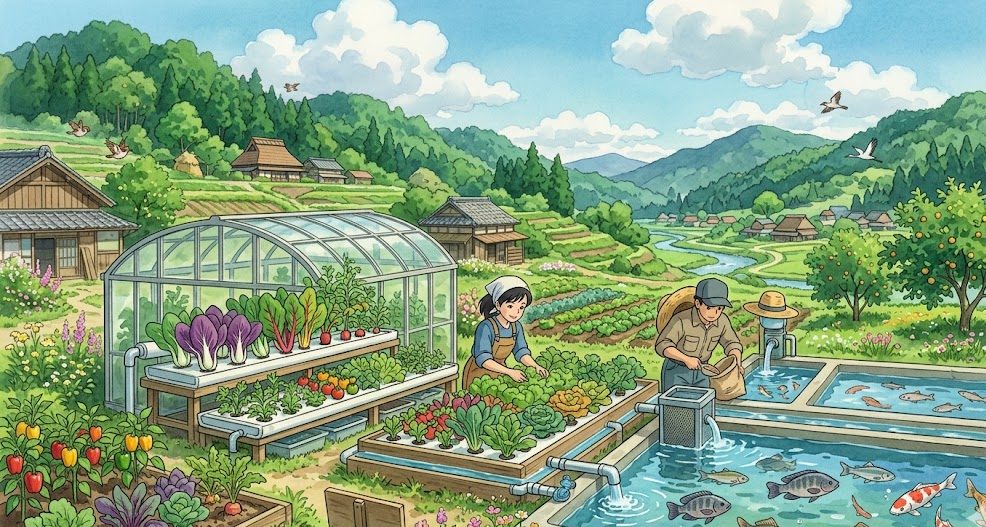
Integrated farming is the ultimate synergy in modern agriculture. By combining Aquaculture (fish farming) and Olericulture (vegetable farming)—often referred to in its most advanced form as Aquaponics—farmers can create a closed-loop system where waste from one species becomes the lifeblood of another.
This guide provides a comprehensive roadmap for starting an integrated farm focused on high-value exotic vegetables and premium fish species, ensuring maximum profitability and environmental sustainability.
1. The Philosophy of Integrated Farming
At its core, integrated farming is about resource optimization. In a standalone fish farm, water high in ammonia (from fish waste) must be discarded. In standalone vegetable farming, expensive chemical fertilizers are needed.
In an integrated system:
- Fish produce waste rich in ammonia.
- Nitrifying bacteria convert that ammonia into nitrates.
- Exotic vegetables absorb these nitrates as organic fertilizer, cleaning the water.
- Purified water is cycled back to the fish tanks.
This “circular economy” reduces water usage by up to 90% compared to traditional soil farming.
2. Selecting Your High-Value Components
To ensure a high Return on Investment (ROI), focus on species that command premium prices in urban markets.
A. The Fish: The Nutrient Engine
- Tilapia: The most popular choice due to its hardiness and fast growth rate.
- Catfish: Excellent for beginners; they can tolerate lower oxygen levels.
- Barramundi (Asian Sea Bass): A premium fish that fetches a high market price but requires more precise water management.
- Koi or Goldfish: If your market leans toward ornamental rather than edible, these can be incredibly lucrative.
B. The Exotic Vegetables: The Profit Center
Exotic vegetables often have a shorter shelf life and higher price points, making them perfect for local integrated farms.
- Leafy Greens: Kale, Swiss Chard, Arugula (Rocket), and Bok Choy.
- Herbs: Sweet Basil, Thai Basil, Mint, and Cilantro.
- Premium Salad Greens: Romaine Lettuce, Butterhead Lettuce, and Lollo Rosso.
- High-Value Peppers: Bell Peppers (Yellow/Red) and Habaneros.
3. Setting Up the Infrastructure
A successful integrated farm requires a balance of mechanical engineering and biological management.
System Design Options
- Media Beds: Filling containers with expanded clay pebbles or gravel. This acts as both a home for the plants and a bio-filter for the bacteria.
- Nutrient Film Technique (NFT): Water flows in a thin film through PVC pipes where plant roots sit. Best for herbs and smaller greens.
- Deep Water Culture (DWC): Floating rafts on a pool of water. Ideal for large-scale lettuce production.
Essential Equipment
- Fish Tanks: Circular tanks are preferred for better water circulation.
- Aeration Pumps: To ensure high dissolved oxygen levels for both fish and plant roots.
- Water Pumps: To move the nutrient-rich water from the fish to the plants.
- Filtration Units: Mechanical filters to remove solid fish waste before it reaches the plant roots.
4. Step-by-Step Implementation Guide
Step 1: Water Cycling and Bacteria Colonization
You cannot add fish and plants on day one. You must “cycle” the system for 2–4 weeks to build a colony of beneficial bacteria (Nitrosomonas and Nitrobacter). Without these, the ammonia will kill your fish.
Step 2: Stocking the Fish
Start with a low stocking density. For beginners, 1kg of fish per 50–100 liters of water is a safe starting point. Monitor the water pH (aim for 6.8 to 7.2) and temperature daily.
Step 3: Seeding the Exotic Vegetables
Start your seeds in organic plugs (like coco-peat). Once they have their first set of “true leaves,” transplant them into your integrated system.
Step 4: Monitoring and Feeding
Use high-quality floating fish feed. The amount you feed the fish directly determines how much “fertilizer” your vegetables receive. If the leaves look yellow, you may need more fish or more frequent feeding.
5. Managing the Ecosystem: Essential Tips
Success in integrated farming lies in the details. Here is how to master the environment:
- pH Balance: This is the most critical factor. Fish prefer 6.5–8.0, plants prefer 5.0–7.0, and bacteria prefer 7.0–8.0. The “Sweet Spot” for the entire system is 6.8 to 7.0.
- Dissolved Oxygen: Aim for at least 5 ppm (parts per million). Use air stones to create a “boiling” effect in the water.
- Temperature Control: Exotic vegetables like Kale prefer cooler temperatures, while Tilapia love warmth. Using a greenhouse with shade nets can help regulate this.
6. Profitability and Market Strategy
An integrated farm is a business. To succeed, you must think beyond the harvest.
| Revenue Stream | Target Market | Strategy |
| Exotic Greens | High-end Cafes & Hotels | Daily harvests for peak freshness. |
| Fresh Fish | Local Seafood Markets | Sell live or chilled to command 20% higher prices. |
| Value-Added | Direct-to-Consumer | “Salad Boxes” containing a mix of exotic greens. |
Pro Tip: Use digital marketing to showcase your “Pesticide-Free” and “Sustainable” methods. Modern consumers are willing to pay a premium for food grown without chemical runoff.
7. Overcoming Common Challenges
- Power Failures: An integrated system relies on pumps. A 2-hour power cut can kill your fish. Investment in a backup solar system or UPS is mandatory.
- Pest Management: Since you have fish in the water, you cannot use chemical pesticides on the plants, as they will drip into the water and kill the fish. Use organic methods like Neem oil or predatory insects (Ladybugs).
- Nutrient Deficiencies: Sometimes fish waste lacks Iron or Potassium. You may need to supplement with “chelated iron” or “potassium carbonate” that is safe for fish.
8. Conclusion: The Future of Farming
Starting an integrated farm is a journey toward self-sufficiency and high-margin agriculture. It requires a blend of being a biologist, a plumber, and an entrepreneur. By mastering the delicate balance between the water and the leaf, you aren’t just growing food—you are managing a living, breathing ecosystem that rewards precision with abundance.
Whether you are starting in a backyard or on a commercial acre, the combination of exotic vegetables and fish farming is the most efficient way to feed the future while securing your financial success.