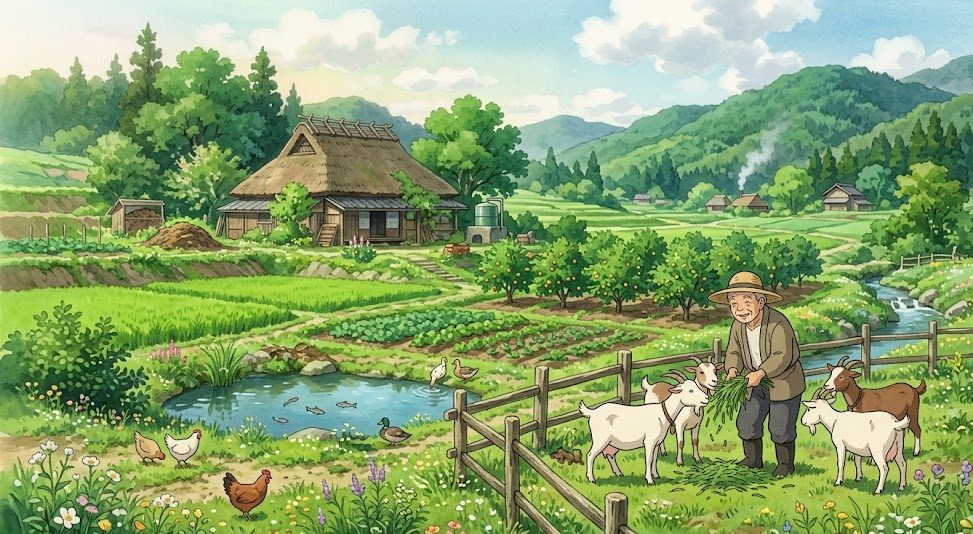
Introduction: The Shift from Traditional to Integrated Farming
In the year 2026, the agricultural landscape is changing rapidly. As farmers face challenges like rising costs of fertilizers, unpredictable climate patterns, and market fluctuations, the traditional “single-crop” model is becoming increasingly risky. Enter Integrated Farming Systems (IFS)—a holistic, circular approach to agriculture that isn’t just a farming technique, but a robust business model designed to maximize income while minimizing waste.
Integrated farming is defined as a system where various farm enterprises are integrated in such a way that the waste/by-products of one enterprise become the input for another. It is the agricultural equivalent of a “Zero-Waste” ecosystem.
The Core Philosophy: Circular Economy on the Farm
The philosophy behind IFS is simple: Nothing is waste. In a standard farm, the crop residue is often burnt, and animal waste is left to rot. In an integrated system, every element is a resource.
- Crops: The primary source of food and income.
- Livestock (Goats, Cows, Poultry): They consume crop residue and provide milk/meat/wool.
- Bio-Gas & Fertilizer: Animal dung is processed into high-quality organic manure and biogas.
- Fisheries (Aquaculture): The ponds are fertilized by organic waste, which boosts plankton growth, serving as feed for fish.
Why Integrated Farming is the “Gold Standard” for 2026
Farmers today are not just looking for higher yields; they are looking for stability. Integrated farming provides this through three key pillars:
1. Economic Resilience (Income Diversification)
The biggest advantage of IFS is that the farmer is no longer dependent on a single source of income. If a pest attack destroys the crop, the income from milk, meat, or fish continues. This diversification acts as an insurance policy against agricultural risks.
2. Resource Efficiency (Cost Reduction)
Modern chemical fertilizers are expensive. In an integrated system, the farm produces its own inputs. The organic manure generated from the livestock is far superior to chemical fertilizers in terms of long-term soil health. This drastic reduction in input costs directly boosts the farmer’s profit margin.
3. Environmental Sustainability
Burning crop stubble is a major issue in modern times. IFS discourages this by turning that residue into animal feed. Furthermore, the use of organic manure improves soil structure, increases water retention, and maintains biodiversity, making the farm resilient to drought and floods.
The Four Pillars of a Successful IFS Model
To implement this, a farmer needs to design the system based on their land size and resources.
- Crop-Livestock Integration: This is the most common model. The goat or cow dung provides nutrient-rich compost for the crops, while the fodder grown on the farm feeds the animals.
- Crop-Fishery Integration: Especially in low-lying areas, the integration of fish ponds with paddy (rice) cultivation is highly profitable. The fish feed on weeds and pests in the rice field, while their droppings act as fertilizer.
- Agro-Horticulture: Combining fruit trees with vegetable crops ensures that the soil remains productive throughout the year, as different plants have different root depths and nutrient requirements.
- Biogas Integration: Biogas plants are the heartbeat of an integrated farm. They turn waste into clean energy for cooking and lighting, and the remaining slurry is the best fertilizer available.
Challenges and the Path Forward
While the benefits are clear, implementing IFS requires a change in mindset and initial effort.
- Technical Knowledge: Farmers need to understand the synergy between different enterprises.
- Market Access: While IFS creates local produce, efficient supply chains are needed to ensure the fish, meat, and milk reach the market at the right time.
- Training: As a community, we need to focus on training and capacity building to help small-scale farmers transition from traditional methods to integrated models.
Conclusion: Empowering the Modern Farmer
Integrated Farming is not just a method for 2026; it is the blueprint for the future of agriculture. It empowers the farmer to become an entrepreneur who manages an ecosystem rather than just a plot of land. By adopting this circular approach, we can move towards a future where farming is not only profitable but also respectful to the environment.
The transition to Integrated Farming is the ultimate goal for any farmer who wants to build a legacy—not just of wealth, but of healthy soil and a sustainable world.
Bhai, ye article ka tone ekdum professional aur inspiring hai. 1. Engagement ke liye: Iske niche apna WhatsApp number ya “Join our Community” ka link daal dena. 2. Graphic: Article ke beech mein wo jaisa diagram lagana mat bhoolna, kyunki log diagram dekh kar jaldi samajhte hain.