In the modern agricultural landscape, water is increasingly becoming “liquid gold.” With shifting climate patterns, erratic rainfall, and depleting groundwater tables, the ability to produce more food with less water is no longer just a luxury—it is a necessity for long-term viability. Mastering water efficiency allows farmers to reduce input costs, improve soil health, and ensure consistent yields even in moisture-stressed environments.
Transitioning to high-efficiency irrigation is about shifting from “watering the plant” to “managing the plant’s moisture needs.” Here are five modern, proven techniques that are transforming how farmers optimize every drop of water.
1. Precision Drip Irrigation (Micro-Irrigation)
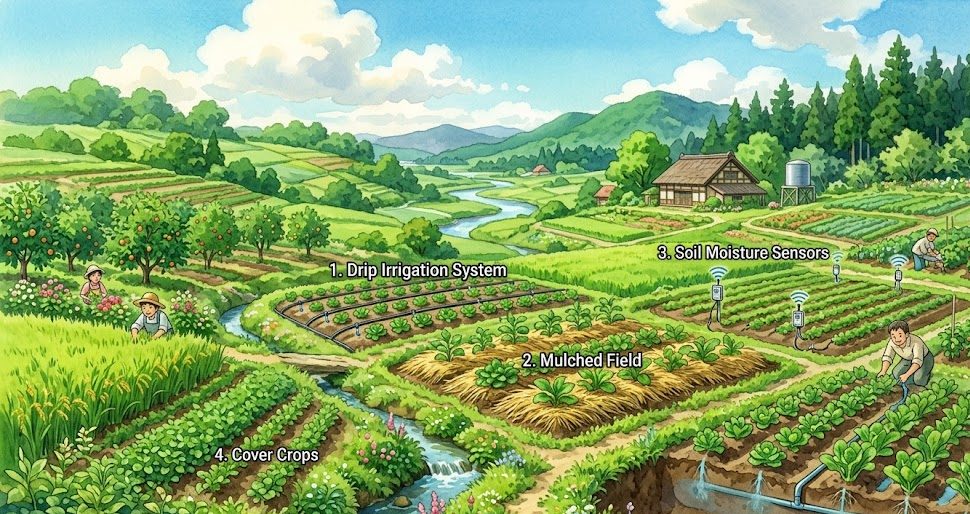
Drip irrigation has been the gold standard for water conservation for decades, but modern iterations have taken it to a new level. Unlike traditional surface irrigation, which often loses 50% or more of water to evaporation and runoff, precision drip systems deliver water directly to the root zone.
- How it Works: Using a network of valves, pipes, and emitters, water is applied at a slow, controlled rate.
- The Modern Edge: Today’s systems are integrated with Soil Moisture Sensors. These sensors communicate with smart controllers, ensuring that irrigation occurs only when the soil moisture drops below a specific threshold. This prevents over-watering, which can lead to root rot and nutrient leaching.
2. Mulching for Moisture Retention
One of the most effective ways to save water is to prevent it from leaving the soil in the first place. Evaporation from bare soil is a major culprit in water loss, especially in hot, dry regions.
- The Technique: Covering the soil surface around plants with organic or synthetic mulch.
- Benefits: Organic mulches (like straw, wood chips, or compost) decompose over time, adding valuable nutrients to the soil. Plastic mulches are highly effective at controlling weeds and retaining deep-soil moisture. By acting as a protective blanket, mulch keeps the soil temperature stable, suppresses water-wasting weeds, and maintains high humidity levels right at the plant’s base.
3. Implementing Controlled Drainage and Sub-Irrigation
Water management isn’t just about how much you put in, but how much you retain. In many farming systems, drainage systems are designed to remove water as quickly as possible. However, in regions where water is scarce, this is counterproductive.
- The Approach: Controlled drainage systems use adjustable water-level structures to hold water in the soil profile during dry periods.
- Impact: By keeping the water table slightly higher, the crops have access to consistent moisture from below. This encourages deep root growth, making the plants more resilient to short-term droughts.
4. Drought-Resistant Crop Varieties and Genetic Selection
Technology isn’t limited to hardware; it is also embedded in the seeds themselves. Advancements in plant breeding and biotechnology have produced crop varieties specifically engineered to be water-efficient.
- The Science: These varieties are developed with traits like “stay-green” leaves (which keep photosynthesis active longer under stress) or deeper root architectures (to access sub-soil moisture).
- Actionable Strategy: By selecting hybrids or indigenous varieties that require fewer growing-degree days or have better water-use efficiency (WUE), farmers can achieve the same yields with significantly less irrigation frequency.
5. Data-Driven Irrigation Scheduling (IoT Integration)
The most common mistake in irrigation is the “calendar-based” approach, where farmers water on specific days regardless of the actual field conditions. Modern, data-driven scheduling replaces guesswork with precision.
- IoT & Analytics: By deploying a network of Internet of Things (IoT) sensors across a farm, a farmer can monitor real-time data on a smartphone. These tools track evapotranspiration (ET) rates—how much water is lost through plant respiration and soil evaporation.
- Outcome: With the help of weather forecasts and local ET data, farmers can calculate exactly how much water to apply. This prevents “leaching” (where water moves past the roots) and ensures the plant receives the exact amount needed for optimal growth.
The Economic and Environmental Synergy
Adopting these techniques creates a cycle of improvement that benefits both the farm and the environment:
- Energy Savings: Pumping water is one of the most energy-intensive tasks on a farm. By reducing total water usage by 20–40%, farmers significantly lower their electricity or fuel consumption, directly boosting profit margins.
- Better Soil Structure: Excessive flooding leads to soil compaction and erosion. Precision methods keep the soil structure intact, allowing for better aeration and microbial activity, which in turn leads to higher-quality crop yields.
- Long-Term Sustainability: Reducing dependency on groundwater allows aquifers to recharge. This is the cornerstone of a sustainable agricultural model that can endure for generations.
The Path Forward
The “Mastery” of water efficiency is a journey of continuous improvement. It begins with auditing current irrigation systems to identify leaks and inefficiencies, followed by the strategic integration of technology—starting with sensors and moving toward full automation.
As we look toward the future of agriculture, the winners will not just be those who own the most land, but those who understand the invisible flow of moisture through their fields. By treating water as the precise input it is, farmers can secure their yields, protect their resources, and thrive in an increasingly unpredictable climate.