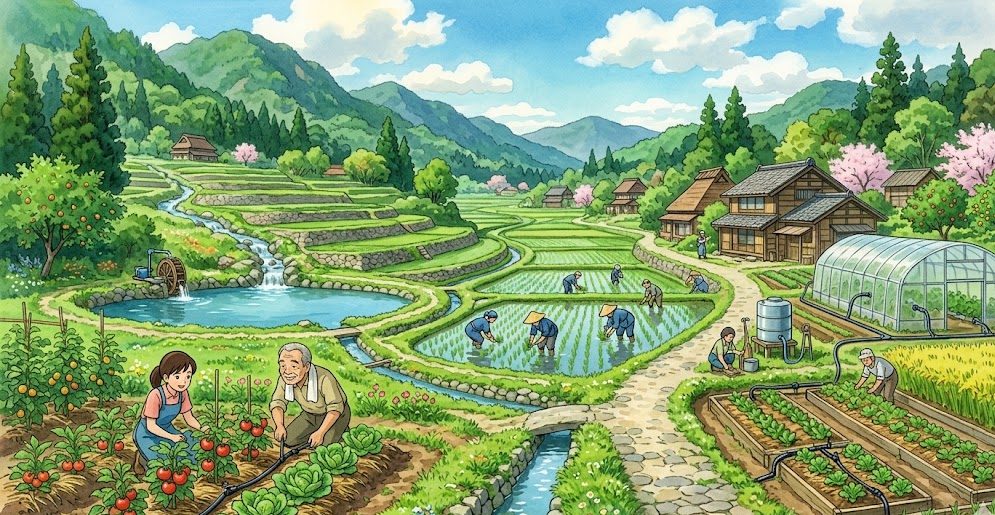
Water is the lifeblood of agriculture, yet it is becoming one of our most scarce resources. For the modern farmer, the challenge is no longer just about growing food; it is about “growing more with less.” As global water tables drop and weather patterns become increasingly erratic, water efficiency has transitioned from an environmental “choice” to a financial necessity.
Achieving high yields doesn’t require flooding your fields. In fact, over-watering often leads to nutrient leaching, root rot, and soil salinization. By adopting smart water-management strategies, you can actually increase your harvest while cutting your water consumption by up to 50%.
Here are the top 10 water-saving techniques that are revolutionizing high-yield farming today.
1. Drip Irrigation: Precision Hydration
Drip irrigation is the undisputed king of water efficiency. Unlike traditional flood or sprinkler systems that lose massive amounts of water to evaporation and wind drift, drip systems deliver water directly to the plant’s root zone.
- The Innovation: Using a network of valves, pipes, and emitters, water drips slowly and consistently.
- The Benefit: It reduces water waste by up to 60% and ensures that weeds between rows don’t get the moisture they need to compete with your crops.
2. Mulching: The Earth’s Protective Shield
Mulching is one of the simplest yet most effective ways to conserve soil moisture. By covering the soil surface with organic or inorganic materials, you create a barrier between the earth and the sun.
- Organic Mulch: Using straw, wood chips, or dried leaves adds organic matter to the soil as it decomposes.
- Inorganic Mulch: Plastic filming (often used in high-value vegetable farming) prevents almost all surface evaporation.
- The Benefit: Mulching can reduce irrigation frequency by 20–30% by keeping the soil cool and damp for longer periods.
3. Laser Land Leveling
If a field is uneven, water will naturally pool in low spots while leaving high spots dry. This leads to uneven growth and massive water waste.
- The Technique: Using a laser-guided system attached to a tractor, the field is leveled to a flat or precisely sloped surface.
- The Benefit: Laser leveling ensures an even distribution of water, reducing the amount of water needed to “cover” a field and increasing yields by ensuring every plant gets an equal drink.
4. Smart Soil Sensors and IoT
Why water based on a calendar when you can water based on real-time data? Internet of Things (IoT) sensors are changing the game.
- The Technology: Tensiometers and volumetric sensors are buried at various root depths. They send a signal to the farmer’s smartphone or an automated irrigation controller when the soil moisture drops below a specific threshold.
- The Benefit: This eliminates “guesswork irrigation,” preventing both under-watering stress and the waste associated with over-watering.
5. Alternate Wetting and Drying (AWD)
Traditionally, rice—one of the world’s most water-intensive crops—is grown in constantly flooded paddies. AWD is a management practice that challenges this norm.
- The Method: The field is allowed to dry out until the water table drops to about 15cm below the soil surface before being re-flooded.
- The Benefit: AWD can reduce water use in rice production by 30% without any reduction in yield, while also significantly cutting methane emissions.
6. Rainwater Harvesting and Farm Ponds
Relying solely on groundwater or canals is risky. High-yield farmers are increasingly turning their land into a catchment area.
- The Technique: Constructing lined farm ponds or tanks to capture monsoon runoff or winter rains.
- The Benefit: This provides a “buffer” during dry spells, ensuring that high-value crops never hit a water-stress point during critical growth stages (like flowering).
7. Hydroponics and Aeroponics
For certain high-value crops like leafy greens, tomatoes, and berries, moving away from soil entirely is the ultimate water-saving move.
- Hydroponics: Plants grow in a nutrient-rich water solution that is constantly recirculated.
- Aeroponics: Roots are suspended in the air and misted with water.
- The Benefit: These “closed-loop” systems use 90% less water than soil-based farming because no water is lost to the ground.
8. Drought-Resistant Crop Varieties
Scaling productivity in water-scarce regions starts with the seed. Plant breeding and biotechnology have produced “Smart Seeds” that can thrive with less moisture.
- The Innovation: Varieties of maize, wheat, and pulses have been developed with deeper root systems or the ability to “go dormant” during short dry spells.
- The Benefit: These crops maintain high yields even when irrigation cycles are stretched, providing a safety net for the farmer.
9. Conservation Tillage (No-Till)
Every time you plow or till a field, you expose moist soil to the air, causing it to dry out instantly.
- The Method: No-till farming involves planting seeds directly into the residue of the previous crop.
- The Benefit: This leaves the soil structure intact and preserves the “capillary” tubes that bring deep-ground moisture up to the surface. It also increases the soil’s organic matter, which acts like a sponge for water.
10. Night-Time and Early Morning Irrigation
When you water during the heat of the day, a significant percentage of that water evaporates before it even hits the ground or the roots.
- The Practice: Shifting irrigation schedules to between 10 PM and 6 AM.
- The Benefit: Lower temperatures and calmer winds mean that almost 100% of the water reaches the plant. It also reduces “leaf scorch,” which can happen when water droplets act like magnifying glasses under the midday sun.
Comparison: Traditional vs. Water-Smart Farming
| Feature | Traditional Method | Water-Saving Method |
| Water Efficiency | 30% – 40% | 85% – 95% |
| Weed Growth | High (Entire field is wet) | Low (Only root zone is wet) |
| Soil Health | Risks Salinization | Maintains Mineral Balance |
| Labour Cost | High (Manual flooding) | Low (Automated systems) |
| Crop Yield | Variable/Stress-prone | Stable and High |
The Economic Impact: Why Saving Water Increases Profit
Saving water isn’t just about being “eco-friendly”—it’s about the bottom line.
- Reduced Pumping Costs: Less water used means less electricity or diesel spent running pumps.
- Lower Fertilizer Costs: Through “fertigation” (adding fertilizer to drip lines), nutrients go directly to the plant rather than being washed away by heavy flooding.
- Higher Produce Quality: Consistent moisture levels prevent fruits from cracking and ensure uniform sizing, which fetches a higher market price.
Final Thoughts: The Path to “Blue” Agriculture
The future of farming is blue—focused on the preservation and smart use of every drop of water. By integrating these 10 techniques, farmers can insulate themselves against climate change while pushing their yields to new heights.
Scaling a farm in the 21st century requires a shift in mindset: we must stop viewing water as an infinite resource and start viewing it as a precision input. Whether you start with simple mulching or invest in high-tech IoT sensors, every drop saved is an investment in the long-term health and productivity of your land.
“The wars of the future may be over water, but the peace of the future will be built by the farmers who know how to save it.”