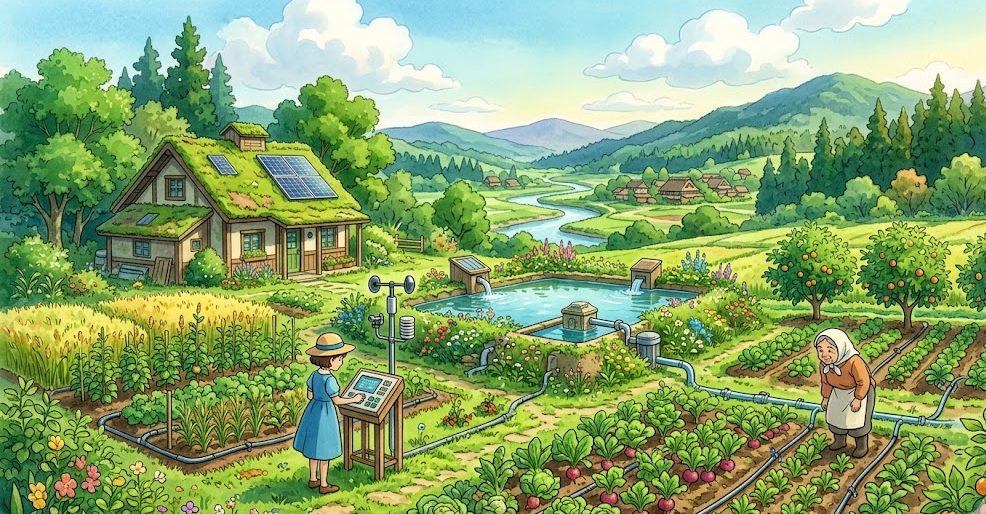
Water is the lifeblood of agriculture, yet it is becoming one of our most critically scarce resources. Globally, agriculture accounts for approximately 70% of all freshwater withdrawals. With changing climate patterns, prolonged droughts, and growing populations, the agricultural sector faces a pressing challenge: produce more food using significantly less water.
To survive and thrive, modern farming must transition from traditional, high-waste watering methods to Advanced Water-Saving Farming. By combining smart irrigation technologies, real-time data, and hydro-efficient field strategies, growers can optimize every single drop, slashing input costs while maximizing crop yields.
1. The Core of Hydro-Efficiency: Moving Beyond Flood Irrigation
Traditional irrigation methods, such as flood or furrow irrigation, are highly inefficient. Up to 50% of the water applied through these methods is lost to evaporation, surface runoff, and deep leaching below the root zone. Hydro-efficiency flips this model by delivering water precisely where, when, and in the exact amount the plant needs.
   [ Traditional Irrigation ]  ───► 50% Water Loss (Evaporation & Runoff)
              │
   [ Hydro-Efficient Model  ]  ───► 95% Efficiency (Targeted Root Delivery)
Subsurface Drip Irrigation (SDI)
Subsurface drip irrigation represents the pinnacle of water-saving delivery systems. Instead of spraying water into the air or flooding the surface, SDI uses a network of buried plastic tubes equipped with emitters. These tubes deliver water and liquid nutrients directly to the plant’s root zone. Because the water remains underground, surface evaporation is virtually eliminated, weed growth between rows is minimized, and wind drift is a non-issue.
Variable Rate Irrigation (VRI)
Not all parts of a field require the same amount of water. Variations in soil texture, topography, and slope mean that low-lying clay areas hold moisture much longer than elevated, sandy zones. Variable Rate Irrigation (VRI) uses GPS and digital mapping to control individual nozzles on center pivot or lateral-move irrigation systems. As the machinery moves across the field, it automatically adjusts its speed and water flow, preventing over-watering in wet zones and under-watering in dry zones.
2. Smart Irrigation: The Role of IoT and Automation
The “smart” in modern irrigation comes from replacing human guesswork with data-driven automation. Internet of Things (IoT) devices and connected software allow fields to communicate their exact hydration needs in real time.
In-Field Soil Moisture Sensors
Deploying soil moisture sensors (such as capacitive or tensiometric probes) at varying root depths gives farmers a clear view of the subterranean water profile. These sensors measure the Volumetric Water Content (VWC) or soil water tension.
When integrated with automated irrigation controllers, the system can be programmed to turn on only when soil moisture drops below a specific “management allowed depletion” threshold and shut off the moment the root zone reaches field capacity.
Weather-Based Controllers (Evapotranspiration Systems)
Smart irrigation setups do not just look at the soil; they look at the sky. Evapotranspiration (ET) controllers utilize local weather station data—including temperature, solar radiation, wind speed, and relative humidity—to calculate how much water a plant has lost through transpiration and how much moisture has evaporated from the soil. If a rain event is forecasted or if high humidity lowers ET rates, the smart controller automatically skips or reduces the scheduled watering cycle.
3. Water-Saving Agronomic Strategies
Technological hardware is only half of the equation; high-quality hydro-efficiency also relies on smart land management and agronomic practices that naturally retain moisture within the ecosystem.
| Strategy | Operational Mechanism | Water-Saving Benefit |
|---|---|---|
| Conservation Tillage / No-Till | Leaving crop residues (like stalks and leaves) on the soil surface rather than plowing them under. | Creates a natural blanket that shades the soil, dropping surface temperatures and reducing evaporation by up to 35%. |
| Cover Cropping | Planting off-season crops like clover, rye, or vetch to keep the ground covered. | Improves soil structure and increases organic matter, which dramatically boosts the soil’s water-holding capacity. |
| Regulated Deficit Irrigation (RDI) | Intentionally applying less water during specific, non-critical growth stages of the plant. | Triggers natural plant resilience and controls excessive vegetative growth without sacrificing final crop yield or quality. |
Export to Sheets
4. Upgrading Micro-Efficiency: Soil Amendments and Polymer Technology
To squeeze the absolute highest efficiency out of every irrigation cycle, advanced farming looks at modifying the soil matrix itself to hold onto water longer.
Hydrogels and Superabsorbent Polymers (SAPs)
When mixed into the root zone during planting, superabsorbent polymers act like microscopic sponges. These non-toxic crystals can absorb up to several hundred times their weight in water. During irrigation or rainfall, they swell and lock in moisture; as the surrounding soil dries out, they slowly release that water back to the plant roots, extending the time needed between irrigation events.
Biochar Integration
Biochar—a highly porous, carbon-rich charcoal created by heating biomass in the absence of oxygen—serves as a permanent structural upgrade for soil. Its incredible surface area and porous nature allow it to hold onto both water and dissolved nutrients, preventing them from washing away through sandy soils and making the land fundamentally more drought-resilient.
5. The Financial and Environmental Return on Investment (ROI)
Transitioning to advanced water-saving farming requires an initial capital investment in sensors, hardware, and specialized management tools. However, the long-term returns make it highly profitable:
The Precision Payoff: By reducing water usage, farmers simultaneously slash their energy pumping costs—often one of the highest operational expenses on a farm. Furthermore, precise water delivery prevents nutrient leaching (where valuable fertilizers are washed past the root zone into groundwater), meaning less fertilizer is required over the course of the season.
From an environmental standpoint, smart irrigation protects local watersheds, reduces agricultural runoff carrying chemicals into nearby rivers, and preserves fragile freshwater ecosystems for the surrounding community.
Conclusion
Advanced water-saving farming is the future of sustainable, high-yield agriculture. By bridging the gap between smart IoT hardware, automated irrigation systems, and conservation-focused soil management, growers can shield their operations from unpredictable weather and rising resource costs. Embracing hydro-efficiency ensures that commercial farming remains both profitable and environmentally responsible, securing our global food supply one drop at a time.