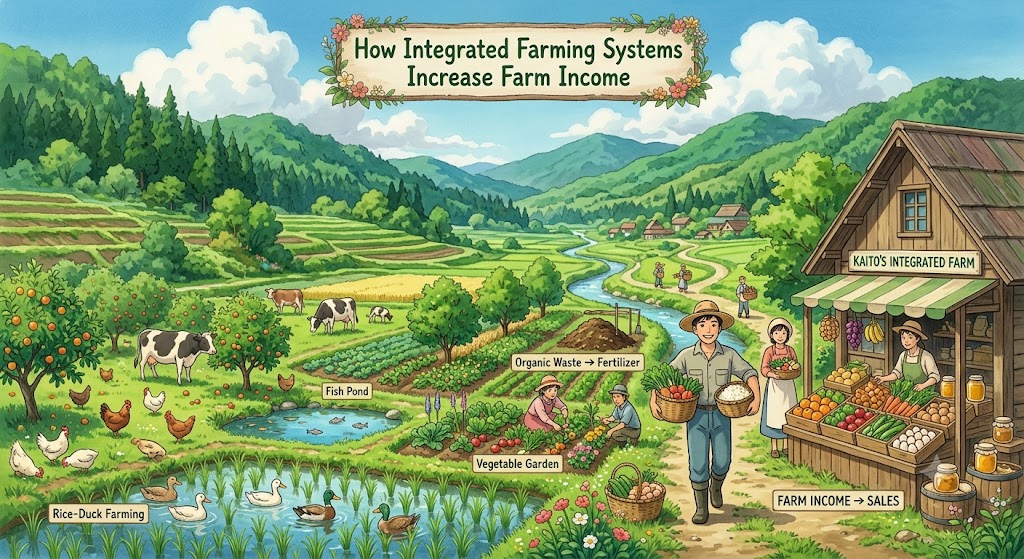
For many farmers, increasing income is no longer as simple as producing a larger harvest. Rising fertilizer prices, expensive animal feed, labor shortages, unpredictable weather, and fluctuating market prices have made farming more challenging than ever. In this environment, relying on a single crop often creates unnecessary financial risk.
Integrated Farming Systems (IFS) provide a practical solution by transforming a farm into a connected production system where every enterprise supports another. Instead of treating crops, livestock, poultry, fisheries, orchards, or composting as separate activities, integrated farming links them together to improve efficiency and create multiple income opportunities.
The result is a farm that generates revenue throughout the year, reduces waste, lowers production costs, and becomes more resilient during difficult seasons.
Looking Beyond a Single Harvest
Traditional farming often depends on one or two major harvests each year. If those crops fail because of drought, pests, diseases, or poor market prices, the entire farm income is affected.
Integrated farming changes this approach by creating several income streams that work together.
Instead of asking, “How much will this crop earn?”, integrated farmers ask, “How can every part of my farm contribute to income?”
That simple shift in thinking often leads to stronger financial stability.
Every Enterprise Becomes a Business Opportunity
A successful integrated farm treats every activity as an opportunity to generate value.
For example:
| Farm Enterprise | Income Source |
|---|---|
| Vegetable farming | Fresh market sales |
| Dairy animals | Daily milk production |
| Poultry | Eggs and meat |
| Fish ponds | Seasonal fish harvest |
| Fruit trees | Fresh fruit and processed products |
| Beekeeping | Honey and beeswax |
| Compost production | Organic fertilizer sales |
Instead of waiting months for a single harvest, farmers receive income from different sources throughout the year.
Recycling Farm Resources Saves Money
Increasing income is not only about earning more—it is also about spending less.
One of the greatest financial strengths of integrated farming is resource recycling.
Examples include:
- Animal manure becomes organic fertilizer.
- Crop residues become livestock feed.
- Poultry litter enriches compost.
- Pond water irrigates vegetable fields.
- Fruit tree leaves become mulch.
By using materials already available on the farm, farmers purchase fewer external inputs.
This directly improves profit margins.
Lower Input Costs Mean Higher Net Profit
Many farming expenses continue increasing every year.
Integrated farming helps reduce dependence on purchased inputs such as:
- Chemical fertilizers
- Commercial animal feed
- Soil conditioners
- Waste disposal services
- Irrigation water
When production costs decrease while yields remain stable or improve, overall farm income naturally increases.
Continuous Cash Flow Throughout the Year
One common challenge for crop farmers is irregular income.
A farmer may receive most earnings only once or twice each year.
Integrated farming creates a more balanced financial cycle.
For example:
- Milk can be sold every day.
- Eggs generate weekly income.
- Vegetables provide regular harvests.
- Honey may be harvested several times a year.
- Fish harvesting adds seasonal earnings.
- Fruit trees contribute annual returns.
This steady cash flow makes it easier to manage household expenses and reinvest in the farm.
Healthier Soil Supports Higher Productivity
Healthy soil plays an important role in farm profitability.
Integrated farming naturally improves soil fertility through:
- Compost application
- Animal manure
- Green manure crops
- Crop rotation
- Mulching
- Organic residue recycling
Better soil produces stronger crops, higher yields, and improved quality while reducing fertilizer expenses.
Healthy soil is one of the most valuable long-term investments any farmer can make.
Risk Is Spread Across Multiple Enterprises
Every agricultural activity involves some level of uncertainty.
A drought may affect crops.
Disease may reduce poultry production.
Fruit prices may fall.
However, when multiple enterprises operate together, losses from one activity can often be offset by income from another.
This diversification creates greater financial security than depending entirely on a single crop.
Making Better Use of Available Land
Integrated farming encourages farmers to maximize every part of their property.
Examples include:
- Growing vegetables between young fruit trees.
- Raising fish in irrigation ponds.
- Keeping poultry near orchards.
- Planting fodder crops for livestock.
- Producing compost from farm waste.
Every section of the farm contributes to productivity instead of remaining unused.
Reducing Waste Creates Additional Value
Traditional farming often produces waste materials that are discarded or burned.
Integrated farming views waste differently.
Materials such as:
- Dry leaves
- Crop stalks
- Livestock manure
- Kitchen waste
- Poultry litter
can all become valuable inputs through composting or animal feeding.
Turning waste into useful products reduces costs while improving farm sustainability.
Adding Value Before Selling
Integrated farming also creates opportunities for processing agricultural products.
Instead of selling only raw materials, farmers may produce:
- Cheese from milk
- Yogurt from dairy products
- Packaged honey
- Organic compost
- Fruit jam
- Dried herbs
- Vegetable pickles
Value-added products usually generate higher profits than raw produce.
Technology Strengthens Integrated Farming
Modern technology makes integrated farm management easier than ever before.
Useful tools include:
- Farm management apps
- Weather forecasting platforms
- Soil testing kits
- Smart irrigation systems
- Livestock monitoring devices
- Digital financial records
Technology improves decision-making while increasing operational efficiency.
A Practical Example
Imagine a farmer with five acres of land.
Instead of growing only one cereal crop, the farm includes:
- Seasonal vegetables
- Two dairy cows
- A poultry unit
- A fish pond
- Fruit trees
- Compost production
The vegetables generate regular market income.
Milk is sold every day.
Eggs provide weekly earnings.
Fish are harvested seasonally.
Fruit trees offer additional annual income.
Compost reduces fertilizer costs while improving soil health.
Each enterprise supports the others, creating a farming system that is both productive and financially resilient.
Common Challenges and Solutions
| Challenge | Practical Solution |
|---|---|
| Managing multiple activities | Expand gradually and plan carefully |
| Initial investment | Start with available resources |
| Additional labor | Improve scheduling and family participation |
| Marketing several products | Develop multiple buyer relationships |
| Technical knowledge | Attend agricultural training programs |
Good planning helps farmers manage these challenges successfully.
Tips for Farmers Starting Integrated Farming
If you’re considering an integrated farming system, these recommendations can help:
- Begin with two or three enterprises.
- Improve soil before expanding production.
- Recycle as many farm resources as possible.
- Maintain accurate financial records.
- Diversify gradually.
- Build relationships with reliable buyers.
- Continue learning modern farming practices.
Steady improvement often delivers better long-term results than rapid expansion.
Looking Toward the Future
As agriculture continues to evolve, farms that combine productivity with sustainability will be in a stronger position to succeed.
Integrated farming supports:
- Better resource management
- Higher profitability
- Environmental conservation
- Climate resilience
- Food security
- Long-term business stability
It is increasingly viewed as one of the most practical farming systems for both small and commercial agricultural operations.
Final Thoughts
Integrated Farming Systems help farmers increase income by creating multiple revenue streams while reducing unnecessary production costs. By connecting crops, livestock, poultry, fisheries, fruit cultivation, composting, and other farm activities into one coordinated system, farmers make better use of available resources and reduce financial risk.
Beyond improving profitability, integrated farming strengthens soil health, conserves water, minimizes waste, and promotes sustainable agricultural development. For farmers seeking stable long-term income rather than depending on a single harvest, integrated farming offers a practical pathway toward greater financial security and more resilient farm businesses.
Frequently Asked Questions
1. What is an Integrated Farming System?
An Integrated Farming System is a farming approach that combines different agricultural enterprises so they support one another and improve overall productivity and profitability.
2. How does integrated farming increase farm income?
It creates multiple income sources, reduces production costs through resource recycling, improves soil fertility, and lowers financial risk.
3. Can small farmers benefit from integrated farming?
Yes. Even small farms can combine crops, livestock, poultry, composting, or beekeeping to improve productivity and generate additional income.
4. Does integrated farming reduce farming costs?
Yes. Recycling manure, crop residues, and organic waste reduces spending on fertilizers, feed, and other farm inputs.
5. Why is integrated farming considered sustainable?
Because it conserves natural resources, reduces waste, improves soil health, increases biodiversity, and supports long-term agricultural productivity.