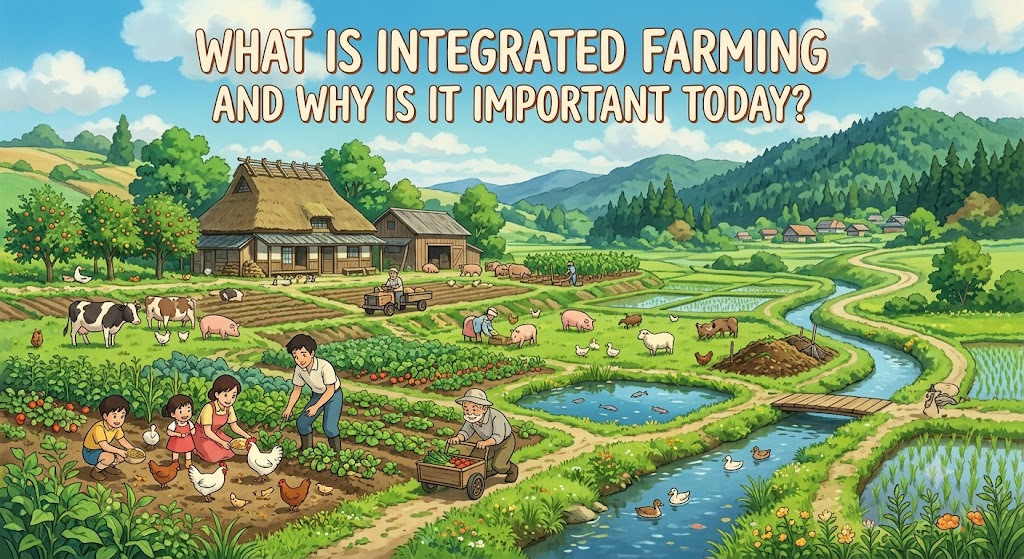
Imagine two farms located in the same village. Both have similar land, climate, and access to water. One farm grows only a single crop throughout the year, while the other combines crops, livestock, fish farming, compost production, fruit trees, and poultry. At the end of the season, the second farm often earns more income, produces less waste, and remains productive even when one enterprise performs poorly.
This is the strength of integrated farming.
Instead of depending on a single source of income, integrated farming brings together different agricultural activities that support one another. Crop residues feed livestock, livestock manure enriches the soil, pond water irrigates fields, and organic waste is converted into compost. Every part of the farm contributes to another, creating a more efficient and sustainable production system.
As farming faces challenges such as climate change, rising input costs, labor shortages, and shrinking natural resources, integrated farming has become one of the most effective approaches for building profitable and resilient agricultural businesses.
Understanding Integrated Farming
Integrated farming is a farming system where multiple agricultural enterprises are managed together on the same farm to improve productivity, reduce waste, and increase profitability.
Rather than operating separately, each component supports the others.
A typical integrated farm may include:
- Crop cultivation
- Dairy farming
- Poultry production
- Fish farming
- Goat or sheep rearing
- Fruit orchards
- Vegetable gardens
- Compost production
- Beekeeping
The goal is to create a balanced farming system where resources are used efficiently and very little goes to waste.
Why Farmers Are Moving Toward Integrated Farming
Modern agriculture has become more expensive due to rising fertilizer prices, fuel costs, labor shortages, and changing weather conditions.
Relying on a single crop also increases financial risk. If disease, drought, floods, or market price declines affect that crop, the farmer may lose most of the year’s income.
Integrated farming reduces this risk by generating income from several different agricultural activities throughout the year.
How Different Farm Enterprises Work Together
The greatest advantage of integrated farming is that one activity supports another.
For example:
- Crop residues become livestock feed.
- Animal manure is converted into compost.
- Compost improves soil fertility.
- Fish pond water irrigates nearby crops.
- Poultry manure can be used as fertilizer.
- Bees improve pollination for fruit and vegetable crops.
- Fruit trees provide shade while generating additional income.
This natural cycle reduces waste and lowers production costs.
Better Use of Farm Resources
Every farm has limited resources such as land, water, labor, and capital.
Integrated farming ensures these resources are used more efficiently.
Examples include:
✔ Recycling organic waste
✔ Sharing irrigation systems
✔ Utilizing family labor year-round
✔ Producing natural fertilizers
✔ Maximizing land productivity
Instead of leaving resources unused, every part of the farm contributes to production.
Improving Soil Health Naturally
Healthy soil is the foundation of successful farming.
Integrated farming improves soil quality through continuous recycling of organic materials.
Common soil improvement practices include:
- Compost application
- Animal manure
- Green manure crops
- Crop rotation
- Mulching
- Cover cropping
These methods increase organic matter while reducing dependence on synthetic fertilizers.
Multiple Sources of Farm Income
One of the biggest strengths of integrated farming is income diversification.
Instead of depending entirely on one crop, farmers can earn money from several enterprises.
Possible income sources include:
| Farm Activity | Potential Income |
|---|---|
| Grain crops | Seasonal harvest sales |
| Vegetables | Regular local market sales |
| Dairy farming | Daily milk production |
| Poultry | Eggs and meat |
| Fish farming | Periodic harvests |
| Fruit orchards | Seasonal fruit sales |
| Honey production | Packaged honey |
| Compost | Organic fertilizer sales |
This creates more stable cash flow throughout the year.
Reducing Production Costs
Integrated farming naturally lowers many operating expenses because farm resources are recycled rather than purchased repeatedly.
Farmers often reduce spending on:
- Chemical fertilizers
- Animal feed
- Waste disposal
- Irrigation
- Soil amendments
Lower production costs generally lead to higher overall profitability.
Environmental Benefits
Integrated farming supports environmental sustainability by reducing waste and improving natural resource management.
Major environmental benefits include:
- Lower chemical use
- Better soil conservation
- Improved biodiversity
- Reduced pollution
- Efficient water use
- Reduced greenhouse gas emissions
These practices protect both the farm and the surrounding ecosystem.
Integrated Farming Builds Climate Resilience
Extreme weather events are becoming more common.
Integrated farming helps farmers recover more quickly because they are not dependent on a single agricultural enterprise.
For example:
- If crop yields decline because of drought, livestock or poultry may continue generating income.
- If vegetable prices fall, fruit production or fish farming may provide financial stability.
Diversification reduces the overall risk faced by farming families.
Can Small Farmers Use Integrated Farming?
Absolutely.
Integrated farming is often especially suitable for small farms because it maximizes the use of limited land and resources.
A small farm might combine:
- Seasonal vegetables
- A few dairy animals
- Chickens or ducks
- Compost production
- Fruit trees
- A small fish pond
- Beekeeping
Even modest integration can improve both productivity and income.
Challenges Farmers Should Consider
Like every farming system, integrated farming requires careful planning.
Some common challenges include:
- Greater management responsibility
- Initial investment in infrastructure
- Additional technical knowledge
- Increased labor during certain seasons
- Marketing multiple products
With proper planning and gradual expansion, these challenges become easier to manage.
Practical Tips for Starting an Integrated Farm
Farmers interested in adopting this approach can begin gradually.
Consider these steps:
- Evaluate available land and resources.
- Start with two or three complementary enterprises.
- Recycle organic waste whenever possible.
- Improve soil using compost and manure.
- Maintain accurate farm records.
- Learn from experienced integrated farmers.
- Expand only after gaining practical experience.
A gradual approach reduces financial risk while building valuable experience.
Why Integrated Farming Represents the Future
Agriculture is moving toward systems that are more productive, environmentally responsible, and financially resilient.
Integrated farming aligns perfectly with these goals because it:
- Uses resources efficiently
- Reduces waste
- Conserves natural resources
- Improves profitability
- Supports sustainable food production
- Creates stronger farming businesses
As environmental and economic challenges continue to grow, integrated farming is expected to become increasingly important worldwide.
Final Thoughts
Integrated farming is more than simply combining different agricultural activities—it is a complete farming philosophy that focuses on efficiency, sustainability, and long-term success. By connecting crops, livestock, fisheries, composting, and other farm enterprises into one balanced system, farmers can improve productivity while reducing waste and lowering production costs.
Whether managing a small family farm or a larger commercial operation, integrated farming provides practical solutions for modern agricultural challenges. With careful planning, efficient resource management, and continuous learning, farmers can build resilient businesses that remain profitable while protecting the environment for future generations.
Frequently Asked Questions
1. What is integrated farming?
Integrated farming is a farming system that combines multiple agricultural activities, such as crop production, livestock, poultry, fish farming, and composting, so they support one another.
2. Why is integrated farming important today?
It helps farmers reduce costs, improve resource efficiency, diversify income, protect the environment, and adapt to climate-related challenges.
3. Is integrated farming suitable for small farms?
Yes. Small farmers can successfully combine crops, livestock, poultry, composting, and other enterprises to maximize productivity from limited land.
4. How does integrated farming improve soil fertility?
It uses organic manure, compost, crop residues, and crop rotation to increase soil organic matter and naturally improve fertility.
5. What is the biggest advantage of integrated farming?
The biggest advantage is reduced financial risk through multiple income sources while making better use of available farm resources and minimizing waste.