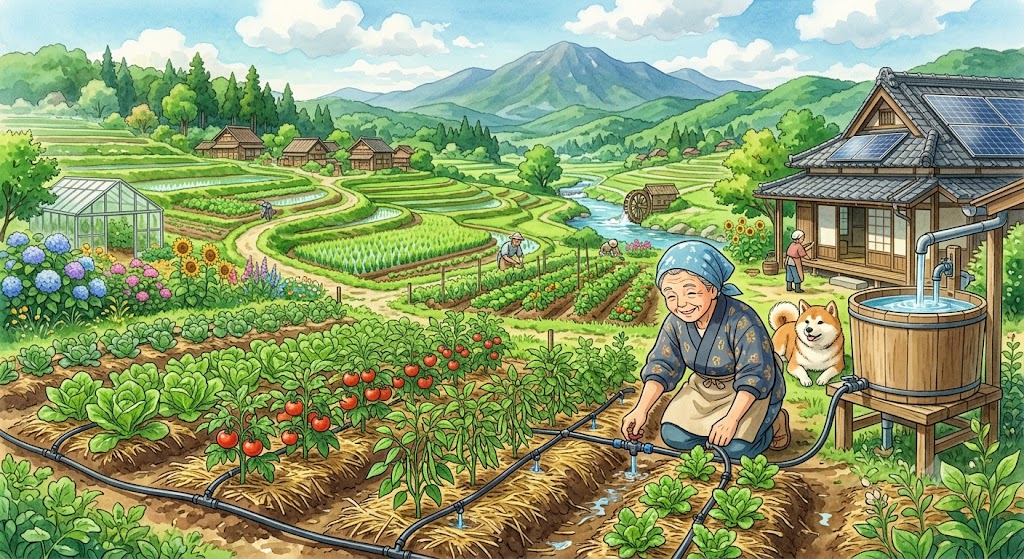
Water is one of the most important resources in agriculture, and managing it well can make a major difference to both crop performance and farm profitability. A field does not necessarily need more water to produce a better harvest. In many situations, the bigger opportunity is to make better use of the water that is already available.
Water can be lost through evaporation, runoff, poor irrigation systems, leaks, deep drainage, or simply applying it at the wrong time. Crops can also struggle when water is supplied unevenly, even when the total amount used appears sufficient.
Efficient water management is therefore about much more than installing a new irrigation system. It begins with understanding the soil, choosing suitable crops, protecting moisture, monitoring field conditions, and delivering water according to actual crop needs.
Farmers can adopt these practices gradually, starting with the areas where the greatest losses occur.
Know Where the Water Is Going
Before trying to reduce water use, it helps to understand how water currently moves through the farm.
After irrigation or rainfall, observe what happens.
Does water remain around the plants?
Does it quickly disappear into the soil?
Does it flow toward lower areas?
Does water collect in particular parts of the field?
These observations can reveal problems that are otherwise easy to miss.
A leaking pipe may waste water continuously. Uneven irrigation may leave one section saturated while another remains dry. Compacted soil may encourage runoff rather than allowing water to enter the root zone.
Water-saving agriculture begins with identifying these losses.
Improve the Soil’s Ability to Hold Moisture
Healthy soil can act as a temporary water reservoir for crops.
Soil structure, organic matter, texture, and root development all influence how water is stored and made available to plants.
Farmers can support soil moisture management by adding suitable organic materials, maintaining crop residues, using cover crops where appropriate, and reducing unnecessary soil disturbance.
Organic matter can improve certain soil properties and contribute to better moisture retention, although the effect depends on soil type and management.
The objective is not to make soil permanently wet.
Roots need both water and air.
Good soil management aims for a balance where water can enter, remain available for an appropriate period, and drain when there is excess.
Choose Crops According to Water Availability
Crop selection has a direct relationship with water requirements.
Some crops naturally require more water than others, and their needs may also change throughout the growing season.
Farmers should therefore consider available water before deciding what to plant.
A crop that requires frequent irrigation may not be the best choice for a farm with limited water supplies, even if its market price appears attractive.
Farmers can compare crop water requirements with local rainfall, irrigation capacity, soil conditions, and expected market returns.
Selecting suitable varieties can also help.
Where appropriate, varieties with characteristics suited to local environmental conditions may perform more reliably under available water conditions.
Irrigate According to Crop Need
One of the simplest ways to waste water is to irrigate according to habit rather than crop conditions.
A fixed schedule may work reasonably well during stable weather, but crop water requirements can change with temperature, rainfall, wind, soil moisture, and plant growth stage.
Farmers should monitor the root zone and adjust irrigation accordingly.
Soil-moisture sensors can provide useful information, but even simple manual observations can help.
The important question is not:
“Is it time to irrigate?”
It is:
“Does the crop actually need more water?”
This change in thinking can improve irrigation decisions significantly.
Deliver Water Close to the Roots
The location of water application matters.
Drip irrigation systems can deliver water near the crop’s root zone rather than distributing it broadly across the entire soil surface.
This can be especially useful for suitable row crops, vegetables, orchards, and other production systems.
Drip systems still require maintenance.
Emitters can become blocked, pipes can develop leaks, and pressure can become uneven.
Farmers should inspect irrigation lines regularly and check whether plants across the field are receiving similar amounts of water.
An efficient irrigation system is only useful when it is functioning correctly.
Irrigate at Better Times of Day
The timing of irrigation can influence water losses.
Applying water during periods of high heat, strong sunlight, or wind can increase evaporation in certain conditions.
Many farms can reduce some surface evaporation by scheduling irrigation during cooler, calmer periods when practical.
However, there is no universal irrigation time that works for every farm.
The best schedule depends on the irrigation method, crop, climate, soil, labor availability, and local weather.
The goal is to deliver water when plants can make effective use of it while avoiding unnecessary losses.
Use Mulch to Slow Moisture Loss
Bare soil can lose moisture relatively quickly under warm and dry conditions.
Mulching places a protective layer over the soil surface.
Suitable materials may include crop residues, straw, leaves, or other appropriate organic materials. Some commercial systems also use synthetic mulch.
Mulch can reduce direct exposure of the soil to sunlight and may help slow evaporation.
It can also protect the surface from the impact of rainfall and contribute to weed-management efforts.
However, mulch should be selected and managed carefully. The wrong material or excessive application can create pest, disease, or planting problems.
Use Cover Crops Strategically
Cover crops can protect soil between main production periods, but their relationship with water requires careful planning.
A living cover crop uses water, so in dry environments farmers need to consider whether it will compete with the following crop.
When appropriately selected and timed, cover crops can contribute to soil protection and improve soil structure over time.
They may also reduce the amount of exposed soil and help limit erosion.
The key is strategic use.
A cover crop should fit the local rainfall pattern, available irrigation, soil conditions, and timing of the next main crop.
Reduce Runoff and Soil Erosion
Water that leaves the field as runoff is water that crops cannot use.
Runoff can also carry soil and nutrients away.
Farmers can reduce these losses through suitable soil-cover practices, contour-oriented farming on appropriate slopes, maintaining vegetation in vulnerable areas, and improving field structure.
The exact strategy depends on the landscape.
Flat farmland and steeply sloping fields require different approaches.
Even small changes to water flow can make a difference when they are applied consistently across a farm.
Collect Rainwater Where Practical
Rainfall is a free water source, but much of it can leave the farm quickly if there is no opportunity for storage or infiltration.
Where legally and practically appropriate, farmers can explore methods of collecting and storing rainfall for later use.
Farm ponds, tanks, reservoirs, or other water-storage systems may provide additional flexibility.
Rainwater management should also consider overflow, water quality, mosquito control, structural safety, and local regulations.
Storage is most useful when it is connected to a clear irrigation plan.
Control Weeds Early
Weeds consume water too.
When unwanted plants compete with crops, some of the available moisture is used by plants that provide little or no economic value to the farmer.
Effective weed management can therefore contribute indirectly to water efficiency.
Methods may include timely cultivation, mulching, crop competition, cover crops, hand removal, and other appropriate control measures.
Farmers should monitor weeds early because established weeds can become more difficult and expensive to manage.
The objective is not necessarily to eliminate every weed immediately. It is to prevent weed competition from reaching economically damaging levels.
Avoid Irrigating Unnecessarily Large Areas
Uniform irrigation can waste water when field conditions vary.
One part of a field may have deeper soil and hold moisture longer, while another section may dry quickly.
Modern precision-farming tools can help identify these differences.
GPS mapping, moisture sensors, satellite imagery, and other technologies may allow farmers to understand variations across a field.
Where equipment permits, water applications can potentially be adjusted to match these differences.
However, farmers do not need expensive technology to begin.
Simply identifying consistently wet and dry areas can be a useful first step toward more targeted irrigation.
Maintain Irrigation Equipment
Water efficiency can disappear through neglected infrastructure.
Small leaks may seem insignificant, but a leak operating every day can result in substantial water loss.
Farmers should regularly inspect:
- Pipes
- Valves
- Pumps
- Filters
- Drip lines
- Sprinklers
- Storage tanks
- Connections
Pressure should also be checked where appropriate.
Blocked emitters can cause some plants to receive insufficient water while others receive too much.
Routine maintenance is often less expensive than continually increasing the amount of water supplied to compensate for an inefficient system.
Protect Roots With Better Field Management
Plants with healthy root systems can often make better use of available soil moisture.
Root development can be affected by compaction, poor drainage, nutrient imbalances, and unsuitable soil conditions.
Farmers should therefore view water management as part of overall crop management.
Improving soil structure, avoiding unnecessary compaction, maintaining suitable nutrient levels, and creating favorable root-zone conditions can help crops access available moisture more effectively.
Water efficiency is not simply about the irrigation pipe.
It is also about what happens after the water enters the soil.
Monitor the Crop During Critical Growth Stages
Crops do not necessarily require the same amount of water throughout their entire life cycle.
Water demand can change as plants move from establishment to vegetative growth, flowering, fruit formation, grain filling, or maturity.
Some stages may be particularly sensitive to water stress.
Farmers can therefore prioritize monitoring during important development periods.
Understanding crop growth stages can help avoid both unnecessary irrigation and harmful water shortages.
Crop-specific recommendations should be used because water requirements differ significantly among species and varieties.
Combine Weather Forecasts With Field Observations
Weather information can improve irrigation planning.
If significant rainfall is expected, farmers may be able to delay irrigation when crop and soil conditions allow.
During periods of unusually high temperature or dry weather, closer monitoring may be appropriate.
However, forecasts should never be treated as perfect predictions.
A field can respond differently from a nearby location because of soil type, crop stage, elevation, and irrigation conditions.
The strongest approach combines forecast information with actual field observations.
Measure Water Use and Crop Results
Farmers cannot improve what they do not measure.
If possible, record irrigation amounts, rainfall, crop yield, and major changes in management.
Over time, these records can reveal whether a water-saving practice is actually working.
For example, a farmer may compare two irrigation schedules and determine whether lower water use affected crop quality or yield.
The objective is not simply to use the smallest possible amount of water.
The objective is to achieve a good balance between water used and crop produced.
Avoid Chasing Yield at Any Cost
More production is not always better if it requires disproportionate amounts of water and money.
Farmers should consider water productivity alongside total yield.
A useful question is:
How much valuable crop is being produced from the water available?
This perspective encourages better resource management.
A slightly lower yield may sometimes produce a stronger economic result if it requires significantly less irrigation and reduces production costs.
The answer will depend on crop prices, water costs, farm conditions, and market requirements.
Build a Water-Smart Farm Gradually
Farmers do not need to replace every irrigation system immediately.
A practical improvement plan can begin with simple actions:
Step 1: Check for leaks and uneven water distribution.
Step 2: Inspect soil moisture before irrigating.
Step 3: Improve soil cover.
Step 4: Control weeds before they become established.
Step 5: Match crop choices with available water.
Step 6: Improve irrigation efficiency where economically practical.
Step 7: Record water use and crop performance.
Step 8: Invest in sensors or automation when the data shows they can provide meaningful value.
This gradual process can make water conservation more manageable.
Water Efficiency Is a Whole-Farm Strategy
Saving agricultural water is not about one machine, one irrigation method, or one farming technique.
It is the result of many decisions working together.
Healthy soil can store and supply moisture. Mulch and crop residues can reduce surface losses. Suitable crops can match available water. Efficient irrigation can deliver water more precisely. Good weed management can reduce competition. Weather information can improve timing, while sensors can provide additional data where useful.
Farmers should focus on the entire system rather than searching for a single solution.
Grow More From Every Drop
Water will remain one of agriculture’s most important resources, particularly in areas where rainfall is unreliable or irrigation supplies are limited.
Farmers who manage water carefully can improve the efficiency of their operations while protecting a resource that future crops will also depend on.
The most effective strategy begins with understanding where water is being lost and where crops actually need it.
From improving soil structure and using mulch to maintaining irrigation equipment, choosing appropriate crops, monitoring weather, and adopting smart technology, there are many ways to make each unit of water more productive.
The goal is not simply to use less water.
It is to waste less, manage better, and help crops make the best possible use of the water available.
When water management becomes part of everyday farm planning, conservation and productivity can work together rather than being treated as competing goals.