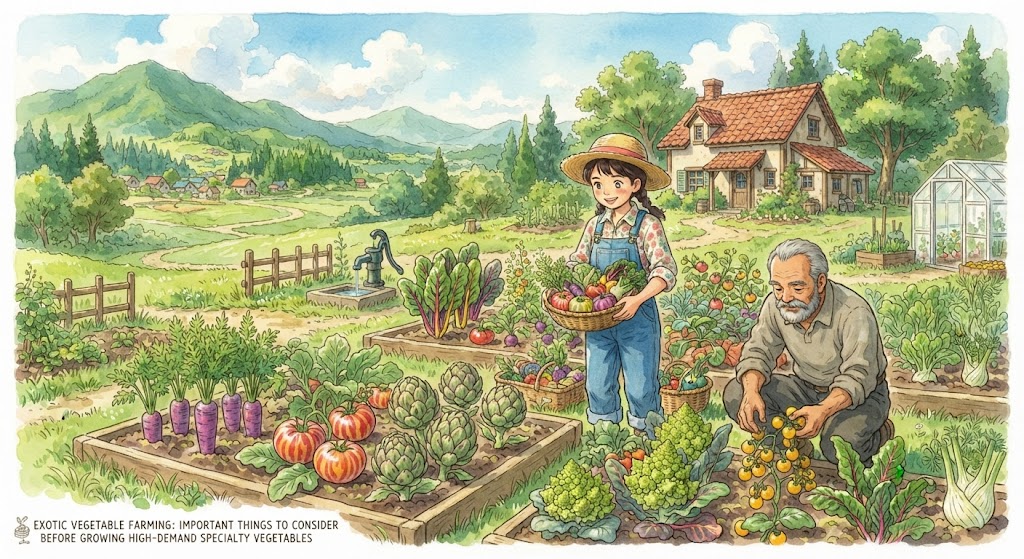
I’ll never forget my fifth year in the dirt. I was scrolling through social media one evening and saw a high-end chef in a big city paying an absolute premium for fresh cucamelons and purple asparagus. My eyes lit up with dollar signs. I had the land, I had the soil, and I figured growing these exotic, specialty vegetables would be my fast track to early retirement.
I ordered expensive seeds, dedicated a quarter of an acre to these “high-demand” crops, and babied them for months. The crop was stunning. I harvested baskets of beautiful, flawless exotic produce.
And then, I threw almost all of it into the compost pile.
Why? Because the local farmers’ market crowd didn’t know what a cucamelon was, and the local restaurants weren’t willing to change their seasonal menus just to accommodate my harvest. I grew a premium product without securing a premium pipeline.
Farming exotic vegetables is one of the most exciting and potentially lucrative ways to run a farm. The profit margins on a pound of baby ginger, Romanesco broccoli, or specialty mushrooms can completely dwarf the margins on a pound of standard potatoes. But the risks are equally massive.
If you are thinking about dedicating your acreage and your sweat to high-demand specialty crops, you need to look past the hype. Before you buy a single expensive seed, here is the veteran’s blueprint for evaluating if an exotic crop will actually make you money, or just break your heart.
1. The “Instagram vs. Reality” Market Check
The single biggest trap in specialty farming is confusing global internet demand with local market reality. Just because a vegetable is trending in Michelin-star restaurants in London or New York does not mean the diner down the street from your farm wants to eat it.
The Pre-Planting Gauntlet: Never grow an exotic crop on speculation. You must practice what I call “Reverse Farming.”
- Secure the Chef First: Don’t grow the crop and then go door-to-door trying to sell it. Go to the chefs in the winter. Show them a seed catalog. Ask them, “If I can grow 50 pounds of organic purple sprouting broccoli by October, what price would you pay for it?” Get a handshake agreement before the seed goes in the dirt.
- Assess the Shelf Life: Exotic vegetables are notoriously delicate. Standard carrots can sit in a root cellar for months. Squash blossoms or micro-herbs will wilt and become completely unsellable in 48 hours. If your buyer isn’t within a tight radius, the logistics of a cold-chain delivery will eat your entire profit margin.
Veteran’s Tip: The faster a crop spoils, the more expensive it is to manage. If you are just starting out with exotics, choose crops that have a long storage life, like specialty hardneck garlic, colored fingerling potatoes, or rare chili peppers.
2. The “Climate Tax” and Infrastructure Demands
By definition, an “exotic” plant is usually one that is not native to your specific agricultural zone. Nature has spent thousands of years adapting local weeds and native crops to survive your local weather. When you introduce a foreign plant, you are fighting nature, and nature always charges a tax.
Understanding the Environmental Barrier: If you want to grow a tropical crop like ginger or turmeric in a temperate climate, you cannot just stick it in a field and hope for the best.
- The Cost of Artificial Environments: You will likely need to build high tunnels, heated greenhouses, or automated shade structures. You must calculate the cost of the plastic, the steel hoops, the heating fuel, and the automated ventilation fans against your projected profits.
- The Pest Unknowns: When you introduce a new plant, you often attract new pests. Your standard crop-scouting routine might not catch an infestation because you don’t know what the pest damage looks like on an exotic leaf.
Before you commit, calculate your infrastructure budget. If a crop requires you to go $15,000 into debt just to build a climate-controlled greenhouse to keep it alive, the financial risk might outweigh the “high-value” reward.
3. The Harvest Bottleneck (Calculating the Sweat Equity)
Let’s talk about the brutal reality of harvesting. When a conventional farmer grows corn or soybeans, they sit in an air-conditioned combine harvester and process acres per hour.
When you grow exotic specialty crops, you are stepping back into the 19th century. High value almost always equals high touch.
The Labor Reality Check:
- Saffron (The Extreme Example): Saffron sells for an astronomical price per ounce. But to get that ounce, you have to hand-pick thousands of tiny crocus flowers at dawn, and then use tweezers to extract three tiny stigmas from each flower. It is agonizing, microscopic labor.
- Baby Vegetables: Chefs love “baby” root vegetables (like baby carrots or thumb-sized beets). But harvesting them requires you to get on your hands and knees, carefully pulling them so you don’t snap the delicate greens, and then painstakingly hand-washing the dirt off them without bruising the skins.
Before you plant, figure out exactly how many hours it will take a human being to harvest and pack 100 pounds of this crop. If you are paying farmhands $15 an hour for meticulous, slow labor, your exotic profit margin will disappear directly into your payroll.
4. The “Education Tax” (Marketing Your Harvest)
If you grow red tomatoes, you don’t have to explain to a customer what a tomato is, how it tastes, or how to cook it. The product sells itself.
When you grow Romanesco (a fractal, alien-looking brassica) or Bitter Melon, your job is no longer just farming. You are now a full-time culinary educator.
Becoming the Marketer: If you plan to sell at a farmers’ market, be prepared for 90% of the people to walk past your booth because they are intimidated by produce they don’t recognize.
- Free Samples and Recipe Cards: You cannot just stack exotic vegetables on a table. You must print out beautiful recipe cards showing the customer exactly how to cook the vegetable. You often have to cook samples and let them taste it.
- The Hustle: You are not just selling a vegetable; you are selling culinary confidence. If you hate talking to people and just want to work quietly in your fields, do not grow highly unusual consumer crops. Stick to wholesale or standard staples.
The Exotic Crop Viability Test
To keep myself grounded, I now run every “great new crop idea” through a strict viability matrix. If it fails more than two of these checks, I refuse to plant it on a commercial scale.
| The Viability Question | Red Flag (Do Not Plant) | Green Light (Safe to Plant) |
|---|---|---|
| Market Demand | “I saw it on a cooking show.” | “Three local chefs signed a pre-order.” |
| Climate Match | Requires a fully heated, expensive greenhouse all winter. | Grows naturally in my zone with minimal row covers. |
| Labor Cost | Requires 100% slow, meticulous hand-harvesting. | Can be harvested efficiently with hand-tools or simple machinery. |
| Customer Education | Customers have never seen or heard of it. | It is a unique, colorful twist on a familiar vegetable (e.g., Purple Carrots). |
| Shelf Life | Wilts or rots within 48 hours of harvest. | Can be cold-stored, dried, or cured for weeks/months. |
The Golden Rule: The 90/10 Split
Farming is fundamentally an exercise in risk management. Exotic vegetables are high-risk, high-reward gambles.
My best advice after a decade in this business is to adopt the 90/10 Rule.
Dedicate 90% of your farm’s acreage to proven, reliable, and slightly boring staple crops. Grow the standard garlic, the reliable salad greens, and the hearty root vegetables. These are your mortgage payers. They keep the lights on and the tractor fueled.
Then, take the remaining 10% of your land and turn it into your exotic playground. Plant the cucamelons. Try the rare ginger. See if you can force a crop of specialty mushrooms. If the 10% experiment fails completely, your farm still survives. But if that 10% succeeds, and you figure out the climate, the labor, and the market, you can confidently expand it to 20% next year.
Exotic farming can absolutely elevate your agricultural business, but only if you treat it like a business. Do the math, secure your buyers, start small, and let your spreadsheet—not your enthusiasm—dictate what you put in the soil.