If you had walked onto my property during my second year of farming, you would have seen a very straightforward, very flawed operation. I grew vegetables on five acres, and that was it.
When harvest ended, I had mountains of leftover stalks, vines, and crop residue. I spent money on diesel to run a tractor to till it all under or haul it away. A few months later, I spent thousands of dollars buying synthetic fertilizer to put nitrogen back into the exact same soil. I was operating in a straight line: buy inputs, grow the crop, sell the crop, throw away the waste.
It was exhausting, and my profit margins were razor-thin.
Everything changed when I stopped looking at my farm as a single factory and started looking at it as an ecosystem. I discovered Integrated Farming Systems (IFS).
The core philosophy of integrated farming is beautifully simple: The waste of one agricultural activity must become the free food or fertilizer for another.
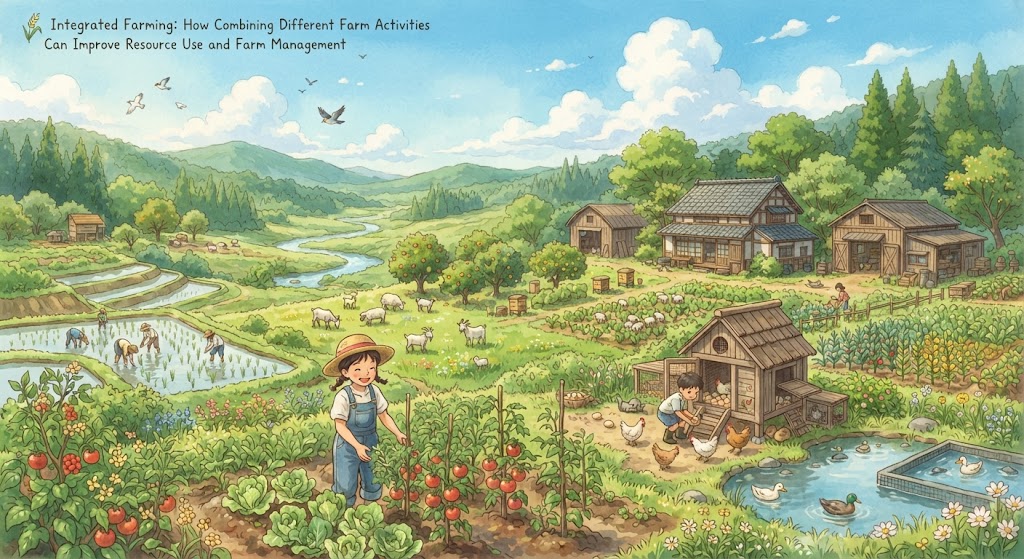
Over the last ten years, transitioning to an integrated system fundamentally changed my workload and my bank account. Whether you are running a small homestead or scaling up a commercial smart farming operation, combining crops, livestock management, and alternative agriculture creates a “closed-loop” system that practically runs itself. Here is exactly how you can build it.
Pillar 1: The Crop and Livestock Connection
This is the classic, foundational pairing of integrated agriculture. If you grow crops and don’t have animals, you are wasting free feed. If you have animals and don’t grow crops, you are wasting free fertilizer.
The Traditional Flaw:
Farmers who only run livestock spend up to 70% of their operating budget buying commercial feed. Farmers who only grow crops spend massive amounts of their budget buying nitrogen fertilizer.
The Integrated Solution:
I brought a small herd of goats and cattle onto the property.
- The Upward Flow: After I harvest my sweet corn, I don’t pay to haul the stalks away. I turn the cattle into the harvested field using portable electric fencing (a staple of modern livestock management). The animals happily eat the leftover crop residue, converting what I saw as “waste” into premium meat and milk.
- The Downward Flow: As the animals graze, they drop manure. That manure is instantly trampled into the soil by their hooves. I don’t have to buy synthetic nitrogen for that field the following spring because the cows just fertilized it for free.
By connecting the two, I slashed my animal feed bill and completely eliminated my synthetic fertilizer bill.
Pillar 2: The Poultry and Aquaculture Stack
If you want to see extreme efficiency, you have to stack your farm vertically. About five years ago, I dug a half-acre pond at the lowest point of my property. I didn’t just want to raise fish; I wanted the fish to help run the rest of the farm.
The Integrated Solution:
I built a chicken coop directly over the edge of the pond with a slatted floor.
- The Feed Loop: The chickens are fed a standard diet, but as they roost over the water, their nutrient-rich droppings fall directly into the pond. This isn’t pollution; it is precise fertilization. The droppings trigger a massive bloom of phytoplankton and zooplankton in the water.
- The Fish Loop: The fish (tilapia and carp) eat the plankton. I don’t have to buy expensive commercial fish pellets because the chickens are indirectly feeding the fish.
- The Final Crop Loop: When the brutal summer heat hits and my vegetable fields need irrigation, I don’t pump freezing, sterile water from a deep well. I use a smart irrigation pump to pull water directly from the fish pond. That pond water is basically “liquid gold”—it is packed with diluted nitrogen and phosphorus from the fish emulsion. It acts as a free, continuous organic fertilizer for my cash crops.
This three-way loop (Poultry → Fish → Crops) turns a single input (chicken feed) into three separate revenue streams (eggs, fish, and vegetables).
To visualize exactly how these nutrients bounce around the farm rather than leaving it, I use a flow model. Play with this interactive system below to see how a closed loop saves you money.
Pillar 3: Agroforestry (Farming in 3D)
Most farmers look at their land in two dimensions: length and width. If a field is full of lettuce, they think the field is “full.” But integrated farming looks at the third dimension: height.
The Integrated Solution:
I stopped clearing every single tree off my land. Instead, I practice alley cropping. I plant rows of high-value timber trees (like black walnut or oak) or fruit trees spaced 40 feet apart.
- The Windbreak Effect: These trees act as a massive physical barrier against harsh winds, preventing my topsoil from blowing away and protecting delicate vegetable crops from wind-burn.
- The Micro-Climate: During the blistering heat of July, the tall canopy of the trees casts a moving shadow across the fields. This mild, intermittent shade lowers the soil temperature by a few degrees, preventing my cool-weather crops from bolting (going to seed prematurely).
- The Long Game: While I harvest vegetables every 60 days, those timber trees are quietly growing in the background. In twenty years, when I am ready to retire, that timber will serve as a massive, passive retirement fund that required almost zero daily management.
The Ultimate Benefit: Risk Mitigation
When farmers talk about integrated systems, they usually focus on the money saved on fertilizer and feed. But after a decade in this business, I can tell you that the greatest benefit is mental peace and financial armor.
If you only grow tomatoes, and a late blight wipes out your tomatoes, you lose 100% of your income for the year. That is a terrifying way to live.
When you run an integrated farm, you have built-in insurance.
- If a freak hailstorm shreds the vegetable leaves, the vegetables can still be chopped up and fed to the cows.
- If the price of beef crashes at the market, your poultry and aquaculture operations can carry the financial weight for the quarter.
- If a drought limits your crop yield, your deep-rooted fruit trees will still produce.
Farming will always be unpredictable. You cannot control the rain, and you cannot control the commodity markets. But by weaving different agricultural activities together, you create a safety net so tightly knit that a single failure can never take down the whole farm.
Final Thoughts from the Field
Transitioning to integrated farming can feel overwhelming. Don’t try to build a fish pond, buy a herd of cattle, and plant an orchard all in the same weekend.
Start with one connection. If you have crops, buy five chickens. Let them run in the harvested rows to eat the bugs and leave their manure. Watch how the soil responds. Once you see the biological magic of a closed loop, you will naturally start looking for the next piece of the puzzle. The goal isn’t to work harder; the goal is to let nature do the heavy lifting.