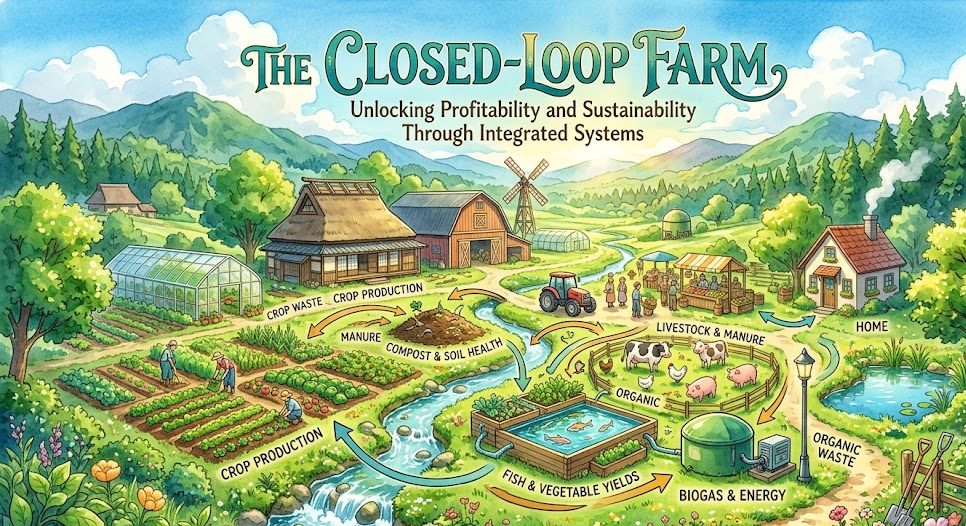
In the traditional industrial model of agriculture, a farm is often viewed as a linear assembly line: inputs (fertilizers, pesticides, fuel) go in, and outputs (harvested crops) come out. The waste—manure, crop residue, and water runoff—is treated as a liability to be disposed of. But what if we could flip this model entirely? What if the farm functioned more like a natural ecosystem, where the waste of one process becomes the fuel for another?
This is the promise of the Closed-Loop Farm. It is an integrated system designed to maximize resource efficiency, slash input costs, and create multiple, overlapping revenue streams. In an era where sustainability is becoming as important as profitability, the closed-loop approach is the ultimate blueprint for the modern, resilient farm.
The Philosophy of “Waste-as-a-Resource”
A closed-loop farm operates on a simple principle: Everything has value. In nature, there is no such thing as “waste.” A leaf that falls in the forest provides nutrients for the soil, which feeds the tree, which grows more leaves. The closed-loop farm mimics this cycle.
By integrating livestock, crop production, and energy generation into a single interconnected system, a farmer can drastically reduce their reliance on expensive, external inputs. Instead of buying chemical nitrogen, you source it from composted manure. Instead of paying for electricity, you generate it from anaerobic digesters fueled by farm waste. This is not just environmental stewardship; it is pure, bottom-line business sense.
Building the Integrated Infrastructure
To create a truly closed-loop system, you need to connect the dots between your farm’s different components. Here are the pillars of an integrated farm:
1. The Nutrient Cycle: Livestock and Crops
The most basic loop is the integration of animals into your cropping system. Livestock—whether poultry, goats, or cattle—produce manure, which is an invaluable source of organic matter and nitrogen.
- The System: Instead of paying for synthetic fertilizer, you process livestock waste through a composting system. This high-quality organic matter improves soil structure and water retention, which in turn leads to healthier crops and higher yields.
- The Return: Healthy soil requires fewer pesticides, saving even more money and increasing the market value of your produce as “sustainably grown.”
2. Water Stewardship: Harvesting and Recirculation
Water is the lifeblood of the farm, yet it is often wasted through evaporation and runoff. A closed-loop farm prioritizes water retention.
- Aquaponics: One of the most sophisticated examples of a closed loop is aquaponics, where fish waste provides nutrients for hydroponic plants, and the plants act as a natural filter to clean the water for the fish.
- Rainwater Harvesting: By capturing and storing runoff from roofs and fields, you can reduce reliance on groundwater extraction, ensuring a stable water supply even during dry spells.
3. Energy Generation: From Waste to Power
Perhaps the most transformative element of the closed-loop farm is the implementation of an Anaerobic Digester.
- The Process: You feed animal manure and food processing waste into an airtight tank (digester). Bacteria break down the material, producing biogas (methane).
- The Benefit: This gas can be burned to generate electricity to power your farm’s pumps, lights, and processing equipment. The byproduct—digestate—is an even more potent, easy-to-absorb fertilizer than raw manure. You are essentially turning “trash” into both power and fuel for your crops.
The Economic Upside: Why It Pays
It is a common misconception that “sustainable” means “expensive.” In reality, a closed-loop system is designed to minimize ongoing operational costs.
- Lower Input Costs: By producing your own fertilizers, energy, and soil amendments, you insulate yourself from the volatile prices of the global commodity market. When the price of chemical fertilizer spikes, your profit margin stays intact.
- Diversified Revenue Streams: A closed-loop farm rarely relies on a single product. You aren’t just selling corn or wheat; you might be selling organic vegetables, high-quality meat, compost, and surplus electricity. This diversification acts as a hedge against market crashes in any single sector.
- Premium Market Positioning: Consumers are increasingly willing to pay a premium for food that is produced with a light carbon footprint. A farm that can demonstrate a circular, zero-waste process has a powerful story that resonates with high-end grocery buyers and direct-to-consumer markets.
Challenges of the Transition
Building a closed-loop system is not an overnight task. It requires a shift in mindset and careful planning.
- Complexity: Managing an integrated system—where the timing of livestock manure production must align with the fertilization needs of the crops—requires better record-keeping and management skills.
- Upfront Investment: Technologies like anaerobic digesters or advanced hydroponic systems require initial capital. The key is to start small: begin by composting manure effectively, then move to integrating irrigation cycles, and finally, look into energy generation.
- Integration Planning: You cannot just add a component; you must design for connectivity. Every addition to the farm should solve a problem elsewhere in the system.
The Vision: The Farm as a Self-Sustaining Ecosystem
The vision of the closed-loop farm is a future where the farm functions as a self-sustaining ecosystem. The sun shines, the crops grow, the animals graze, the waste is recycled into energy and fertility, and the cycle repeats—more efficiently, and more profitably, with every passing season.
This model is the antidote to the instability of modern industrial agriculture. It empowers the farmer to take control of their resources, reducing the reliance on third-party suppliers and building a business that is resilient against climate change and market shocks.
The transition to a closed-loop system is a journey of becoming an Agri-Ecosystem Architect. It requires patience and a willingness to learn, but the rewards are profound: a farm that is not just profitable today, but fertile and productive for decades to come. The question is not whether we can afford to integrate our systems, but whether, in the face of rising costs and environmental challenges, we can afford not to.