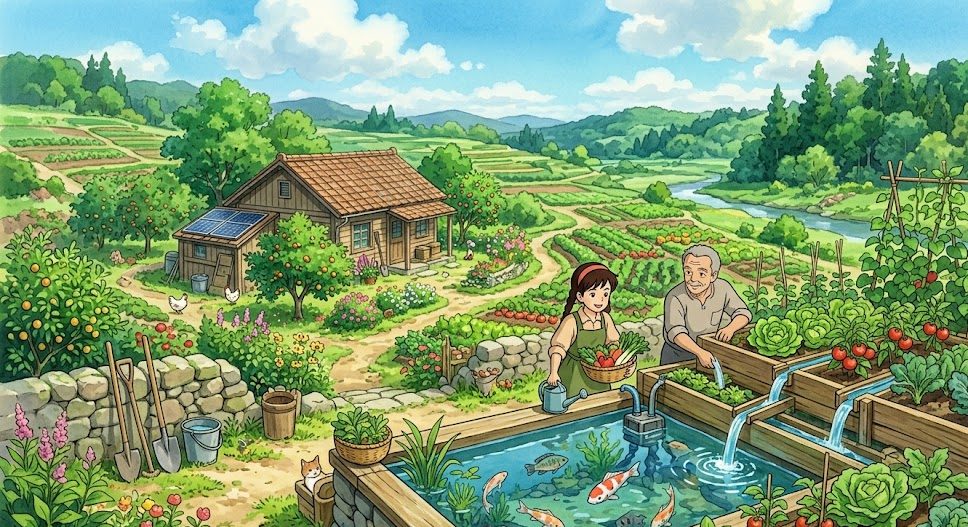
In an era where resource scarcity and climate instability are top of mind for every farmer, the concept of “waste” is increasingly being viewed as a design flaw. Traditional agriculture often treats inputs—water, fertilizer, and land—as linear commodities: you use them, they disappear, and you pay to replenish them.
But what if your farm functioned like a forest? In nature, there is no trash; the output of one organism is the input for another. This is the philosophy behind Zero-Waste Integrated Farming, specifically the integration of fish farming (aquaculture) and vegetable gardening (hydroponics), commonly known as aquaponics.
By closing the loop, you can turn a system that is usually resource-intensive into a self-sustaining powerhouse that produces two distinct, high-value harvests with a fraction of the waste.
The Architecture of a Closed-Loop System
At its core, a zero-waste integrated system is a circular bio-filter. Here is how the “waste” becomes “wealth”:
- The Input (Fish Feed): You provide high-quality feed to your fish. This is the only major input required.
- The “Waste” (Ammonia): As fish digest their food, they excrete waste rich in ammonia. In a standard pond, this ammonia would build up and become toxic to the fish.
- The Bio-Filter (Nature’s Cleanup Crew): You divert this water through a media bed filled with expanded clay or gravel. This bed acts as a home for beneficial bacteria. These bacteria are the unsung heroes of the farm—they convert toxic ammonia into nitrites, and finally into nitrates.
- The Harvest (Nitrate-Rich Nutrition): Plants absorb these nitrates as their primary food source. They grow faster and more robustly than their soil-grown counterparts because the nutrients are delivered directly to their roots in a bioavailable form.
- The Return (Clean Water): By the time the water filters through the plant bed and returns to the fish tank, it is purified and oxygenated, ready to sustain the fish once again.
Why “Zero-Waste” is Your Competitive Advantage
For a small-scale farmer, every dollar spent on inputs is a dollar cut from your margin. Integrated farming attacks these costs from every angle:
1. Fertilizer Elimination
Synthetic fertilizers are expensive and volatile in price. In an integrated system, your fish effectively “manufacture” your fertilizer 24/7. Your cost of nutrients drops to near zero, as it is a direct byproduct of feeding your fish.
2. Radical Water Conservation
Conventional field farming loses massive amounts of water to evaporation and runoff. Because an integrated system is a closed loop, you are only replacing the small amount of water that the plants transpire or that is lost to evaporation. This allows you to farm in environments where water is limited or highly regulated.
3. Synergy in Pest Management
The natural health of an aquaponic system is superior. Because you cannot use harsh chemical pesticides (as they would harm the fish), you are forced to adopt Integrated Pest Management (IPM) strategies—like using neem oil, beneficial insects, or physical barriers. The result? A cleaner, safer product that attracts the growing “organic” and “all-natural” market segment.
Building Your Integrated Ecosystem: Practical Steps
You don’t need to be an engineer to get started, but you do need to be meticulous about the design.
- Start with the Fish-to-Plant Ratio: A common mistake is having too many fish for the amount of plants, or vice versa. For beginners, a safe starting point is roughly 1 pound of fish for every 5–10 gallons of water, and a grow bed area that is about 1:1 or 2:1 compared to the tank volume.
- Select Compatible Species: Tilapia remain the king of beginners’ aquaculture due to their tolerance for varying water conditions. Pair them with “heavy feeders”—leafy greens like arugula, lettuce, and basil. Once you graduate to fruiting crops like tomatoes or cucumbers, you will need a higher fish density to provide the extra potassium and phosphorus they crave.
- Energy Management: The system relies on constant water flow. To ensure your “zero-waste” farm doesn’t fail during a power outage, invest in a simple backup battery system or a gravity-fed design that can function for a few hours without pumps.
Diversifying Your Revenue Streams
A zero-waste farm isn’t just about efficiency; it’s about business resilience. By producing two different product lines, you insulate yourself from market swings.
- The Bundle Offer: Sell “Farm-to-Table” kits. A customer walks away with a head of organic lettuce and a fresh, sustainable fillet of fish. This is a unique offering that supermarket chains cannot match.
- The “Zero-Waste” Brand: Use the story of your system in your marketing. People want to support farmers who are actively working to save water and avoid chemicals. Your story is a marketing asset that can command premium pricing.
- Byproduct Sales: Even the “waste” can be monetized. If you ever need to clean out your system, the sludge left at the bottom of the tank is essentially “liquid gold” for soil-based gardeners. Bottle it and sell it as premium organic liquid fertilizer.
The Mindset of a Modern Steward
Transitioning to integrated, zero-waste farming requires a shift in perspective. You are no longer just a “farmer”; you are an ecosystem manager. Your success depends on your ability to observe the balance of the system.
If the plants look yellow, the fish might need more food. If the water is cloudy, the bacteria colony might need more surface area in the grow bed. This constant feedback loop makes you a better, more observant grower.
It is a challenging journey, but one that leads to true independence. When you master the art of combining fish and vegetables, you stop being dependent on expensive, imported inputs and start relying on the elegant, circular wisdom of nature itself.
In a world of finite resources, this is the most secure way to farm. It is efficient, it is profitable, and most importantly, it is a model that can be sustained for generations to come.