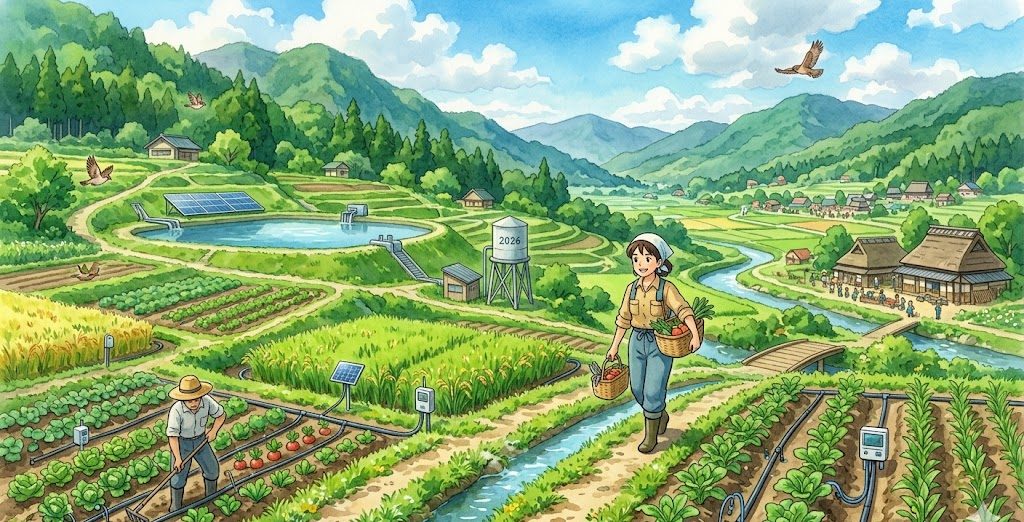
As we navigate through 2026, the agricultural sector faces a historic crossroads. With the global population continuing to climb and climate patterns becoming increasingly erratic, the “old ways” of water management are no longer just inefficient—they are unsustainable. Agriculture currently accounts for approximately 70% of global freshwater withdrawals. To ensure food security without exhausting our planet’s most precious resource, we must transition to Smart Irrigation.
This guide explores the cutting-edge techniques and technologies defining the landscape of water-saving farming this year.
1. The Precision Revolution: IoT and Sensor-Based Irrigation
The era of “guessing” when to water is over. In 2026, smart farming is driven by data.
- Soil Moisture Sensors: These devices are buried at root level to provide real-time data on volumetric water content. Instead of watering on a fixed schedule, farmers only trigger systems when the soil hits a specific “refill point.”
- IoT Integration: Using LoRaWAN or 5G networks, these sensors communicate directly with automated pump stations. If the sensor detects sufficient moisture from a recent light rain, it automatically cancels the next scheduled irrigation cycle, saving thousands of gallons of water in a single day.
- Evapotranspiration (ET) Controllers: Often called “weather-based” controllers, these systems use local weather data (humidity, temperature, solar radiation, and wind speed) to calculate exactly how much water the plants have lost and need to replace.
2. Advanced Drip and Micro-Irrigation Systems
While drip irrigation isn’t new, the 2026 iterations are far more sophisticated than their predecessors.
- Subsurface Drip Irrigation (SDI): By burying drip lines 6 to 12 inches below the surface, water is delivered directly to the root zone. This almost entirely eliminates evaporation and surface runoff. It also keeps the topsoil dry, which naturally reduces weed growth and the need for herbicides.
- Pressure-Compensating Emitters: Modern emitters ensure that every plant, whether at the top of a hill or the bottom of a valley, receives the exact same amount of water, preventing the “over-watering” of low-lying areas.
3. AI-Driven Predictive Analytics
Artificial Intelligence has become the “brain” of the modern farm. By analyzing historical weather patterns, satellite imagery, and crop health data, AI models can predict water needs up to two weeks in advance.
The 2026 Advantage: AI can now distinguish between a plant that is thirsty and a plant that is suffering from disease, preventing farmers from accidentally over-watering a sick crop, which would only worsen root rot.
4. Alternative Water Sources and Circularity
Sustainability isn’t just about using less water; it’s about using the right water.
| Technique | Description | Benefit |
|---|---|---|
| Tailwater Recovery | Capturing irrigation runoff in ponds to be filtered and reused. | Reduces fertilizer runoff into local rivers. |
| Treated Wastewater | Using ultra-filtered municipal “gray water” for non-edible or processed crops. | Reduces demand on clean aquifers. |
| Atmospheric Water Generation | Using solar-powered fans to pull moisture from the air in humid regions. | Provides a decentralized water source for remote fields. |
Export to Sheets
5. Nature-Based Solutions: Improving Soil “Sponge” Capacity
Technology is only half the battle. To save water, we must improve the soil’s ability to hold it.
- Regenerative Practices: Techniques like No-Till farming and Cover Cropping increase organic matter. For every 1% increase in soil organic matter, an acre of land can hold an additional 20,000 gallons of water.
- Hydrogels and Biochar: In arid regions, farmers are mixing biochar (stablized carbon) into the soil. It acts like a microscopic sponge, holding onto water molecules and releasing them slowly as the plant needs them.
6. Drone-Assisted Water Stress Mapping
In 2026, multi-spectral cameras mounted on drones are standard equipment. These cameras “see” in infrared, allowing them to detect water stress in plants long before the human eye sees a wilted leaf. By identifying specific “hot spots” in a 500-acre field, a farmer can apply water only to those stressed patches rather than soaking the entire area.
7. The Math of Sustainability: Efficiency Equations
To truly understand the impact of these technologies, we look at Water Use Efficiency (WUE). The goal of 2026 farming is to maximize the ratio of “Crop Yield” to “Water Applied.”
The general formula for Irrigation Efficiency (Ei) is expressed as:
Ei(%)=(WfWb)×100
Where:
- Wb = Water beneficially used by the crop.
- Wf = Total water delivered to the field.
Traditional flood irrigation often has an Ei of only 40-50%, whereas modern smart systems are pushing toward 95%.
8. Economic and Policy Drivers
The shift toward smart irrigation in 2026 is also fueled by economic necessity.
- Carbon and Water Credits: Farmers who demonstrate significant water savings can now trade “water credits” to industrial users, creating a new revenue stream.
- Smart Subsidies: Governments are moving away from flat agricultural subsidies and toward performance-based incentives that reward the installation of IoT-enabled hardware.
Conclusion
Sustainable irrigation in 2026 is a symphony of high-tech hardware, intelligent software, and ancient ecological wisdom. By treating water as a finite, high-value asset rather than a cheap commodity, modern farmers are proving that we can grow more food with less water. The transition to smart water-saving techniques isn’t just a trend—it’s the only way forward for a planet in flux.
The future of farming isn’t just green; it’s smart.