For small-scale farmers holding less than two to three acres of land, relying entirely on a single traditional crop is a high-stakes gamble. If the monsoon fails, market prices crash, or a specific pest attacks the field, an entire year’s livelihood can vanish overnight. Monoculture—growing just one crop—constantly keeps small landowners on the edge of financial vulnerability.
To break free from this cycle, smart agriculture is shifting back to a modernized version of an ancient practice: Integrated Farming Systems (IFS).
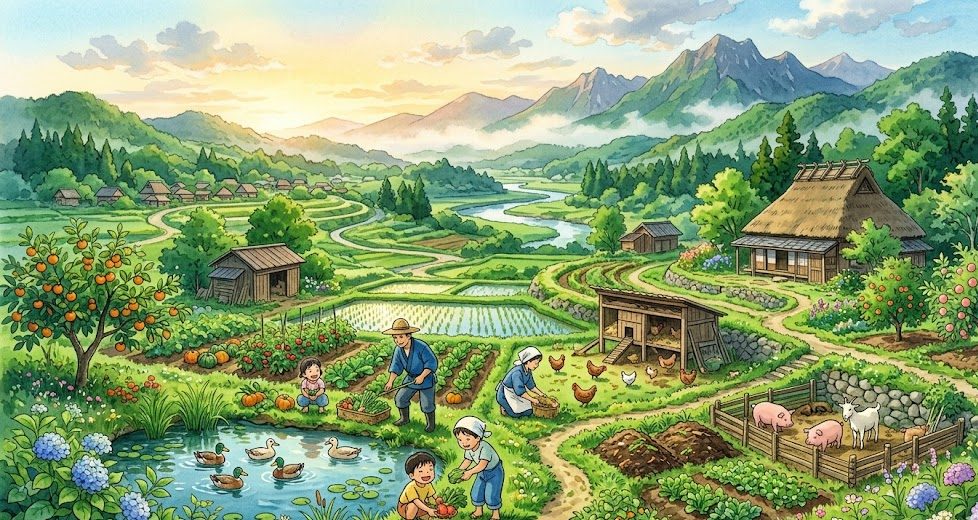
Integrated farming is a holistic resource management strategy where different agricultural sectors—such as crop cultivation, livestock, poultry, aquaculture, and bee-keeping—are combined systematically on the same piece of land. The core philosophy is simple: The waste product of one process becomes the nutrient input for another.
By eliminating waste and maximizing internal resource sharing, integrated farming allows small farmers to exponentially increase their income with minimal external investment. Here is a deep dive into how this ecosystem works and why it is the ultimate financial shield for small-scale agriculture.
1. The Zero-Waste Ecosystem: How IFS Slashes Input Costs
The biggest drain on a small farmer’s bank account is the recurring cost of commercial inputs: synthetic chemical fertilizers, chemical pesticides, animal feed, and fuel. Integrated farming targets and dismantles these exact expenses.
In a well-designed integrated system, the components feed into each other in a closed loop:
- Livestock to Crop: Cattle manure, goat droppings, and poultry litter are processed into rich organic compost or liquid bio-fertilizers (like Jeevamrutha). This completely replaces the need to purchase expensive chemical NPK fertilizers, restoring natural soil health for free.
- Crop to Livestock: Crop residues, husk, and damaged grains—which are usually burned or discarded—are repurposed as highly nutritious fodder for cows, goats, and poultry.
- Biogas Integration: Animal dung can be fed into a small-scale biogas digester. This produces clean cooking gas for the household and a highly concentrated nutrient slurry that serves as a premium liquid fertilizer for the fields.
By utilizing these internal loops, a farmer’s out-of-pocket investment drops to near zero, automatically widening profit margins.
2. Multi-Layer Income Streams: Squeezing Profits from Every Inch
When a farmer only grows rice or wheat, they get paid once or twice a year. This creates massive cash-flow issues. Integrated farming introduces multiple concurrent income models on the same plot of land, ensuring a steady stream of daily, weekly, and seasonal revenue.
The Multi-Tier Agricultural Matrix:
- Daily Income: Produced by selling fresh milk from dairy cattle or eggs from a backyard poultry unit. This covers the family’s daily operational expenses without forcing them into debt.
- Weekly/Bi-Weekly Income: Generated by growing fast-cycling, high-value vegetables, mushrooms, or fresh fish from a small farm pond.
- Seasonal Income: Achieved from the primary cash crops (grains, pulses, or oilseeds) harvested at the end of the traditional cropping cycle.
- Long-Term Assets: Raising goats, sheep, or planting timber/horticulture trees along field boundaries acts as a biological savings account that can be liquidated for major family events or emergency expenses.
3. High-Yield Synergy: Real-World Integrated Combinations
To make the system work with low investment, farmers must choose components that naturally complement each other. Here are the most successful, low-cost integrated combinations used globally:
A. Rice-Fish-Duck Farming
In this brilliant setup, a low-land rice field is slightly modified with a small trench to hold water. Fish fingerlings and ducklings are introduced directly into the standing water of the paddy field.
- The Synergy: Ducks and fish eat harmful insects, stem-borers, and weeds that attack rice plants, completely eliminating the need for chemical pesticides.
- The Result: As they swim, their droppings naturally fertilize the water, boosting rice yields by up to 15% while giving the farmer two high-value bonus harvests: organic fish and duck eggs.
B. Agroforestry and Goat Rearing
Planting nitrogen-fixing trees (like Sesbania or Subabul) along field borders provides a permanent structural windbreak that protects main crops from soil erosion. The leaves of these trees serve as premium, high-protein green fodder for goats, reducing commercial feed expenses down to zero.
Integrated vs. Traditional Farming: A Financial Comparison
To visualize how integrated farming fundamentally restructures a farm’s economics, consider this baseline comparison for a 1-acre plot:
| Operational Metric | Traditional Monoculture Farm | Integrated Farming System (IFS) |
| Primary Risk Factor | Extremely High (Crop failure = Total ruin) | Very Low (Diversified across 3–4 sectors) |
| External Input Costs | High (Heavy spending on chemical NPK & seeds) | Very Low (Utilizes farm-generated waste) |
| Cash Flow Frequency | 1 to 2 times per year (Post-harvest) | Daily, weekly, and seasonal income intervals |
| Soil Health Lifecycle | Degrades over time due to chemical reliance | Regenerates continuously via organic inputs |
| Net Profit Potential | Standard / Fixed by market wholesale rates | Doubled or Tripled via multi-commodity sales |
4. Climate Resilience and Risk Mitigation
Climate change is bringing erratic weather, unseasonal rains, and prolonged heatwaves. If a heatwave destroys a traditional farmer’s vegetable patches, they lose everything.
In an integrated farm, if the weather severely impacts the crop yield, the livestock unit, the poultry shelter, or the honey bee hives continue to produce. The structural diversity of an integrated farm creates a micro-climate that buffers the land against extreme weather shocks, making the entire ecosystem highly resilient.
Conclusion: The Path to Sustainable Prosperity
Doubling a small farmer’s income doesn’t require purchasing massive, expensive tractors or high-end automated machinery. It requires a smarter, systemic approach to resource management.
Integrated farming proves that small acreage is not an economic limitation; it is an efficiency opportunity. By converting waste into wealth, minimizing reliance on corporate chemical supplies, and diversifying into livestock and short-cycle crops, small-scale farmers can establish a highly profitable, self-sustaining business. The future of secure, high-margin farming lies not in expanding land boundaries, but in deepening the harmony between the components within them.