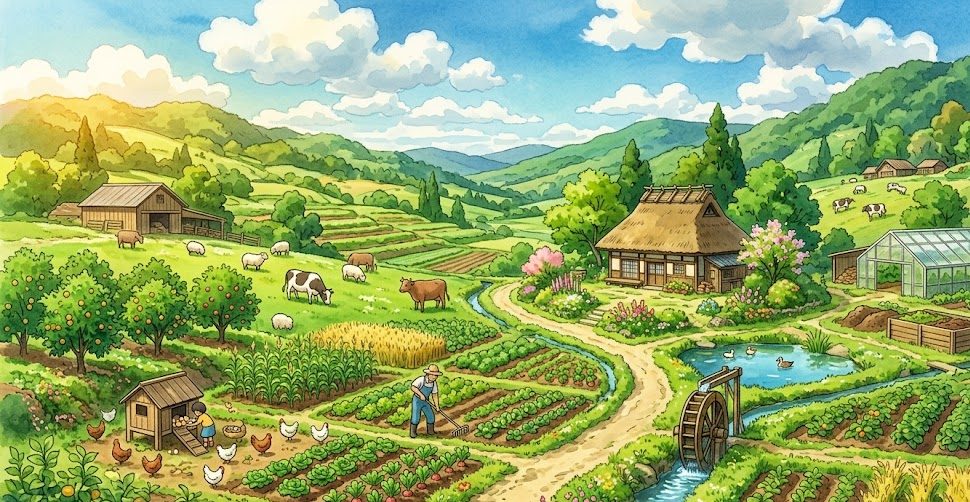
In traditional agriculture, we often think of crops and livestock as two separate businesses. A grain farmer grows corn, and a cattle farmer raises beef. While this specialization has been the hallmark of modern industrial agriculture, it often comes at a high environmental and financial cost. Farmers are forced to buy expensive synthetic fertilizers for their crops and dispose of massive amounts of manure from their livestock as waste.
But what if you could turn that “waste” into your greatest asset? This is the core philosophy of the Integrated Farming Model (IFM). By closing the loop—using the outputs of one system as the inputs for another—you can slash your operating costs, improve soil health, and significantly increase your farm’s overall profitability.
What Is the Integrated Farming Model?
The Integrated Farming Model is a holistic agricultural system where crops, livestock, and other biological components (like aquaculture or beekeeping) are managed together. Instead of working in isolation, these components support each other.
The manure from your poultry or cattle serves as organic fertilizer for your fields, while the crop residues and cover crops provide nutritious feed for your animals. This synergy mimics natural ecosystems, where nothing is wasted and everything has a purpose.
The Synergy of Integration: Why It Works
Integrating crops and livestock is more than just a farm management trend; it is a strategy to achieve resilience and efficiency.
1. Reduced Input Costs
The most immediate benefit of the IFM is the reduction in purchased inputs. When you have a steady supply of livestock manure, your reliance on synthetic fertilizers drops dramatically. Similarly, if your animals graze on your cover crops or harvest residues, your expenditure on commercial animal feed is substantially lower.
2. Improved Soil Health and Structure
Synthetic chemicals often degrade soil biology over time, leading to compaction and nutrient loss. Manure, however, adds vital organic matter back into the soil, improving its water-holding capacity and structure. This creates a more robust environment for your crops, which translates into higher yields.
3. Diversified Revenue Streams
Relying on a single crop is a massive financial risk. If a pest outbreak or a market price crash hits that one crop, your entire year’s income is in danger. In an integrated system, you are selling products from multiple sources—perhaps corn, eggs, meat, and honey. This diversification stabilizes your income and helps you survive market fluctuations.
4 Essential Strategies for Integrating Crops and Livestock
If you are ready to implement an integrated model, you don’t have to overhaul your entire farm overnight. Start with these foundational strategies:
A. Managed Intensive Grazing (MIG)
Move your cattle or sheep through your fields in small, fenced sections. By rotating them, you ensure they graze the grass evenly without killing the roots. The animals deposit manure directly onto the land, distributing fertilizer for you. Once the animals move to the next section, the grass recovers quickly, and your next crop planting will benefit from that rich, localized soil enrichment.
B. The “Chicken Tractor” Method
Poultry are excellent workers. They love to forage for bugs, weed seeds, and dropped grains. By using portable pens (often called “chicken tractors”) on your fields, you can let your chickens do the weeding and pest control for you. They clear the ground, provide nitrogen-rich manure, and produce high-quality eggs—all while you save on labor and pest control costs.
C. Using Crop Residues for Fodder
After the harvest, a traditional farm might burn or discard the corn stalks or wheat straw. In an integrated system, this is high-fiber fodder. By processing these residues into silage or simply allowing livestock to graze the field after the primary harvest, you transform what was once “trash” into healthy, productive animal nutrition.
D. Integration with Aquaculture
If your land has water access, consider an “Aquaponics” or rice-fish farming setup. Fish waste provides nutrients for crops, and the water filtered by the plant roots returns to the fishpond clean and oxygenated. This is one of the most efficient, high-density farming models available.
Overcoming Challenges in Integrated Farming
While the benefits are clear, integration requires a change in mindset and management.
- Complexity: Managing livestock and crops requires a broader skillset. You aren’t just an agronomist; you are also a livestock manager. The best way to overcome this is to start with a “pilot” integration, such as adding a small flock of chickens to your existing vegetable operation.
- Infrastructure Investment: You may need to invest in portable fencing, water systems for animals, or storage for manure. Remember that these are not just expenses; they are investments that will pay for themselves through reduced fertilizer and feed bills within a few seasons.
- Time Management: Integrating systems requires careful scheduling. You must ensure your animals are managed during planting and harvest times to prevent crop damage.
Frequently Asked Questions (FAQs)
Q: Is integrated farming suitable for large commercial farms? A: Yes. Many large-scale farms are returning to integrated models, often referred to as “regenerative agriculture.” It is simply a matter of scaling the rotation and management systems to fit the land size.
Q: Do I need to be certified organic to use this model? A: No, but the IFM is a foundational step if you ever decide to pursue organic certification. It reduces your chemical usage naturally, making the transition much easier.
Q: Which livestock combination is best for a beginner? A: For many, poultry (chickens or ducks) paired with a vegetable plot is the easiest entry point. They are easy to manage, provide daily returns (eggs), and have a relatively small environmental footprint.
Q: Will this model increase my labor requirements? A: Initially, yes. You will need to manage animal movement and waste distribution. However, over time, the system often becomes self-regulating, and the cost savings on inputs often outweigh the increase in labor hours.
Conclusion
The Integrated Farming Model is about returning to the wisdom of the closed-loop system, where the farm acts as a self-sustaining organism. By breaking down the silos between crop and livestock management, you can stop fighting against nature and start working with it.
You will find that your soil grows healthier, your animals remain more productive, and your profit margins improve as you stop spending money on inputs that your farm can produce for itself. If you are looking for a way to build a farm that is not only profitable but also resilient enough to last for generations, integration is the key.
Start small, observe the natural cycles on your land, and begin integrating your systems today. Your land is capable of much more than just a single harvest; it is capable of becoming a vibrant, profitable ecosystem.