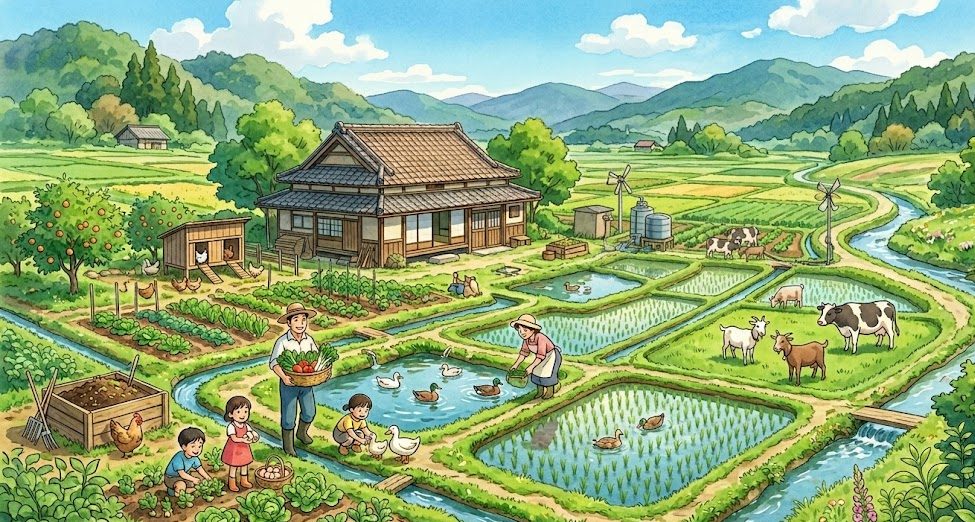
The economics of modern farming can feel like a high-stakes gamble. Traditional farmers who rely entirely on a single crop or livestock variety—known as monoculture—often find themselves at the mercy of unpredictable forces. A sudden shift in market prices, a delayed monsoon, or an aggressive pest outbreak can wipe out an entire year’s income in a matter of days.
As input costs for synthetic chemical fertilizers, diesel, and animal feed continue to climb, a growing number of agricultural entrepreneurs are asking a fundamental question: How can we make our land more profitable without increasing our financial risk?
The most sustainable answer doesn’t come from a chemical laboratory or an expensive piece of machinery. It comes from an ancient ecological strategy updated for the modern world: the Integrated Farming System (IFS).
An Integrated Farming System is a conscious, systematic approach that combines multiple agricultural practices—such as crop cultivation, livestock rearing, aquaculture, agroforestry, and apiculture—on the same piece of land. Instead of managing these components as isolated businesses, an IFS links them together so that the waste product of one enterprise becomes the highly valuable fuel or nutrient for the next.
By eliminating waste and building a circular economy right on your property, you can drastically cut your daily operating expenses while creating multiple, reliable streams of steady income year-round.
The Core Philosophy of Integrated Farming
At its heart, an Integrated Farming System mimics the natural world. In a wild ecosystem, there is no such thing as “waste.” The fallen leaves of a tree feed the soil microbes; the waste of a wild animal fertilizes the grass; birds keep insect populations in check.
When applied to a commercial farm, this interconnected loop fundamentally changes how a business operates.
Instead of buying expensive synthetic nitrogen fertilizers, an IFS farmer uses composted livestock manure to feed their crops. Instead of purchasing 100% of their poultry or fish feed from commercial mills, they grow high-protein cover crops, aquatic weeds, or utilize crop residues to feed their animals.
According to agricultural research data from leading global extension institutes, implementing a well-designed integrated system can increase total farm productivity by over 40% while reducing external dependency on commercial inputs by nearly half. It shifts your operational goals from maximizing the volume of a single crop to maximizing the total economic efficiency of your entire land area.
Popular and Profitable IFS Combinations
An Integrated Farming System is highly adaptable. It can be scaled down to a half-acre homestead or expanded across hundreds of acres. The specific components you choose to link together will depend on your local climate, soil profile, and regional market demands. Below are some of the most successful, proven combinations driving farm profitability today.
1. The Crop-Livestock-Biogas Model
This is the classic backbone of traditional integrated agriculture. In this system, cash crops and fodder are grown to feed dairy cattle, goats, or pigs. The resulting animal manure is not left to sit in a polluting pile; instead, it is funneled into an on-farm biogas digester.
The biogas system produces two incredible outputs:
- Clean Energy: Free methane gas that can be used for household cooking, heating, or running a farm generator to pump water.
- Bio-Slurry: A nutrient-dense, odorless liquid fertilizer that is pumped right back onto the crop fields, completely replacing the need for chemical fertilizers.
2. The Rice-Fish-Duck Ecosystem
Commonly utilized in low-lying, water-abundant regions, this combination turns a standard rice paddy into a highly dynamic, triple-income environment.
Farmers introduce young fingerling fish and ducklings directly into the flooded rice fields. The ducks and fish swim through the rows, eating problematic weeds and destructive insect pests like stem borers. This biological action completely eliminates the need for expensive chemical herbicides and pesticides. Simultaneously, the dropping waste from the ducks and fish acts as a continuous, organic fertilizer for the rice roots, leading to healthier grain development and an additional harvest of premium fish and poultry meat.
3. Agroforestry and Apiculture (Trees and Bees)
Integrating rows of high-value timber, fruit, or nut trees alongside traditional field crops creates a multi-layered canopy. Introducing honey bee hives into this system triggers a powerful symbiotic relationship. The trees provide shade and a diverse mix of seasonal nectar for the bees, while the bees provide intensive pollination services that can boost fruit and crop seed yields by 20% to 30%. The farmer secures steady seasonal income from field crops, sweet cash flow from premium raw honey, and a massive long-term financial payout when the timber matures.
Economic Advantages: Mapping the Input-Output Loop
To understand why integrated systems are so financially resilient, look at how materials circulate within the farm boundaries. What was once an expense item on a balance sheet transforms into an internal, zero-cost transfer.
| Farm Component | What it Gives to the System (Outputs) | What it Takes from the System (Inputs) | Primary Revenue Channel |
|---|---|---|---|
| Field Crops | Straw, bran, and crop residues for animal feed; stalks for composting mulch. | Organic manure from livestock; bio-slurry from biogas units. | Grains, oilseeds, or vegetables sold at market. |
| Dairy / Livestock | Nutrient-rich manure; biogas fuel; slurry fertilizer; draft power. | Crop residues; farm-grown green fodder grasses; fresh water. | Milk, meat, hides, and organic compost sales. |
| Aquaculture (Fish) | Nutrient-dense pond water for crop irrigation; nutrient-rich bottom silt. | Crop processing wastes; insect larvae; aquatic farm weeds. | Fresh fish sold directly to local consumers or restaurants. |
| Apiculture (Bees) | Intensive crop pollination; honey; beeswax; propolis byproducts. | Nectar from cash crops, orchard trees, and flowering cover crops. | Premium raw honey and artisanal wax products. |
Step-by-Step Blueprint to Design Your Integrated Farm
Transitioning your land into an Integrated Farming System requires structured, long-term planning. Trying to introduce five new animal and crop species simultaneously can overwhelm your farm management capabilities. Follow this logical, step-by-step rollout matrix to ensure a smooth transition.
1
Inventory Your Existing Assets and Infrastructure
Resource Assessment
1.Inventory Your Existing Assets and Infrastructure:Resource Assessment.
Analyze your available land, water access, daily solar patterns, and existing structures. Take careful note of your current primary waste products—such as crop residues, empty spaces under orchard trees, or unutilized wastewater streams—that could serve as the foundation for a secondary farm enterprise.
2
Optimize Your Primary Enterprise and Establish Bio-Links
Core Stabilization
2.Optimize Your Primary Enterprise and Establish Bio-Links:Core Stabilization.
Focus on your main source of income first (e.g., your crop fields). Introduce a secondary component that directly benefits it with minimal risk. If you grow crops, set up a small compost or vermiculture (worm composting) unit and introduce a small flock of poultry to process crop waste into immediate fertilizer.
3
Develop Multi-Purpose Water Harvesting Systems
Water Integration
3.Develop Multi-Purpose Water Harvesting Systems:Water Integration.
Dig a farm pond or create a rainwater catchment basin at a naturally low point on your property. Use this water body to launch a small-scale aquaculture system. The nutrient-packed water from your fish pond can eventually be pumped out to irrigate your crop fields during dry spells, delivering pre-fertilized water right to your plants.
4
Introduce Energy Recycling and Advanced Niches
Circular Optimization
4.Introduce Energy Recycling and Advanced Niches:Circular Optimization.
Once your crop, livestock, and water systems are functioning smoothly, seal the loop. Install a biogas digester to process animal manure into clean energy and stable bio-slurry. Introduce honey bee hives or high-value agroforestry trees to maximize vertical space and secure your long-term financial future.
Common Management Pitfalls to Avoid
While the financial rewards of an IFS are exceptional, managing an integrated system requires a higher level of daily observation and planning than standard monoculture farming.
Pitfall 1: Overstocking Livestock Beyond Land Capacity It is easy to assume that if ten cows are profitable, twenty will double your returns. However, if you have more livestock than your crop residues and pasture lands can naturally feed, you will be forced to buy expensive commercial feed from external markets, destroying your closed-loop profit margin. Keep your animal numbers in perfect balance with your land’s carrying capacity.
Pitfall 2: Neglecting Biosecurity and Disease Cross-Contamination Housing multiple animal species in close proximity requires strict hygiene. If poultry housing is built directly over a fish pond without proper ventilation or biological filters, an overload of fresh manure can deplete oxygen levels in the water, causing severe fish kills. Design your system layouts with proper structural buffers and waste-treatment phases.
Pitfall 3: Failing to Schedule Labor Productively Monoculture farmers experience intense labor spikes during planting and harvest seasons, with long periods of downtime in between. An integrated farm requires consistent, steady daily labor year-round to feed animals, monitor fish ponds, manage biogas units, and harvest rotating crops. Ensure your daily operational schedule is structured to prevent burnout.
FAQs: Frequently Asked Questions
1. How does an Integrated Farming System minimize a farmer’s financial risk?
An IFS minimizes risk through diversification. If a severe market drop crashes the price of your primary grain crop, your business remains stable because you are still generating consistent daily or weekly revenue from milk sales, fresh fish, honey, or poultry. Furthermore, because you produce your own fertilizers and feeds internally, your upfront financial investment per season is drastically lower.
2. Can I implement an Integrated Farming System on a very small piece of land?
Yes, absolutely. Small-scale farmers can run highly efficient integrated setups on less than an acre. For example, a micro-farm can successfully combine vertical vegetable gardening with a small flock of backyard chickens and a compact worm-composting system, yielding diverse food and zero-cost fertilizer in a tiny footprint.
3. What is the role of a biogas plant in an integrated farming setup?
A biogas plant acts as the ultimate recycling hub for a crop-livestock system. It takes raw animal dung and breaks it down anaerobically (without oxygen). This process captures clean methane gas for cooking or electricity, while leaving behind an incredibly rich, weed-seed-free bio-slurry that serves as a premium liquid organic fertilizer for field crops.
4. How do fish and ducks help in rice cultivation?
Ducks and fish act as natural, biological field workers. As they move through a flooded rice field, they eat harmful insects, snails, and weed seedlings, saving the farmer hours of manual labor and cutting out chemical costs. Their continuous movement stirs up oxygen in the water, and their organic waste feeds the rice plants directly.
5. Is it difficult to market so many different farm products simultaneously?
While it requires a bit more communication, selling a diverse mix of products actually makes you more attractive to local buyers. Local families, restaurants, and organic food boutiques prefer sourcing their fresh milk, vegetables, eggs, and honey from a single, trusted, hyper-local farm rather than dealing with multiple independent suppliers.
Conclusion
Maximizing your farm’s efficiency and income doesn’t require expanding your borders or purchasing expensive chemical inputs. True agricultural wealth is built by unlocking the hidden value inside your existing acreage through an Integrated Farming System.
By thoughtfully linking crops, livestock, aquaculture, and bio-energy systems together, you transform your property from a collection of independent expenses into a self-sustaining, zero-waste biological engine.
While an integrated system requires careful observation, smart labor planning, and an ecosystem mindset, the long-term rewards are undeniable: drastically lower operating costs, complete resilience against erratic weather patterns, and a predictable, diversified income that secures your financial future. Step by step, close the loops on your land, let nature’s synergies do the heavy lifting, and watch your farm’s efficiency and profitability thrive.