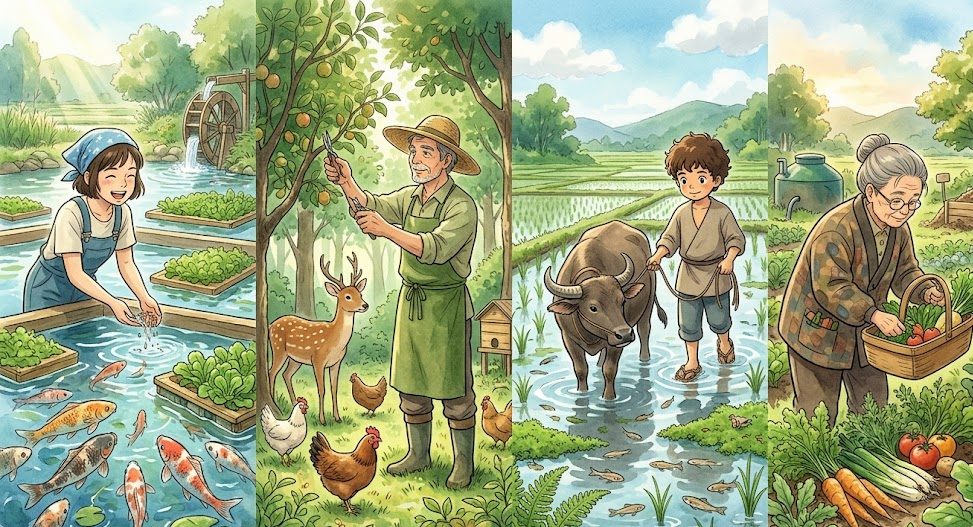
Agriculture is currently facing a silent crisis. Rising costs for synthetic fertilizers, unpredictable climate shifts, and degrading soil health are making traditional farming harder and less profitable every year. Many growers feel trapped in a stressful cycle, spending more money on chemical inputs just to maintain their baseline harvest.
However, a highly effective solution is gaining momentum across the agricultural world. It is called integrated farming. Rather than viewing a farm as a factory that produces a single product, integrated farming treats the land like a living, breathing ecosystem. It is about connecting different agricultural activities so they support each other naturally.
If you want to build a resilient, profitable, and environmentally friendly farm, moving away from single-crop setups is the smartest decision you can make. This guide will walk you through the core principles of integrated farming, offering practical advice to help you transform your agricultural business.
What is Integrated Farming?
At its core, integrated farming is a closed-loop system. In standard agriculture, you buy fertilizer, grow a crop, harvest it, and throw away the waste. In an integrated system, the waste from one part of the farm becomes the essential fuel for another part.
This method combines crop cultivation with livestock, poultry, aquaculture, or even agroforestry. The goal is to mimic natural biological cycles. When elements of a farm are connected correctly, you drastically reduce the need for outside resources. You stop buying expensive feed and fertilizers because your farm produces its own. This not only cuts your operational costs but also creates a highly sustainable environment that heals the soil over time.
The Financial and Environmental Benefits
The primary advantage of integrated farming is risk reduction. When you grow only one crop, a single pest outbreak or a sudden drought can destroy your entire yearly income. By diversifying your farm with multiple interconnected products—like vegetables, eggs, and fish—you create multiple income streams. If the vegetable market drops, your poultry sales can keep the business afloat.
Environmentally, this system is unmatched. Because you are recycling organic waste into compost and feed, you eliminate the toxic runoff that usually pollutes local water sources. Your soil biology improves rapidly, absorbing more carbon from the atmosphere and holding water much more efficiently during dry spells.
Practical Tips You Can Apply Today
You do not need to bulldoze your entire property to start integrating your farm. You can begin shifting your practices immediately with a few practical steps:
- Identify Your Waste Streams: Look at what you currently throw away or burn. If you have vegetable scraps, crop stalks, or weed clippings, realize that this is free energy. Plan how to feed this biomass to livestock or turn it into high-grade compost.
- Stack Your Functions: Every element on your farm should serve at least two purposes. For example, planting a row of fruit trees provides a cash crop, but it also acts as a windbreak to protect delicate vegetables and provides natural shade for grazing animals.
- Introduce Natural Foragers: If you have an orchard, consider running chickens or ducks through the grass beneath the trees. They will eat the fallen, rotting fruit (which breaks pest life cycles), consume harmful insects, and leave behind nitrogen-rich manure.
- Capture Rainwater: Integrated systems thrive on good water management. Set up simple swales or catchment ponds to hold rainwater on your land, which can later be used for irrigation or small-scale aquaculture.
A Real-Life Example: The Crop-Poultry-Fish Loop
To understand how powerful this system can be, consider a mid-sized farm that successfully transitioned to an integrated loop. Originally, this farm only grew row crops and struggled with poor soil fertility and high water bills.
The owner decided to dig a large irrigation pond at the lowest point of the property to catch rainwater runoff. But instead of just holding water, they stocked the pond with local, fast-growing fish. Above the pond, they built a slatted-floor poultry house.
The system worked beautifully. The chickens were fed grain and vegetable scraps from the main fields. The chicken waste dropped directly into the pond, which fertilized the aquatic plant life and algae. This algae became the primary food source for the fish. Finally, when it was time to water the main crops, the farmer pumped the nutrient-dense pond water straight into the vegetable fields.
Without buying a single bag of synthetic fertilizer, the farm produced a high-yield vegetable harvest, fresh eggs, and a seasonal catch of fish. The profitability per acre nearly tripled.
Common Mistakes to Avoid
While the benefits are incredible, the transition to integrated farming requires careful thought. Beginners often make a few predictable errors.
The most common mistake is overcomplicating the system too quickly. It is exciting to think about managing crops, bees, cows, and fish all at once, but doing too much leads to burnout. Managing livestock is vastly different from managing plants. If you stretch your attention too thin, the whole system collapses.
Another frequent error is poor biosecurity. When animals and crops are close together, you must manage manure properly. Applying raw, uncomposted animal waste directly to food crops can spread harmful bacteria and burn plant roots. Always ensure animal waste is properly aged or composted before it touches a vegetable bed.
Finally, never ignore your local climate. A farming loop that works perfectly in a humid, tropical region will fail miserably in a dry, arid zone. Always choose plants and animals that naturally thrive in your specific weather conditions.
Step-by-Step Guide to Starting Your Integrated Farm
Ready to build your own sustainable loop? Follow this simple framework to get started safely and profitably.
Step 1: Audit Your Current Resources Walk your land and take notes. Where does water naturally gather? Which areas get the most sun? What organic waste are you currently producing? Understanding what you already have is the foundation of integration.
Step 2: Choose Two Complementary Elements Start small. Pick just two things that naturally work together. The easiest starting point for most people is combining a vegetable garden with a small flock of laying hens.
Step 3: Design the Loop Plan exactly how the waste from element A will feed element B. For the garden and hens, the loop is simple: weeds and damaged vegetables go to the chickens, and the chicken manure is collected, composted for three months, and put back on the garden beds.
Step 4: Implement and Observe Put your plan into action, but watch it closely. Are the chickens getting enough nutrition from the scraps, or do they need supplemental feed? Is the compost getting hot enough? Adjust your daily routines based on what you observe.
Step 5: Expand Gradually Once your two-element loop is running smoothly and turning a profit, you can add a third element. Perhaps you use the excess compost to start a small orchard, or you introduce bees to pollinate the expanding garden. Grow the system at a pace you can easily manage.
Conclusion
Integrated farming is not just a passing trend; it is a return to agricultural common sense. By viewing your farm as a collaborative ecosystem rather than an industrial factory, you unlock natural efficiencies that chemicals and heavy machinery simply cannot match.
While setting up an interconnected system requires deep thought and careful planning, the long-term rewards are undeniable. You will build healthier soil, spend less money on external inputs, and create a diverse range of products that protect you from market crashes. Start small, observe nature closely, and allow your farm to become the self-sustaining, profitable environment it was always meant to be.
Frequently Asked Questions (FAQs)
Q: Does integrated farming require a massive amount of land? A: Not at all. The principles of integration work on any scale. Even on a quarter-acre plot, you can successfully integrate intensive raised vegetable beds with a small worm farm (vermicompost) and a few backyard chickens to create a highly productive micro-loop.
Q: Is it more labor-intensive than traditional farming? A: In the beginning, setting up the infrastructure (like fencing, ponds, or compost bays) takes effort. However, once the system is established, the labor often decreases. Because the animals and plants are doing the work of fertilizing and pest control for you, you spend less time spraying chemicals and spreading synthetic fertilizers.
Q: Can I transition my existing conventional farm to an integrated system? A: Yes, and it is best done gradually. You do not have to stop your current operations completely. Take a small percentage of your land—perhaps a few acres—and test an integrated method there. Use the profits and lessons from that test plot to slowly transition the rest of your property over several years.
Q: Are the yields lower in this type of farming? A: While the yield of one specific crop might be slightly lower than in an aggressive, chemical-heavy monoculture, the total yield of the farm increases. You are no longer just harvesting corn; you are harvesting corn, beef, and honey from the exact same acreage. Overall profitability is generally much higher.
Q: Do I need special equipment to start? A: No. One of the greatest benefits of integrated farming is that it relies more on biological processes than on expensive machinery. Good fencing, basic water management tools, and a reliable composting setup are usually all you need to get the first loops running successfully.