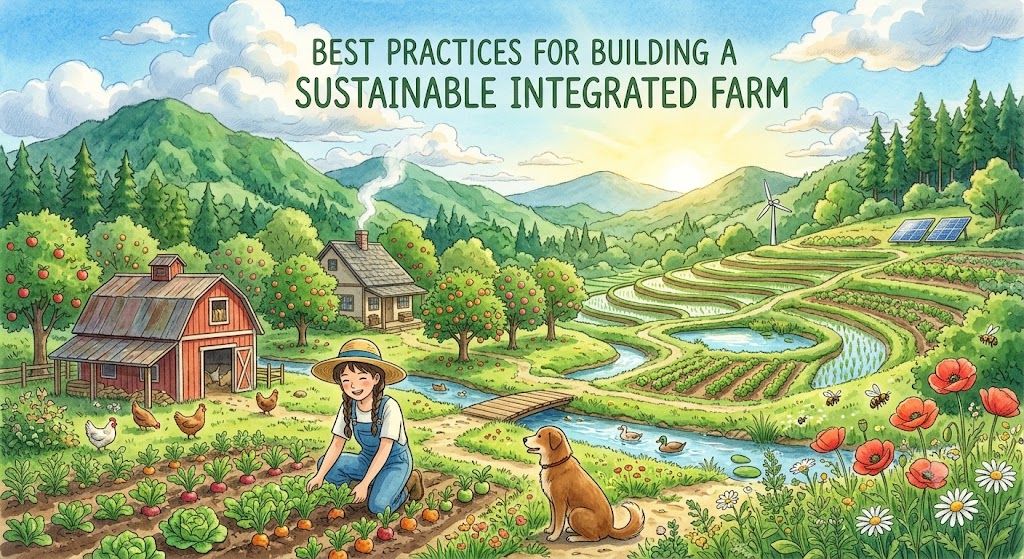
A sustainable integrated farm is not created by adding more crops or raising more animals. It is built by designing a farming system where every resource has a purpose, every activity supports another, and very little goes to waste. The goal is to create a farm that remains productive, profitable, and environmentally responsible for many years.
Across the world, farmers are discovering that long-term success comes from balance rather than dependence on a single enterprise. A well-managed integrated farm combines crop production, livestock, poultry, fisheries, fruit trees, composting, and natural resource management into one connected system. Each component contributes to the success of the others, creating stronger productivity while lowering operating costs.
Building such a farm requires careful planning rather than large investments. Whether you own one acre or one hundred acres, following the right practices can help create a resilient farming business capable of adapting to changing climates, rising production costs, and evolving market demands.
Begin With a Farm Plan, Not With Crops
One of the biggest mistakes many new farmers make is deciding what to plant before creating an overall farm plan.
Successful integrated farms begin with a simple question:
How can every part of the farm work together?
Before starting, evaluate:
- Total available land
- Water resources
- Soil condition
- Climate
- Family labor
- Nearby markets
- Available budget
Planning first prevents costly mistakes later.
Design Every Enterprise to Support Another
The strength of an integrated farm lies in the connections between different activities.
A well-designed system may look like this:
- Crops produce residues for livestock feed.
- Livestock produce manure for compost.
- Compost improves soil fertility.
- Healthy soil produces better crops.
- Pond water irrigates vegetable fields.
- Bees improve pollination in orchards.
- Trees provide shade, fruit, and wind protection.
When these relationships are carefully planned, the farm becomes more efficient and less dependent on outside inputs.
Build Soil Before Expanding Production
Healthy soil should always be the first investment.
Without fertile soil, increasing production becomes expensive and difficult.
Improve soil by regularly using:
- Compost
- Farmyard manure
- Green manure crops
- Crop residues
- Mulch
- Cover crops
Healthy soil stores more water, supports beneficial microorganisms, and supplies nutrients naturally throughout the growing season.
Diversify Without Overcomplicating the Farm
Diversification increases stability, but adding too many enterprises at once can become difficult to manage.
A practical combination might include:
| Enterprise | Main Benefit |
|---|---|
| Field crops | Staple food production |
| Vegetables | Regular cash flow |
| Dairy animals | Daily income from milk |
| Poultry | Eggs and meat |
| Fruit trees | Seasonal income |
| Fish pond | Additional protein and income |
| Compost unit | Natural fertilizer |
Begin with a few complementary activities and expand gradually as experience grows.
Make Water Management a Priority
Water is one of the most valuable assets on any farm.
Efficient water use benefits every enterprise.
Consider practices such as:
- Drip irrigation
- Rainwater harvesting
- Farm ponds
- Mulching
- Soil moisture monitoring
- Recycling safe wastewater where appropriate
Every drop saved contributes to long-term sustainability.
Reduce Waste by Recycling Farm Resources
One of the defining characteristics of integrated farming is resource recycling.
Instead of treating organic materials as waste, successful farms convert them into valuable inputs.
Examples include:
✔ Animal manure becomes compost.
✔ Crop stalks become livestock feed.
✔ Fallen leaves become mulch.
✔ Kitchen waste supports compost production.
✔ Pond sludge enriches crop fields.
Recycling lowers costs while improving soil health.
Protect Biodiversity Across the Farm
A healthy integrated farm supports many forms of life.
Biodiversity improves natural pest control, pollination, and ecological balance.
Ways to encourage biodiversity include:
- Plant flowering borders.
- Maintain shade trees.
- Grow different crop species.
- Preserve beneficial insects.
- Avoid unnecessary pesticide use.
- Create habitats for pollinators.
A diverse ecosystem is generally more resilient than a uniform one.
Balance Organic and Modern Farming Techniques
Sustainability does not require rejecting technology.
The most successful integrated farms combine traditional farming knowledge with modern innovations.
Helpful technologies include:
- Weather forecasting apps
- Soil testing
- Smart irrigation controllers
- GPS field mapping
- Farm management software
- Mobile record-keeping tools
Technology improves decision-making while supporting efficient resource use.
Manage Livestock Responsibly
Livestock play an important role in integrated farming, but they require proper care.
Good livestock management includes:
- Clean housing
- Balanced nutrition
- Fresh drinking water
- Regular health checks
- Proper manure handling
Healthy animals produce higher-quality products while contributing valuable organic fertilizer.
Focus on Preventive Farm Management
Waiting until problems become serious often increases expenses.
Successful farmers monitor their farms regularly.
Routine inspections help identify:
- Pest activity
- Disease symptoms
- Irrigation issues
- Nutrient deficiencies
- Weed growth
- Livestock health concerns
Early action usually prevents larger financial losses.
Build Reliable Market Connections
Producing excellent products is only one part of a profitable farm.
Successful integrated farmers also develop dependable marketing channels.
Potential buyers include:
- Local markets
- Supermarkets
- Restaurants
- Food processors
- Farmers’ markets
- Community-supported agriculture groups
- Direct consumers
Reliable buyers provide greater financial stability throughout the year.
Keep Learning Every Season
Agriculture continues evolving with new research, improved crop varieties, and changing climate conditions.
Farmers should regularly:
- Attend workshops.
- Learn from neighboring farmers.
- Follow agricultural research.
- Test new practices on small areas.
- Evaluate yearly performance.
Continuous improvement keeps farms competitive.
Mistakes to Avoid When Building an Integrated Farm
Many new farmers face unnecessary difficulties because of poor planning.
Avoid these common mistakes:
- Expanding too quickly.
- Ignoring soil health.
- Choosing enterprises without market research.
- Overusing chemical inputs.
- Neglecting farm records.
- Poor water management.
- Failing to recycle available resources.
Learning from these mistakes saves both time and money.
Measuring Long-Term Success
A sustainable integrated farm should be evaluated using more than crop yields.
Success can also be measured by:
- Soil fertility improvements
- Lower production costs
- Stable yearly income
- Better water efficiency
- Reduced waste
- Improved biodiversity
- Strong customer relationships
These indicators demonstrate whether the farming system is becoming more resilient over time.
Final Thoughts
Building a sustainable integrated farm is a gradual process that combines thoughtful planning, efficient resource management, healthy soil, diversified production, and continuous learning. By creating connections between crops, livestock, poultry, fisheries, orchards, and composting systems, farmers can reduce waste, lower production costs, and generate multiple sources of income throughout the year.
The most successful integrated farms are not necessarily the largest—they are the ones that make the smartest use of every available resource. As agriculture continues to face environmental and economic challenges, integrated farming offers a practical pathway toward long-term productivity, profitability, and sustainability for farms of every size.
Frequently Asked Questions
1. What is a sustainable integrated farm?
A sustainable integrated farm combines different agricultural enterprises that support one another while conserving natural resources and improving long-term productivity.
2. Why is planning important in integrated farming?
Proper planning ensures that crops, livestock, water resources, and other farm activities work together efficiently, reducing waste and increasing profitability.
3. Can integrated farming work on small farms?
Yes. Small farms can successfully combine crops, poultry, livestock, composting, vegetables, and fruit production to maximize productivity.
4. How does integrated farming reduce costs?
It lowers expenses by recycling farm resources, improving soil fertility naturally, reducing waste, and decreasing dependence on purchased inputs.
5. What is the biggest advantage of sustainable integrated farming?
Its greatest advantage is creating a balanced farming system that generates multiple income sources while protecting soil, water, biodiversity, and long-term farm productivity.