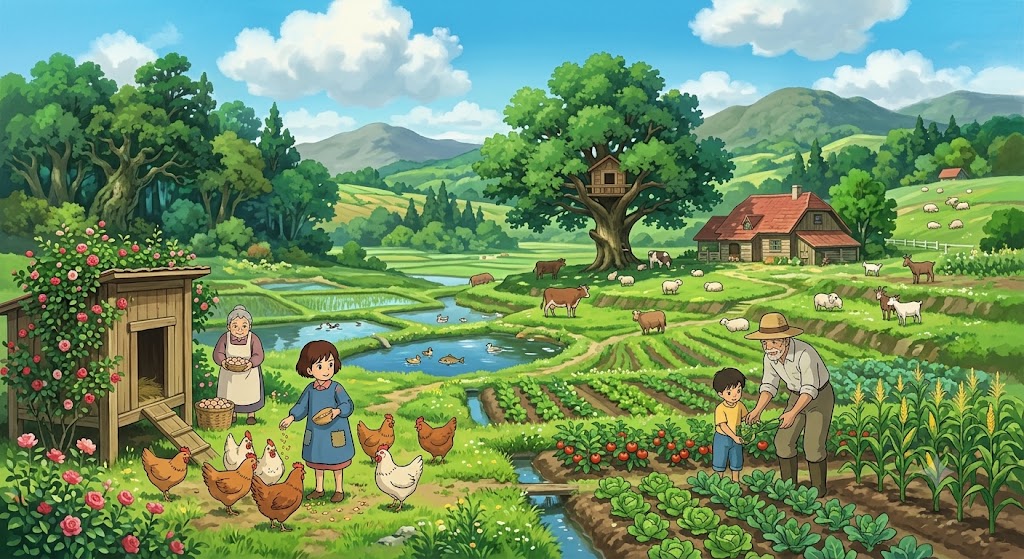
Integrated farming is a modern agricultural approach that combines different farming activities within the same farm. Instead of depending on only one crop or one source of income, farmers connect crop production with livestock, poultry, fish farming, beekeeping, composting, or other agricultural activities.
The basic idea is simple: the waste or by-product of one activity becomes a useful input for another. Crop residues can be used as animal feed, animal manure can improve soil fertility, pond water can support irrigation, and farm waste can be converted into compost or biogas.
This connected system helps farmers reduce costs, use resources efficiently, increase productivity, and build a more stable agricultural business.
What Is an Integrated Farming System?
An integrated farming system is a planned combination of two or more agricultural enterprises on the same farm.
Common combinations include:
- Crops and dairy animals
- Crops, poultry, and fish
- Vegetables and beekeeping
- Fruit orchards and livestock
- Fish farming and duck rearing
- Crops, goats, and compost production
- Greenhouses and renewable energy systems
Each enterprise supports the others. For example, livestock produce manure, which can be used as organic fertiliser. Crop residues can feed animals, while pond silt can be applied to fields as a nutrient-rich soil amendment.
The system is designed to minimise waste and maximise the value of available land, water, labour, and farm materials.
Why Integrated Farming Is Important
Farmers who depend on only one crop may face serious financial risks. Crop failure, changing weather, low market prices, pests, or diseases can reduce their entire income.
Integrated farming spreads this risk across several activities. If crop production is affected, income from milk, eggs, fish, honey, or vegetables may still support the farm.
This makes farming more resilient and provides farmers with multiple sources of food and income throughout the year.
Integrated farming is also important for environmental protection. It reduces waste, improves nutrient recycling, supports soil health, and lowers dependence on expensive external inputs.
Crop and Livestock Integration
Combining crops with livestock is one of the most common integrated farming models.
Cattle, buffaloes, goats, or sheep can consume crop residues such as straw, stalks, leaves, and damaged produce. This reduces feed costs and prevents useful materials from being wasted or burned.
In return, animal manure can be composted and applied to crop fields. It adds organic matter, improves soil structure, increases water-holding capacity, and supports beneficial soil organisms.
Farmers should properly process manure before applying it to crops. Well-decomposed manure is safer and provides nutrients more gradually than fresh manure.
This combination is especially useful for farms growing cereals, fodder crops, fruits, or vegetables.
Crop and Fish Farming Systems
Fish farming can be integrated with crop production where sufficient water and suitable land are available.
Farm ponds can store rainwater, support fish production, and provide irrigation during dry periods. Nutrient-rich pond water may also benefit crops when used carefully.
Farmers can grow crops around the pond or use pond embankments for vegetables, banana plants, fodder grasses, or fruit trees.
Fish farming provides an additional source of protein and income. Species should be selected according to local climate, water quality, market demand, and available feed.
The pond must be managed properly to avoid overcrowding, poor water quality, and disease problems.
Poultry and Fish Integration
Poultry farming can also be connected with fish production.
In some systems, poultry shelters are built near or above fish ponds. Poultry droppings provide nutrients that encourage the growth of natural fish food.
However, the amount of manure entering the pond must be carefully controlled. Excessive waste can reduce oxygen levels and damage fish health.
Farmers should regularly monitor water colour, smell, oxygen availability, and fish behaviour.
This type of system can reduce fish feed and fertilisation costs when it is properly managed.
Integrating Beekeeping with Crops
Beekeeping is a valuable addition to farms growing fruits, vegetables, oilseeds, herbs, and flowering crops.
Bees improve pollination, which can increase fruit development, seed production, and overall crop quality. Farmers may also earn income from honey, beeswax, and other bee-related products.
Bee boxes require relatively little land and can be placed near suitable flowering plants.
Chemical spraying must be managed carefully around bees. Pesticides should not be applied when bees are actively visiting flowers. Farmers should choose safer pest-control methods whenever possible.
Healthy bee populations support both farm productivity and local biodiversity.
Composting and Waste Recycling
Integrated farms produce many organic materials, including animal manure, crop residues, fallen leaves, vegetable waste, and bedding materials.
Instead of throwing these materials away, farmers can convert them into compost.
Compost improves soil fertility and reduces the need for purchased fertilisers. It also helps the soil retain moisture and supports long-term crop productivity.
Farmers can create compost pits or piles using a balanced mixture of dry and moist materials. The pile should have enough moisture and air to support decomposition.
Properly prepared compost should have a dark colour, an earthy smell, and no visible fresh waste.
Biogas Production
Farms with enough animal manure may establish a small biogas system.
Biogas units convert manure and other organic materials into gas that can be used for cooking, heating, or in some cases electricity generation.
The remaining slurry is rich in nutrients and can be used as fertiliser.
Biogas production reduces dependence on firewood or conventional fuel. It also helps manage manure more hygienically and reduces unpleasant odours.
The system requires proper construction, regular feeding, water availability, and basic maintenance.
Efficient Use of Water
Water can be used more efficiently in an integrated farming system because the same source may support several activities.
Rainwater harvesting ponds can provide water for fish, livestock, and crop irrigation. Drip irrigation can deliver pond or stored water directly to crop roots.
Wastewater from certain farm activities may be reused only when it is safe and free from harmful chemicals or pathogens.
Mulching, cover crops, and organic matter application can further reduce water loss from the soil.
Farmers should plan water use carefully so that one enterprise does not reduce the supply needed by another.
Better Use of Farm Labour
Different farm enterprises require labour at different times. Crop farming may need more workers during planting and harvesting, while dairy, poultry, and fish farming require regular attention throughout the year.
Integrated farming allows family labour and hired workers to remain productive across different seasons.
Activities can be scheduled to avoid excessive labour demand at the same time. Good planning also helps ensure that animals, crops, and fish receive proper care.
Farmers should maintain clear work schedules and assign responsibilities for feeding, irrigation, cleaning, harvesting, and record-keeping.
Multiple Sources of Farm Income
One of the strongest benefits of integrated farming is income diversification.
A farmer may earn money from:
- Grains
- Vegetables
- Fruits
- Milk
- Eggs
- Meat
- Fish
- Honey
- Compost
- Seedlings
- Fodder
- Biogas products
These products may be available at different times of the year. Regular income from milk or eggs can help cover daily expenses, while crop harvests may provide larger seasonal returns.
Farmers should study local demand before adding a new enterprise. A product is useful only when it can be consumed, stored, processed, or sold profitably.
Improving Soil Health Naturally
Integrated farming supports soil health by returning organic matter to the land.
Manure, compost, crop residue, green manure, and pond silt can improve soil structure and nutrient availability.
Crop rotation can also be included in the system. Farmers may rotate cereals with legumes to improve soil nitrogen and reduce pest problems.
Cover crops protect bare soil from erosion and suppress weeds. Deep-rooted plants can bring nutrients closer to the soil surface.
These practices gradually reduce soil degradation and improve long-term productivity.
Reducing Chemical Dependence
Because integrated systems recycle nutrients and support ecological balance, they can reduce the need for synthetic fertilisers and pesticides.
Healthy soil often produces stronger plants that are better able to tolerate stress. Crop rotation and mixed farming can also interrupt pest and disease cycles.
Farmers can use biological pest control, resistant crop varieties, traps, mulching, and proper field sanitation.
Chemical products may still be needed in some situations, but they should be used responsibly and only when necessary.
Planning an Integrated Farm
A successful integrated farming system should be based on local resources and practical needs.
Before starting, farmers should consider:
- Available land
- Soil condition
- Water supply
- Climate
- Labour availability
- Investment capacity
- Farmer experience
- Local market demand
- Access to veterinary and technical services
It is usually better to begin with a small number of connected activities. For example, a farmer may first combine crops with dairy animals and composting.
Once the system becomes stable, fish farming, poultry, beekeeping, or other enterprises can be added gradually.
Trying to manage too many activities at once may create financial and management problems.
Maintain Proper Farm Records
Records help farmers understand whether each enterprise is profitable.
Important information includes:
- Input costs
- Labour expenses
- Feed consumption
- Crop yields
- Milk or egg production
- Fish growth
- Veterinary costs
- Product sales
- Equipment maintenance
- Water and energy use
Farmers can compare the performance of different enterprises and identify areas that need improvement.
Even a notebook or simple digital spreadsheet can be useful for basic farm management.
Challenges of Integrated Farming
Integrated farming offers many benefits, but it also requires good management.
Possible challenges include:
- Lack of technical knowledge
- High initial investment
- Disease risks in animals or fish
- Limited water supply
- Poor market access
- Labour shortages
- Difficulty managing several enterprises
- Inadequate storage or processing facilities
Farmers can reduce these risks by starting small, seeking expert guidance, attending training programmes, and selecting activities suited to their local conditions.
Regular observation and timely action are essential because problems in one part of the farm may affect other connected activities.
Conclusion
Integrated farming systems help farmers achieve better productivity by connecting crops, livestock, fish, poultry, beekeeping, composting, and other agricultural activities.
The system makes better use of land, water, labour, nutrients, and farm waste. It provides multiple income sources, improves soil health, reduces production costs, and supports environmental sustainability.
The most effective integrated farm is not necessarily the largest or most complicated one. It is the system in which each activity has a clear purpose and supports the others.
By planning carefully, recycling resources, monitoring results, and expanding gradually, farmers can create productive, resilient, and sustainable farms for the future.
Frequently Asked Questions
1. What is the main purpose of integrated farming?
The main purpose is to connect different agricultural activities so that resources are used efficiently, waste is reduced, and farm income becomes more stable.
2. Is integrated farming suitable for small farms?
Yes. Small farmers can combine simple activities such as vegetables, poultry, livestock, composting, or beekeeping according to their available land and resources.
3. How does integrated farming improve soil fertility?
Animal manure, compost, crop residues, pond silt, and green manure return nutrients and organic matter to the soil.
4. Can integrated farming reduce production costs?
Yes. It can reduce spending on animal feed, fertilisers, irrigation, energy, and waste management by recycling farm resources.
5. What is the best integrated farming combination?
There is no single best combination. The right system depends on climate, soil, water, market demand, labour, investment, and the farmer’s experience.