I will never forget my fourth year of farming. It was mid-July, the sun was absolutely baking the earth, and it hadn’t rained a drop in five weeks. I stood next to my primary irrigation well, listening to the pump whine and sputter as it struggled to pull water from a rapidly dropping water table.
My fields were turning dusty, my crops were wilting by noon, and my electricity bill for pumping water was pushing me toward bankruptcy. I was doing exactly what I had been taught: pointing massive overhead sprinklers at the sky and praying the water made it to the roots before the sun boiled it away.
That drought nearly broke me. But it also forced me to realize a hard, undeniable truth: Pumping more water isn’t farming; it’s mining.
When you rely purely on an endless supply of well water, you are setting yourself up for failure. Over the last decade, I had to completely dismantle my relationship with water. I realized that true water-saving farming isn’t just about turning the tap off; it is about redesigning the entire farm to catch, hold, and stretch every single drop.
Today, my farm uses 40% less water than it did ten years ago, yet my yields are higher and my crops are far more resilient. Instead of fighting the drought, I built a system that ignores it. If you want to cut your water bills and build a genuinely sustainable farm, we have to rebuild your water strategy from the ground up. I call this the Four-Tier Drought Architecture.
Tier 1: The Underground Reservoir (Fixing the Soil)
You cannot save water if your bucket is full of holes. Most farmers focus entirely on how water is delivered to the plant, completely ignoring where the water lives once it hits the dirt.
If you are farming on heavily tilled, dead dirt, any water you apply is going to evaporate into the air or run off into the ditches. We have to turn your dirt into a biological sponge.
The Fix: Supercharging Organic Matter
For every 1% you increase your soil’s organic matter, an acre of land can hold an additional 20,000 gallons of water. Let that sink in.
- The Carbon Sponge: By integrating massive amounts of compost and using cover crops, you introduce carbon into the soil. This carbon binds with the dirt to create a porous structure. When it rains, or when you irrigate, this sponge traps the moisture in the root zone for weeks, releasing it slowly to the plants only when they need it.
- The 4-Inch Armor Rule: Never, ever let the sun touch your bare soil. I keep a minimum of four inches of heavy organic mulch (like straw, woodchips, or chopped leaves) covering every inch of my vegetable beds. This physical barrier acts like insulation. It drops the soil temperature by 10 to 15 degrees in the dead of summer, completely halting surface evaporation.
Tier 2: The Precision Delivery (Killing the Sprinkler)
When I started out, I used big overhead impact sprinklers. They looked great, throwing massive arcs of water across the fields. But the math was horrifying. On a hot, windy day, up to 40% of that water evaporated into the atmosphere or blew onto the weeds before it ever reached my cash crop.
Overhead watering is for golf courses, not profitable farms.
The Fix: Sub-Surface Drip Irrigation
If you want to save water, you have to put it exactly where it belongs: directly on the root hairs, under the mulch.
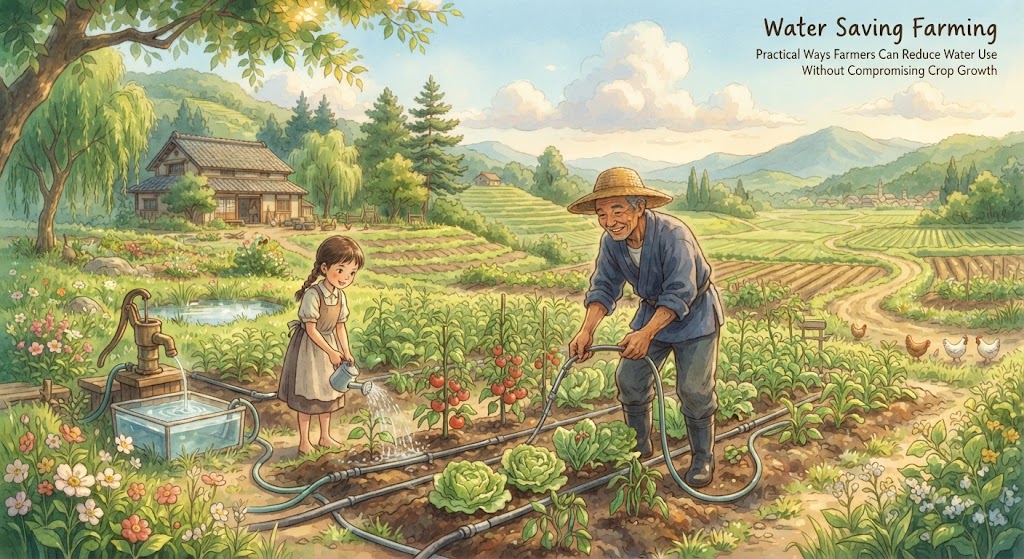
- Drip Tape Systems: I ripped out the sprinklers and laid miles of pressure-compensating drip tape down the center of my rows. This system drips water slowly, right at the base of the plant.
- Under the Armor: Because the drip tape is buried under that 4-inch layer of straw mulch we talked about in Tier 1, the water is never exposed to the sun or the wind. We achieve nearly 98% water efficiency.
- Timing is Everything: Stop watering at 1:00 PM. The absolute best time to run your drip lines is between 3:00 AM and 5:00 AM. The soil is cool, the plants are deeply hydrated before the sun comes up, and evaporation is mathematically at its lowest point of the day.
The Water Math: Seeing the Savings
Switching from overhead watering on bare soil to drip irrigation on mulched soil requires an initial investment, which is why a lot of beginners hesitate. But when you look at the long-term operational savings, the system pays for itself in less than two seasons.
To prove it, I use a specific calculation model before I upgrade any block of land. You can test your own farm’s numbers right here to see exactly how much water—and money—you are currently evaporating into thin air.
Tier 3: Biological Drought Training (Toughening the Plants)
This is a concept that took me years to accept because it feels completely counter-intuitive: Most farmers baby their plants too much, creating weak crops.
If you water a tomato plant every single day, the plant realizes it doesn’t have to work for its dinner. It will grow a massive, lazy, shallow root system that sits right at the surface of the soil. The moment you miss a day of watering, or a heatwave hits, that shallow root system instantly dries out, and the plant collapses in shock.
The Fix: Tactical Dehydration
You have to train your crops to survive without you.
- Deep and Infrequent Soaking: Once a plant has moved past the fragile seedling stage, I immediately change my watering habits. Instead of watering for 15 minutes every day, I will run the drip lines for three hours, but only once a week.
- Forcing the Roots: This massive, deep soaking drives the moisture far down into the subsoil. Over the next five days, as the surface layer dries out, the plant panics just a little bit. To survive, it forces its roots to dive deep into the earth chasing that receding moisture.
- The Result: By the time August arrives, my plants have root systems that are three feet deep, tapping into natural ground moisture that the summer sun can’t touch. They become biologically drought-proof.
Tier 4: Farm-Scale Catchment (Holding the Rain)
The final tier of water saving isn’t about how you pump water; it is about how you catch it. When a heavy spring thunderstorm hits, most farms act like a drainage board, shuttling all that beautiful, free rainwater into the nearest ditch and off the property.
We have to stop treating runoff as a nuisance and start treating it as liquid gold.
The Fix: Slow It, Spread It, Sink It
- Swales on Contour: In my sloping pastures, we dug shallow trenches horizontally across the contour of the hill. When it rains heavily, the water runs down the hill, hits the trench, and stops. Instead of washing my topsoil away, the water pools in the swale and slowly sinks into the groundwater table over the next 48 hours, recharging my well.
- Windbreaks: Wind is the silent thief of water. A hot, dry summer breeze pulling across your fields will suck the moisture out of your plant leaves (transpiration) faster than the sun will. By planting thick, tall hedgerows of native trees on the windward side of my property, I slow the wind down. This creates a calm, humid micro-climate over my crops, drastically reducing how much water they sweat out during the day.
The New Farming Paradigm
Ten years in the dirt will teach you a lot of things, but the most important lesson I’ve learned is that water is a privilege, not a guarantee.
When you transition to this four-tier system, something amazing happens. You stop waking up in a panic checking the weather forecast. You stop spending half your operating budget on electricity for the well pump. You realize that by mulching heavily, installing drip lines, training your roots, and catching the rain, you aren’t just saving water—you are building a farm that can survive almost anything nature throws at it.
Start small. Mulch one bed. Convert one row to drip tape. Watch how those plants thrive while the bare rows struggle. Once you see the math work in the dirt, you’ll never go back to the old way again.