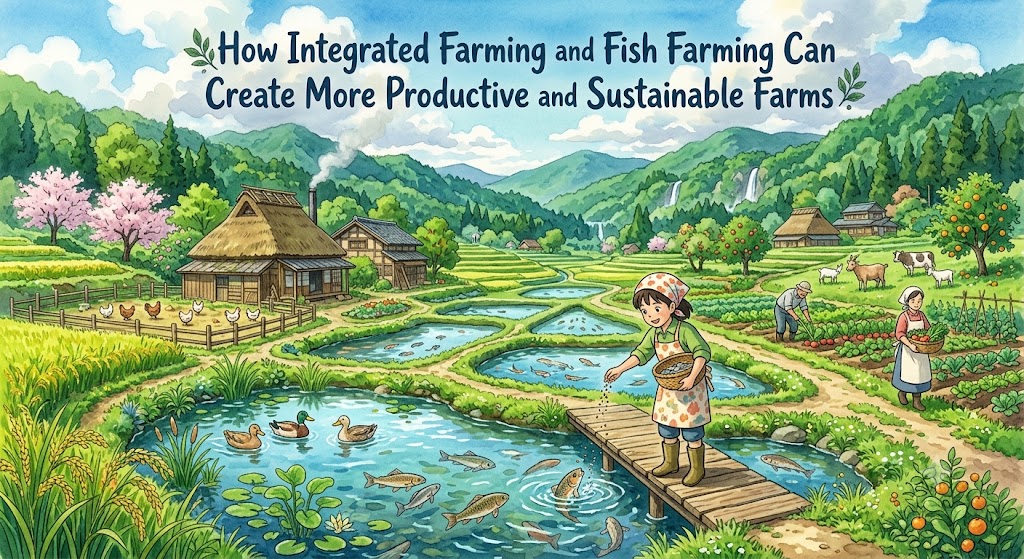
A farm does not always have to depend on a single crop or livestock activity. In many agricultural systems, different activities can be planned so that they support one another. Crops can provide useful residues, livestock can produce organic materials, ponds can supply water and nutrients, and fish can become an additional source of farm income.
This concept is commonly associated with integrated farming.
Integrated farming brings different agricultural activities together within a coordinated system. When fish farming is included, ponds can become an important part of the overall farm design rather than functioning as an isolated production unit.
The goal is not simply to produce more activities on the same piece of land. Good integration means understanding how resources move around the farm and finding practical ways to reduce waste while creating additional production opportunities.
A well-planned system can improve resource use, diversify farm income, and make better use of land and water. However, successful integration requires careful management because poor planning can create water-quality, disease, nutrient, or financial problems.
What Integrated Farming Really Means
Integrated farming is based on connection.
Instead of treating crop production, livestock, and aquaculture as completely separate businesses, farmers can design relationships between them.
For example, crop residues may have useful applications within a livestock system. Livestock manure can be managed as a nutrient resource after appropriate treatment. Pond water may potentially be used for certain agricultural purposes when its quality is suitable and local regulations permit.
Fish production adds another layer to this system.
The pond becomes both a production area and an important component of the farm’s water and nutrient cycle.
The exact combination depends on the farm’s size, climate, available water, labor, markets, and local regulations.
Why Add Fish Farming?
Fish can provide an additional source of food and farm revenue.
A pond can also make use of land that may not be suitable for conventional crop production, although pond construction and management require investment.
Fish farming can be particularly interesting for diversified farms because the farmer is not relying entirely on one product.
If crop prices decline, fish may provide another source of income. Likewise, crop production can continue even when fish markets or production conditions change.
Diversification does not remove financial risk, but it can distribute risk across different activities.
Design the Farm Before Digging the Pond
One common mistake is to build a pond first and think about integration later.
A better approach is to design the complete farm system.
Consider:
Where will the pond be located?
How will water enter and leave the pond?
Can the pond overflow safely?
Where will crops be planted?
Where will livestock facilities be located?
How will workers access each area?
How will fish feed and equipment be stored?
Where will harvested fish be handled?
Good layout can reduce unnecessary labor and make resource movement easier.
The pond should also be designed with local soil, drainage, water availability, and environmental conditions in mind.
Professional or local agricultural guidance can be valuable before construction.
Choose Fish Species Carefully
Fish selection should be based on local conditions rather than popularity alone.
Important considerations include water temperature, oxygen requirements, growth characteristics, available feed, stocking practices, local regulations, and market demand.
Farmers should identify which species are legally and environmentally appropriate for their region.
Market demand is especially important.
There is little benefit in producing a fish that grows well but has limited local demand.
Before stocking, farmers should investigate who will buy the fish, what sizes are preferred, and how harvested fish will be transported.
Keep Water Quality at the Center
Water quality is one of the most important factors in fish farming.
Fish require suitable conditions for oxygen, temperature, pH, and other water-quality parameters.
Poor water management can quickly affect fish health.
Farmers should monitor the pond regularly and watch for signs such as unusual fish behavior, poor feeding response, surface gasping, sudden mortality, or changes in water appearance.
A pond that looks green or cloudy is not necessarily healthy or unhealthy based on appearance alone.
Water testing provides more reliable information.
Farmers should also avoid adding untreated materials to ponds simply because they are available on the farm.
Integration should never mean uncontrolled waste disposal.
Manage Organic Materials Carefully
Integrated systems often involve organic resources.
Livestock manure, crop residues, and other materials may contain nutrients, but their management requires care.
Uncontrolled nutrient inputs can contribute to excessive algae growth and oxygen problems in ponds.
This is particularly important because fish depend on stable water conditions.
Organic materials should therefore be handled according to appropriate aquaculture and agricultural recommendations.
The principle is simple:
Reuse resources where appropriate, but never compromise water quality in the process.
Connect Crops With the Pond Responsibly
A fish pond can become part of the wider farm water system.
Where water quality and local regulations permit, pond water may sometimes be used for agricultural purposes.
Nutrients present in the water can have agricultural value, although farmers should understand exactly what the water contains before applying it to crops.
Irrigation systems should be designed to avoid unnecessary contamination or environmental discharge.
The connection should be controlled rather than automatic.
Use the Pond as a Farm Asset
A well-managed pond can provide more than fish.
Depending on the system, it can contribute to water storage, support certain farm activities, and create additional habitat.
However, pond water should not be assumed to be suitable for every agricultural purpose.
Water quality, salinity, nutrient concentration, pathogens, and local regulations need to be considered.
Farmers should also plan for periods of drought.
A pond that depends entirely on unreliable rainfall may not provide consistent production.
Livestock and Fish Can Be Integrated, But Carefully
Livestock can form another part of an integrated farming system.
However, direct discharge of animal waste into fish ponds is not automatically a safe practice.
Excess organic material can reduce dissolved oxygen and negatively affect water quality.
If livestock and aquaculture are integrated, nutrient flows should be controlled.
Manure may need to be collected, processed, and applied according to an appropriate plan rather than being allowed to enter the pond without management.
This distinction is important because “integrated” does not mean “uncontrolled.”
Grow Crops Around the Pond
The area surrounding a pond can be used strategically.
Suitable crops, trees, grasses, or other vegetation may help stabilize soil and reduce erosion.
Vegetation can also provide useful shade in some situations, although excessive shading can create different pond-management issues.
Farmers should avoid planting crops so close to the pond that fertilizers, pesticides, or soil can easily wash into the water.
Buffer areas can help protect water quality.
Reduce Nutrient Losses From the Farm
One advantage of an integrated system is the opportunity to manage nutrients more efficiently.
Instead of allowing useful organic materials to become waste, farmers can look for appropriate uses.
Crop residues can be composted or used within suitable livestock systems. Livestock manure can be managed as a soil amendment after proper handling. Pond water may have agricultural uses when its quality is appropriate.
This creates a circular approach to resource management.
But nutrient recycling must be controlled.
Too much of any nutrient in the wrong location can become an environmental problem.
Use Multiple Income Streams
One of the strongest economic arguments for integrated farming is diversification.
A farm might produce:
- Fish
- Vegetables
- Fruits
- Grains
- Livestock products
- Eggs
- Fodder
- Compost or other farm resources
The exact combination depends on local opportunities.
Multiple products can help reduce dependence on a single market.
However, diversification also increases management complexity.
Farmers should not add activities simply because they sound profitable.
Each activity should be evaluated based on labor, capital, skills, infrastructure, market demand, and expected returns.
Start With a Manageable System
Farmers interested in integrated fish farming do not necessarily need to transform the entire farm immediately.
A small pond or pilot area can provide valuable experience.
During the first production cycle, farmers can monitor:
Fish growth
Feed expenses
Water quality
Labor requirements
Mortality
Crop performance
Water use
Revenue
Operating costs
These records can show whether the system is actually working.
If the results are positive, the farm can gradually expand.
Feed Management Affects Profit and Water Quality
Fish feed is often one of the major operating expenses in aquaculture.
Overfeeding does not necessarily make fish grow faster.
Uneaten feed can break down and contribute organic material to the water.
Farmers should follow appropriate feeding practices for the selected fish species and monitor how quickly fish consume the feed.
Feeding amounts may need adjustment based on fish size, water temperature, stocking density, and other conditions.
Efficient feeding can support both financial and environmental goals.
Stocking Density Needs Careful Planning
Putting too many fish into a pond can create unnecessary stress.
Higher stocking densities can increase competition for oxygen and increase the amount of waste entering the water.
The appropriate density depends on fish species, pond size, aeration, water exchange, feeding system, and management skill.
Farmers should follow reliable local recommendations rather than choosing stocking numbers based solely on how many fish the pond can physically hold.
More fish do not automatically mean more profit.
Protect Fish From Common Risks
Fish farms can face problems from disease, predators, poor water quality, extreme weather, and equipment failure.
Farmers should monitor fish regularly and maintain pond infrastructure.
Screens, fencing, netting, or other suitable protective measures may help in some situations.
Emergency planning is also useful.
What happens if a pump fails?
What happens after heavy rainfall?
Where will harvested fish be stored?
How will fish be transported to buyers?
Planning these details before problems occur can prevent major losses.
Do Not Ignore Environmental Responsibility
An integrated farm should improve resource use without creating new environmental problems.
Farmers should prevent untreated wastewater, excessive nutrients, chemicals, or sediment from leaving the farm and entering natural waterways.
Pesticide use near ponds requires particular care because some agricultural chemicals can be harmful to aquatic organisms.
Local environmental and aquaculture regulations should always be followed.
Responsible management protects both the farm and the surrounding ecosystem.
Keep the Economics Simple
Farmers should calculate the complete cost of the integrated system.
For fish farming, expenses may include:
- Pond construction
- Fingerlings
- Feed
- Aeration
- Pumps
- Water management
- Labor
- Harvesting
- Transportation
- Equipment maintenance
Then compare these expenses with realistic fish revenue.
Do the same for the crop and livestock components.
A system is only genuinely successful when the combined operation provides an acceptable economic return while remaining manageable.
Build a Resource Cycle
The ideal integrated farm is designed around useful resource flows.
Crops produce residues.
Livestock can produce organic materials.
Organic resources can be managed and reused appropriately.
Ponds produce fish and contain water.
Suitable pond resources may support other farm activities.
Crop and livestock production provide diversified income.
This creates a connected farm rather than a collection of unrelated activities.
The connections should always be managed carefully, but the basic idea is powerful.
A Practical Integrated Farm Model
A simple model could involve a fish pond positioned near selected crop areas.
The pond supports fish production.
Vegetation around the pond helps stabilize vulnerable areas.
Appropriately managed pond water may support irrigation where suitable.
Crop residues can be managed through composting or other approved uses.
Livestock manure can be collected and handled separately rather than discharged directly into the pond.
Farm products can then be sold through different market channels.
This type of system creates several opportunities without requiring every resource to perform multiple jobs.
Learn, Measure, and Adjust
Integrated farming is not a fixed recipe.
Conditions change from season to season.
Rainfall may be different. Feed prices can change. Crop markets may rise or fall. Fish growth can vary with temperature and water quality.
Farmers should therefore keep records and review results regularly.
If one component consumes too much labor, it may need to be redesigned.
If pond water quality becomes difficult to maintain, nutrient inputs may need to be reduced.
If a particular crop consistently loses money, it may make sense to replace it with another option.
Flexibility is one of the strengths of an integrated system.
Why Integration Can Make a Farm Stronger
Integrated farming with fish production can create several potential advantages.
It can diversify farm income, make better use of available land, encourage responsible resource recycling, and provide additional food production from the same overall operation.
But integration does not automatically guarantee sustainability or profitability.
Every connection needs to be planned.
Water must remain safe. Nutrients must be managed. Fish density must remain appropriate. Crops must have markets. Livestock systems must be hygienic. Costs must be monitored.
When these factors are considered together, integration becomes much more than simply adding a fish pond to a farm.
Building a More Connected Farm
The future of farming will increasingly depend on using available resources carefully.
Integrated farming offers one practical way to approach this challenge by connecting crop production, livestock, aquaculture, water management, and resource recycling within a coordinated system.
Fish farming can provide an additional product and income stream, while the pond can become part of the broader farm design.
The key is responsible integration.
Farmers should start with realistic goals, understand local conditions, test smaller systems where possible, monitor water quality, control nutrient flows, maintain proper fish management, and calculate the economics of every activity.
A productive farm does not need to waste resources simply because they come from different parts of the operation.
With careful planning, some resources can be managed in ways that benefit more than one part of the farm.
That is the real strength of integrated farming: not simply producing more, but creating a better-connected agricultural system where land, water, crops, livestock, fish, labor, and income are managed as parts of one larger operation.