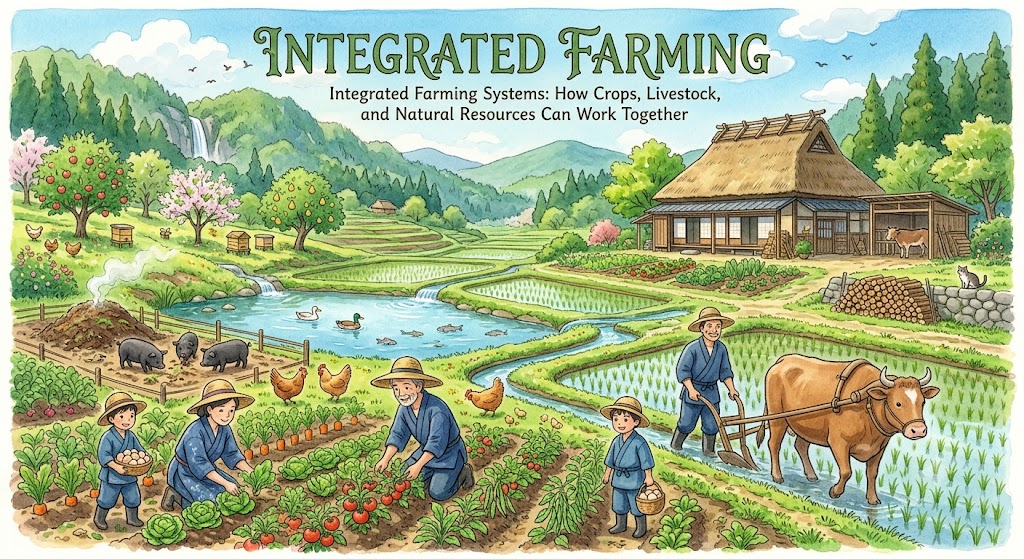
Farming does not always have to be organized around a single crop or production activity. A farm can operate as a connected system in which crops, livestock, water, soil, organic materials, and other resources support one another.
This approach is commonly described as an integrated farming system.
Instead of treating every activity separately, integrated farming looks at the farm as a whole. Crop residues may become livestock feed, livestock manure can contribute to soil fertility, farm ponds can support irrigation, and certain crops can provide useful materials for other parts of the operation.
The exact combination depends on land size, climate, available water, farmer skills, labor, market access, and local conditions.
The purpose is not to create the most complicated farm possible. The goal is to use available resources more efficiently while creating a practical and manageable production system.
What Is an Integrated Farming System?
An integrated farming system combines two or more agricultural activities that can interact with each other.
A farm might include:
- Field crops
- Vegetables
- Fruit trees
- Dairy animals
- Goats or sheep
- Poultry
- Fish production
- Composting
- Beekeeping
- Agroforestry
- Rainwater harvesting
- Renewable energy
These activities do not necessarily have to exist on every farm.
The important feature is the relationship between them.
For example, crop residues that would otherwise have limited value may be used as livestock feed when appropriate. Manure produced by livestock can be managed and returned to crop fields as a source of organic material and nutrients.
This creates a cycle in which resources move between different parts of the farm.
Think of the Farm as a Connected Cycle
A conventional farm may look like a series of separate activities:
Crop → Harvest → Sale
An integrated farm can involve a broader cycle:
Crop production → Residues → Livestock → Manure → Soil → Crop production
Other components can be added to this cycle.
For example:
Rainfall → Farm pond → Irrigation → Crops → Crop residues → Livestock → Manure → Compost → Soil
The objective is to keep useful resources circulating within the farm as much as practical.
Not every material can or should be reused. Food safety, animal health, environmental protection, and local regulations must always be considered.
Start With the Farm’s Existing Resources
Integrated farming should begin with an assessment of what is already available.
Look at:
- Total land area
- Soil types
- Water sources
- Existing crops
- Livestock
- Farm buildings
- Labor availability
- Equipment
- Storage facilities
- Nearby markets
- Organic residues
- Seasonal rainfall
A farmer with limited water may need a very different integrated system from a farmer with reliable irrigation.
Likewise, a farm with existing livestock already has an opportunity to connect manure management with crop production.
The best system is usually the one that fits the farm’s actual resources.
Combining Crops With Livestock
Crop-livestock integration is one of the most familiar forms of integrated farming.
Crops can provide:
- Grain
- Fodder
- Straw
- Leaves
- Crop residues
Livestock can provide:
- Milk
- Eggs
- Meat
- Manure
- Other farm products
Manure can be managed and incorporated into an appropriate soil-fertility program.
This relationship can reduce dependence on outside inputs in some farming systems, although livestock feed, veterinary care, housing, and other costs still need to be considered.
The farmer should also ensure that crop residues used as feed are safe and nutritionally appropriate for the particular animals.
Crop Residue Management
After harvest, farms can generate substantial quantities of plant material.
Depending on the crop, residues may include:
- Straw
- Stalks
- Leaves
- Husks
- Vegetable trimmings
- Pruned branches
- Other plant materials
Instead of automatically treating all residues as waste, farmers can evaluate whether they can be used for:
- Animal feed
- Composting
- Mulching
- Soil cover
- Bedding
- Bioenergy systems where practical
The correct use depends on the material.
Some residues are valuable as feed, while others may be more appropriate for composting or soil cover.
Livestock Manure as a Farm Resource
Livestock manure contains organic matter and plant nutrients, making it a potentially useful agricultural resource when properly managed.
However, raw manure should not simply be placed anywhere on the farm.
Good manure management involves:
- Suitable storage
- Protection from excessive rain
- Preventing runoff
- Appropriate composting where applicable
- Proper application rates
- Consideration of crop requirements
Well-managed manure can contribute to soil organic matter and nutrient cycling.
Poorly managed manure, on the other hand, can create odor, nutrient-loss, water-quality, and sanitation problems.
Integrating Poultry Into the Farm
Poultry can be another component of an integrated system.
Chickens may provide eggs or meat while producing manure that can be managed as part of the farm’s organic-resource cycle.
Some farms may also use poultry areas in combination with crop production, but housing, hygiene, disease prevention, and biosecurity must be carefully planned.
Poultry production should not be added simply because it appears easy to integrate.
Feed costs, labor, animal health, market demand, and housing requirements can have a major effect on the economics of the activity.
Adding Goats or Sheep
Small ruminants such as goats and sheep can fit into some mixed farming systems because they can utilize certain types of forage, crop residues, and managed grazing areas.
A farm may produce part of its own fodder while livestock contribute manure back to the production system.
However, grazing needs to be controlled.
Unmanaged grazing can damage crops, compact soil, reduce vegetation cover, and create erosion problems.
Fencing, rotational grazing, feed planning, and animal health management are therefore important.
Trees and Crops Can Work Together
Agroforestry is another way to integrate different agricultural components.
Trees can be combined with crops, pasture, or livestock depending on the system.
Potential benefits may include:
- Additional farm products
- Wind protection
- Shade
- Soil protection
- Habitat for beneficial organisms
- Long-term diversification
However, trees also compete with nearby crops for sunlight, water, and nutrients.
Species selection and planting arrangement therefore matter.
Farmers should consider mature tree size, root behavior, water availability, crop compatibility, and harvesting requirements before establishing an agroforestry system.
Integrating Vegetables and Fruit Crops
Vegetable production can complement longer-term crops such as orchards.
For example, suitable vegetables may be grown between young fruit trees while the orchard is still developing.
This can provide additional production from land that might otherwise have unused space.
However, the practice needs careful planning.
Vegetable crops should not interfere with tree development, irrigation, root growth, or future machinery movement.
As trees mature, available sunlight and space may change, meaning the intercrop plan may need to change as well.
Water as a Shared Resource
Water management is one of the most important parts of an integrated farming system.
A farm may combine:
- Rainwater harvesting
- Farm ponds
- Irrigation storage
- Drip irrigation
- Water channels
- Soil-moisture conservation
- Crop planning
Rainwater can potentially be collected and stored for later agricultural use where suitable.
Water can then support different parts of the farm according to priority.
For example, stored water may be used for crop irrigation, livestock needs, or other approved agricultural purposes.
Water quality should always be considered before using a particular source for crops or animals.
Soil Is the Foundation of the System
Almost every part of an integrated farm eventually connects back to soil.
Crop residues, manure, compost, mulch, roots, and cover crops can all influence soil conditions.
A healthy soil-management plan may include:
- Regular soil testing
- Organic matter management
- Crop rotation
- Cover crops
- Reduced soil disturbance where appropriate
- Erosion control
- Balanced nutrient management
- Maintaining soil cover
The objective is to maintain productive soil rather than simply maximize production during one season.
Crop Rotation Creates More Connections
Crop rotation can strengthen an integrated farming system.
Different crops have different nutrient requirements and root structures.
A rotation may include combinations of:
- Cereals
- Pulses
- Oilseeds
- Vegetables
- Fodder crops
- Cover crops
Rotations can help spread production activities throughout the year and may reduce the buildup of certain crop-specific problems.
When livestock are part of the system, fodder crops can also be included in the rotation.
This creates another connection between crop planning and livestock management.
Composting Farm Materials
Composting can turn suitable organic materials into a useful soil amendment.
Potential compost materials may include:
- Crop residues
- Animal manure
- Leaves
- Grass
- Vegetable waste
- Other suitable organic materials
A properly managed composting process requires an appropriate balance of materials, moisture, air, and time.
Finished compost should be mature before being used for its intended agricultural purpose.
Composting can reduce the amount of organic material leaving the farm while creating a product that can support soil-management efforts.
Adding Fish Production Where Suitable
Aquaculture can sometimes become part of an integrated farm, particularly where a suitable water body or farm pond already exists.
Fish production can provide an additional source of farm output while making productive use of certain water resources.
However, fish farming has its own requirements involving:
- Water quality
- Fish species
- Stocking levels
- Feed
- Pond management
- Disease prevention
- Harvesting
- Market access
It should therefore be treated as a separate production activity that happens to interact with the wider farm system.
Beekeeping as a Supporting Activity
Beekeeping can be another diversification option.
Bees can provide honey and other products while interacting with flowering crops and vegetation.
Farmers considering beekeeping need to understand bee management, seasonal flowering patterns, hive placement, pest and disease management, and market requirements.
Pesticide use around bee colonies also needs particularly careful management.
The goal should be to protect pollinators while maintaining responsible crop protection.
Reduce External Inputs Where Practical
One potential advantage of integration is the opportunity to reduce certain external inputs.
For example, a farm that produces livestock manure may have a local source of organic material for soil management.
A farm that grows fodder may reduce the need to purchase all livestock feed.
A farm that harvests rainwater may reduce pressure on another water source.
However, self-sufficiency should not be assumed.
Integrated farms may still require purchased:
- Seeds
- Fertilizer
- Animal feed
- Veterinary products
- Equipment
- Fuel
- Packaging
- Electricity
- Labor
The goal is efficient resource use, not necessarily eliminating all external inputs.
Diversify Farm Income
Integration can also diversify sources of farm income.
Instead of relying entirely on one crop, a farm might generate revenue from several activities:
- Grain
- Vegetables
- Milk
- Eggs
- Livestock
- Fruits
- Honey
- Fish
- Compost
- Nursery plants
Diversification can spread production across different seasons.
However, more activities also mean more management responsibilities.
A farm should not add five new enterprises at once without considering labor, skills, infrastructure, and market demand.
Keep the System Manageable
An integrated farm can become complicated very quickly.
Every additional activity requires:
- Time
- Knowledge
- Equipment
- Capital
- Monitoring
- Record keeping
- Market access
For this reason, integration should be introduced gradually.
A farmer might begin with:
Crops + livestock + manure management
Then later add:
Composting + fodder production
And eventually consider:
Rainwater harvesting + orchard + additional enterprise
This gradual approach makes it easier to understand what works.
Create a Resource Flow Map
One practical way to plan integration is to draw a simple resource-flow map.
For example:
Crop fields → Crop residues → Livestock
Livestock → Manure → Compost
Compost → Soil → Crop fields
Rainfall → Storage pond → Irrigation → Crops
Crops → Produce → Market → Farm income
This simple diagram can help identify resources that are currently being wasted.
It can also reveal where a new enterprise might fit into the existing system.
Record the Economics of Every Enterprise
An integrated farm should still be managed like a business.
For each activity, record:
- Initial investment
- Operating expenses
- Labor requirements
- Production
- Selling price
- Waste or losses
- Maintenance costs
- Net returns
Also record the value of resources transferred between enterprises where practical.
For example, if crop residues are used as livestock feed, the farm can estimate their value compared with purchasing equivalent feed.
This creates a clearer picture of how the entire system performs.
Watch for Hidden Costs
Integration does not automatically mean lower costs.
A new enterprise may require:
- Additional housing
- Fencing
- Irrigation
- Storage
- Machinery
- Labor
- Transportation
- Training
There can also be opportunity costs.
If managing livestock requires so much labor that crop operations suffer, the overall system may become less efficient.
Therefore, every new component should be evaluated based on the entire farm rather than its individual benefits.
A Practical Way to Build an Integrated Farm
Farmers can use a simple five-stage approach.
1. Assess
Map land, soil, water, livestock, labor, buildings, and existing crops.
2. Connect
Identify useful relationships between existing activities.
3. Start Small
Introduce one new connection or enterprise at a time.
4. Measure
Track production, costs, labor, resource use, and income.
5. Improve
Keep successful practices and modify activities that create unnecessary costs or complications.
This approach allows the system to develop according to real farm experience.
Common Mistakes in Integrated Farming
Some problems can reduce the benefits of integration.
Common mistakes include:
- Adding too many enterprises
- Ignoring labor requirements
- Keeping livestock without reliable feed
- Poor manure storage
- Overusing farm water
- Planting incompatible crops together
- Ignoring market demand
- Failing to maintain records
- Treating all organic waste as suitable for reuse
- Expanding before testing a system
- Focusing on production while ignoring profitability
Integration works best when every component has a clear purpose.
The Role of Modern Technology
Technology can improve coordination between different farm activities.
Farmers can use:
- Weather monitoring
- Soil moisture sensors
- Irrigation controllers
- Farm management software
- Livestock monitoring tools
- Digital accounting
- Mobile market platforms
- GPS mapping
- Remote sensing
The technology does not need to be complicated.
Even a spreadsheet containing crop production, livestock numbers, feed requirements, manure quantities, water use, and expenses can help improve decision-making.
Final Thoughts
Integrated farming systems offer a practical way to look at agriculture as a connected network rather than a collection of isolated activities.
Crops can provide food and residues, livestock can provide products and manure, trees can contribute additional outputs and environmental functions, and water resources can be managed across multiple farm activities.
The strongest integrated systems are not necessarily the largest or most complicated. They are systems in which each component has a clear role and the connections between activities are practical, economically sensible, and manageable.
Farmers can begin with the resources they already have, identify areas where materials or resources are being wasted, and introduce new connections gradually.
With careful planning, accurate records, responsible resource management, and attention to market demand, integrated farming can become a flexible approach to building a more diversified and efficient agricultural operation.