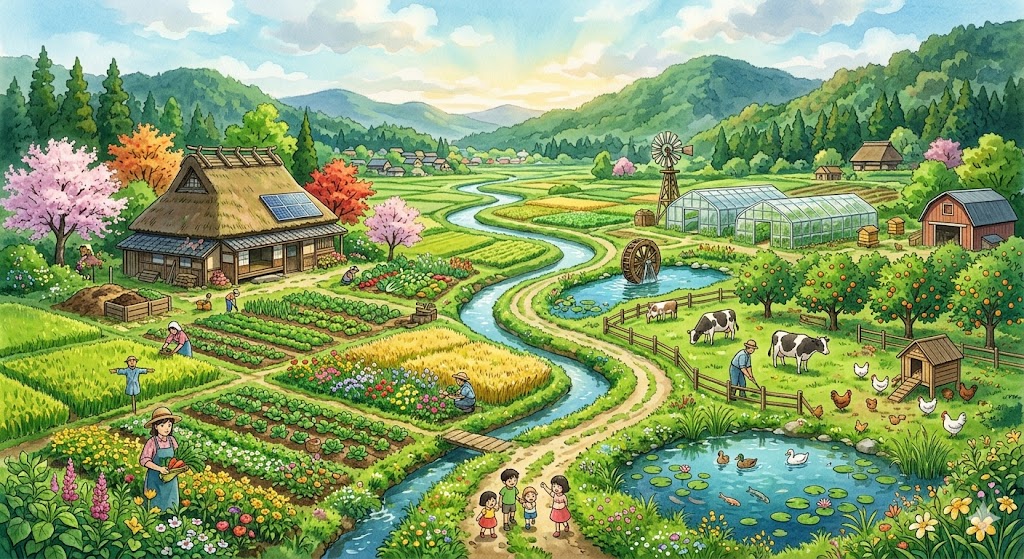
In an era marked by fluctuating market prices, rising input costs, and unpredictable climate patterns, relying on a single commercial crop is a major financial risk for modern growers. Monoculture farming not only depletes soil health but also leaves farmers completely vulnerable to market crashes or localized pest outbreaks.
To achieve long-term financial security and environmental resilience, global agriculture is shifting toward a highly strategic framework: Sustainable Integrated Farming Systems (IFS) and Multi-Crop Ecosystems. By mimicking natural ecological cycles and diversifying revenue streams, these systems drastically lower operational risks while pushing Return on Investment (ROI) to its absolute limit.
1. Understanding Integrated Farming Systems (IFS)
An Integrated Farming System (IFS) is a holistic resource management strategy that links multiple agricultural enterprises—such as crop cultivation, livestock rearing, aquaculture, agroforestry, and beekeeping—so that the waste product of one enterprise becomes a valuable input for another.
Instead of operating in silos, components are tightly woven into a circular bio-economy on the farm.
How a Closed-Loop System Cuts Input Costs:
- Livestock to Crops: Dairy cattle, goats, or poultry produce large volumes of manure. Instead of purchasing expensive synthetic nitrogen and phosphorus fertilizers, this manure is composted and applied to the fields, restoring soil organic matter for free.
- Crops to Livestock: Crop residues (such as maize stalks, wheat straw, or pulse husks) that are typically burned or discarded are processed into highly nutritious animal fodder.
- Biogas Integration: Livestock waste can be routed into an on-farm anaerobic digestor to generate biogas. This provides clean energy for farm operations (or household cooking) and yields a nutrient-rich liquid digestate that acts as an exceptional bio-fertilizer.
2. Designing High-Yield Multi-Crop Ecosystems
A Multi-Crop Ecosystem involves growing two or more crop species simultaneously on the same piece of land. This practice optimizes the use of spatial and environmental resources like sunlight, water, and soil nutrients.
Strategic Intercropping Frameworks
- Row Intercropping: Growing at least two crops simultaneously where at least one is planted in distinct rows. A classic example is planting high-yielding maize alongside low-growing, nitrogen-fixing cowpeas or soybeans.
- Relay Cropping: Planting a second crop into an existing standing crop before it is harvested. This maximizes land-use efficiency throughout the year without leaving the soil bare or unproductive.
- Agroforestry: Integrating perennial trees with seasonal crops. For instance, growing high-value timber or fruit trees (like walnut or citrus) alongside shade-tolerant forage crops or medicinal plants. The deep roots of the trees pump up nutrients from deep soil layers, making them accessible to shallower seasonal crop roots.
The Science of “Spatiotemporal Complementarity”
Multi-crop systems succeed because different plants occupy different ecological niches. For example, a deep-rooted taproot crop (like pigeon pea) draws water from deep underground layers, while a shallow-rooted fibrous crop (like finger millet) feeds on the topsoil. Because they do not compete for the exact same resource zone, total biomass production per square meter increases significantly.
3. Financial Analysis: Maximizing ROI in IFS
From a business standpoint, the primary metric that matters is ROI. Integrated and multi-crop systems consistently outperform monoculture setups across three distinct financial pillars:
De-Risking Cash Flow Through Diversification
In a monoculture system, a farmer receives a payout only once or twice a year after harvest. If a sudden pest outbreak or market price collapse occurs during that window, the entire year’s profit is wiped out.
An IFS creates a steady, diversified cash flow matrix:
- Daily Income: Dairy milk sales, poultry eggs.
- Seasonal Income: Short-duration vegetable harvests, grains, pulses.
- Long-Term Assets: Timber, orchard fruits, livestock sales.
Drastic Reduction in Operational Expenditure (OpEx)
By substituting commercial, synthetic inputs with on-farm biological inputs (e.g., replacing chemical fertilizer with vermicompost; replacing chemical pesticides with biological pest traps), the cash outflow of the farm drops dramatically. Lower production costs combined with stable yields translate directly into a wider profit margin and a significantly higher ROI.
4. The Synergy and ROI Comparison Matrix
| Farming Metric | Traditional Monoculture | Sustainable Multi-Crop & IFS |
| Input Cost Reliance | Extremely High (Chemicals, Seeds, Synthetic Fertilizers) | Low to Moderate (Closed-loop recycling of farm waste) |
| Risk Profile | High (Vulnerable to a single market drop or pest epidemic) | Low (Multi-tiered asset distribution offsets losses) |
| Soil Health & Vitality | Degrades over time (Requires increasing chemical doses) | Improves steadily (Natural nitrogen-fixation & organic matter) |
| Revenue Frequency | 1 to 2 times per year | Continuous (Daily, monthly, and seasonal income streams) |
| Long-Term ROI Potential | Declining due to rising input costs | Optimized and compounding year-over-year |
Conclusion: The Ultimate Agri-Business Blueprint
Transitioning from conventional monoculture to a Sustainable Integrated Farming System is the ultimate upgrade for modern agri-businesses. By building multi-crop ecosystems, farmers can utilize every square inch of their land, naturally regenerate soil fertility, and eliminate heavy reliance on costly chemical inputs.
Ultimately, IFS turns a volatile, unpredictable farming practice into a highly efficient, climate-resilient enterprise designed for maximum financial return.