Introduction
Agriculture is evolving to meet the growing demand for food while protecting natural resources and improving farmers’ livelihoods. Traditional farming often focuses on a single crop or enterprise, but modern agriculture encourages systems that maximize productivity, reduce waste, and generate multiple sources of income. One of the most effective approaches to achieving these goals is Integrated Farming.
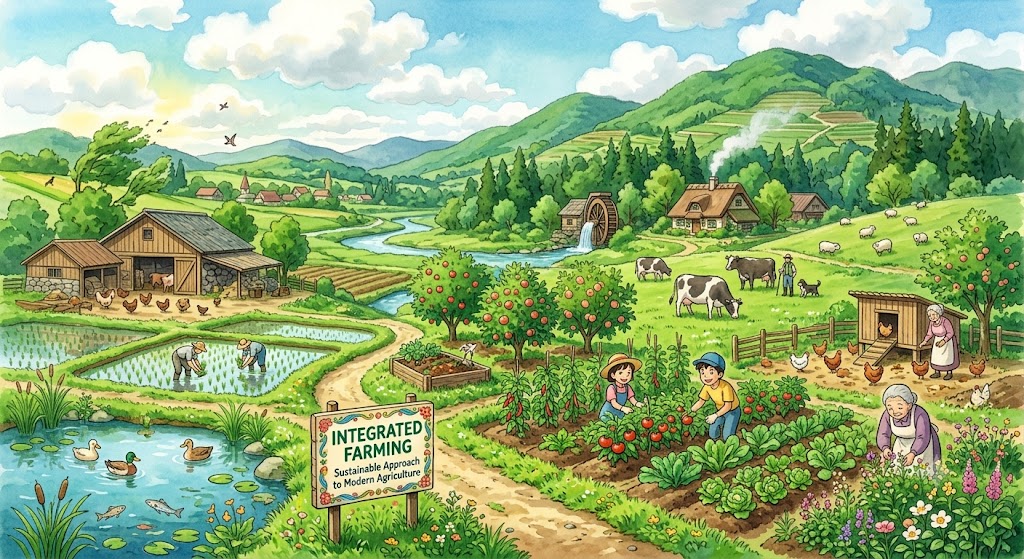
Integrated farming is a holistic agricultural system where different farming activities such as crop cultivation, livestock rearing, poultry farming, fish farming, horticulture, compost production, and agroforestry are combined on the same farm. These enterprises support one another by efficiently utilizing available resources. Waste from one activity becomes a valuable input for another, creating a self-sustaining and environmentally friendly farming system.
This farming model improves soil fertility, increases farm income, reduces production costs, and minimizes environmental pollution. It also helps farmers reduce financial risks by diversifying their agricultural activities instead of depending on a single source of income.
What is Integrated Farming?
Integrated farming is a farming system that combines multiple agricultural enterprises into one well-managed operation. Instead of growing only crops or raising only livestock, farmers integrate different activities to make better use of land, water, labor, and other available resources.
A typical integrated farm may include:
- Crop cultivation
- Dairy farming
- Poultry farming
- Fish farming
- Goat or sheep rearing
- Vegetable production
- Fruit orchards
- Compost preparation
- Vermicomposting
- Beekeeping
- Agroforestry
These components work together to improve overall farm efficiency and sustainability.
Why Integrated Farming is Important
Modern agriculture faces many challenges, including rising input costs, climate change, declining soil fertility, and unpredictable market prices. Integrated farming provides practical solutions by creating a balanced agricultural ecosystem.
Its importance includes:
- Reducing dependence on a single crop
- Improving farm profitability
- Conserving natural resources
- Increasing food production
- Reducing agricultural waste
- Promoting sustainable farming
- Enhancing rural employment
Integrated farming also provides greater financial stability because income comes from multiple agricultural activities throughout the year.
Key Components of an Integrated Farming System
Crop Production
Crop cultivation remains the foundation of most integrated farms. Farmers grow cereals, vegetables, fruits, pulses, or oilseed crops based on local climate and market demand.
Crop residues can later be used as livestock feed or compost material.
Livestock Farming
Cattle, goats, sheep, and buffalo play an important role in integrated farming.
Benefits include:
- Milk production
- Meat production
- Organic manure
- Additional income
- Improved nutrient recycling
Animal waste becomes valuable organic fertilizer for crop fields.
Poultry Farming
Poultry farming is an excellent addition to integrated agriculture.
It provides:
- Eggs
- Meat
- Organic manure
- Regular cash flow
Poultry manure is rich in nutrients and improves soil fertility when properly composted.
Fish Farming
Fish ponds can be integrated into agricultural systems to maximize water utilization.
Fish farming offers:
- High-quality protein
- Additional farm income
- Efficient water use
- Nutrient recycling
Water from fish ponds can also be used to irrigate crops.
Horticulture
Growing fruits, vegetables, herbs, and flowers increases farm diversity and profitability.
Popular horticultural crops include:
- Tomatoes
- Mangoes
- Bananas
- Papayas
- Spinach
- Chilies
These crops often provide higher returns than traditional field crops.
Compost and Vermicomposting
Organic waste from crops and livestock is converted into compost or vermicompost.
Benefits include:
- Improved soil fertility
- Better water retention
- Reduced chemical fertilizer use
- Enhanced microbial activity
Composting transforms farm waste into valuable organic fertilizer.
Resource Recycling in Integrated Farming
One of the greatest strengths of integrated farming is efficient resource recycling.
For example:
- Crop residues feed livestock.
- Livestock manure fertilizes crop fields.
- Poultry waste enriches compost.
- Compost improves soil fertility.
- Fish pond water irrigates crops.
- Crop waste becomes mulch or animal feed.
This cycle reduces waste while maximizing resource efficiency.
Benefits of Integrated Farming
Higher Farm Income
Multiple enterprises provide several income sources throughout the year, reducing financial uncertainty.
Better Resource Utilization
Every available resource is used efficiently, minimizing waste and increasing productivity.
Improved Soil Health
Organic manure and compost increase soil fertility and biological activity.
Reduced Production Costs
Farm-generated fertilizers and animal feed reduce dependence on purchased inputs.
Environmental Sustainability
Recycling nutrients and reducing chemical use help protect ecosystems and biodiversity.
Employment Opportunities
Integrated farms require labor throughout the year, creating additional rural employment.
Increased Food Security
Farmers produce cereals, vegetables, fruits, milk, eggs, meat, and fish from a single farm.
Modern Technologies Supporting Integrated Farming
Technology has made integrated farming more productive and easier to manage.
Artificial Intelligence (AI)
AI helps monitor crops, livestock health, and weather conditions while improving farm planning.
Internet of Things (IoT)
Smart sensors measure soil moisture, temperature, humidity, and livestock conditions in real time.
Smart Irrigation
Automated irrigation systems conserve water while ensuring healthy crop growth.
Agricultural Drones
Drones inspect fields, monitor crop health, and identify pest or disease outbreaks.
Farm Management Software
Digital platforms help farmers maintain production records, monitor expenses, and improve decision-making.
Challenges of Integrated Farming
Although integrated farming offers many advantages, farmers may face several challenges.
Initial Investment
Developing multiple farming enterprises requires careful financial planning.
Technical Knowledge
Farmers need training in crop production, livestock care, aquaculture, and organic farming.
Labor Requirements
Managing several farm activities requires good planning and efficient labor management.
Market Access
Farmers need reliable markets for selling different agricultural products.
Best Practices for Successful Integrated Farming
Farmers can improve success by following these recommendations:
- Select enterprises suitable for local conditions.
- Conduct regular soil testing.
- Maintain proper livestock health management.
- Recycle farm waste efficiently.
- Use drip irrigation to conserve water.
- Grow diversified crops throughout the year.
- Apply organic compost regularly.
- Monitor crops and animals frequently.
- Keep accurate farm records.
- Continue learning modern farming techniques.
Future of Integrated Farming
Integrated farming is expected to play an increasingly important role in global agriculture. Growing concerns about climate change, food security, and environmental sustainability are encouraging farmers to adopt diversified farming systems.
Future developments include:
- AI-powered farm management
- Climate-smart integrated agriculture
- Renewable energy-powered farms
- Precision livestock management
- Vertical farming integration
- Smart greenhouse systems
- Automated compost production
- Digital agricultural monitoring
These innovations will improve productivity while reducing environmental impact.
Why Integrated Farming Supports Sustainable Agriculture
Integrated farming creates a balanced agricultural ecosystem where crops, livestock, fisheries, and other farm activities work together instead of operating independently. This interconnected approach reduces waste, conserves natural resources, improves biodiversity, and strengthens the resilience of farming systems against climate change.
By reducing dependence on chemical inputs and maximizing resource efficiency, integrated farming contributes to long-term agricultural sustainability while supporting healthier ecosystems and stronger rural communities.
Conclusion
Integrated farming is one of the most effective approaches to sustainable agriculture. By combining crop production, livestock farming, poultry, fisheries, horticulture, composting, and other agricultural enterprises, farmers can improve productivity, increase income, and make better use of available resources.
This farming system not only reduces production costs and environmental pollution but also creates a resilient agricultural model capable of adapting to changing climate conditions and market demands. With the support of modern technologies such as Artificial Intelligence, smart irrigation, IoT sensors, and precision agriculture, integrated farming is becoming even more efficient and profitable.
As agriculture continues to evolve, integrated farming will remain a key strategy for achieving food security, environmental conservation, and long-term economic success for farming communities around the world.