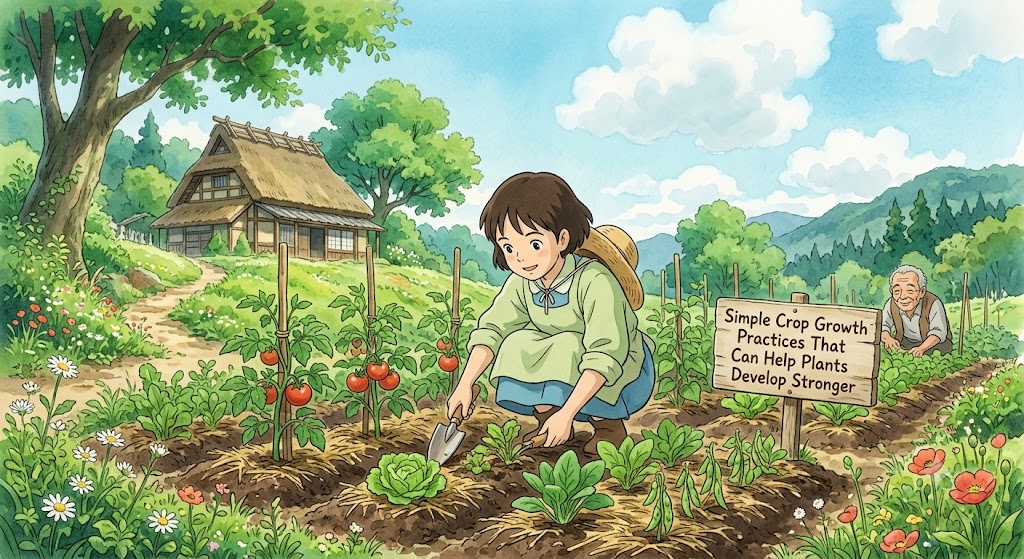
Growing a healthy crop is not usually the result of one special technique or expensive product. Strong plants are generally the result of many small decisions made throughout the season, from preparing the soil and selecting suitable varieties to managing water, nutrients, weeds, pests, and harvest timing.
For farmers across the United States, crop conditions can vary significantly between regions and even between fields on the same farm. A practice that works well in Iowa may need to be adjusted for Arizona, California, Texas, or Georgia.
The good news is that many crop-growth practices are straightforward. Farmers can combine traditional field knowledge with modern tools such as soil testing, GPS equipment, weather technology, sensors, satellite imagery, and farm-management software.
The objective is simple: give plants the conditions they need to establish strong roots, maintain healthy growth, and produce a reliable harvest.
Start With Healthy Soil
Strong crops begin below the soil surface.
Healthy soil provides roots with water, air, nutrients, and physical support.
Before planting, farmers should understand the condition of their fields through soil testing and field observation.
A soil test can provide useful information about pH and nutrient availability.
Farmers should also look for:
- Compaction
- Poor drainage
- Erosion
- Low organic matter
- Uneven soil conditions
- Areas with repeated weak crop growth
Not every field needs the same treatment.
Using field-specific information can help farmers avoid unnecessary inputs while focusing resources where they are most useful.
Choose Crops and Varieties That Fit the Farm
Crop selection has a major influence on final performance.
Farmers should consider climate, soil type, growing-season length, water availability, disease pressure, market requirements, and expected yield when selecting varieties.
A variety with excellent performance in one region may not perform the same way elsewhere.
Local trial data and recommendations can be particularly valuable.
Farmers should also consider whether the crop fits the farm’s equipment and marketing system.
A variety that produces impressive yields but is difficult to harvest or market may not provide the best overall result.
Give Seeds a Strong Start
Plant establishment is one of the most important stages of crop development.
Seeds need suitable moisture, temperature, depth, and soil contact to germinate successfully.
Planting too deeply can delay emergence.
Planting too shallow can leave seeds vulnerable to drying or other environmental problems.
Farmers should follow crop-specific planting recommendations and pay attention to field conditions.
Uniform emergence is especially valuable because plants that emerge at very different times may compete unevenly throughout the season.
A strong beginning gives the crop a better chance to compete with weeds and handle environmental stress later.
Protect the Root Zone
Roots are responsible for accessing much of the water and nutrients required for plant growth.
Soil compaction can restrict root development and reduce the movement of air and water through the soil.
Heavy equipment traffic is one potential source of compaction, particularly when fields are worked while wet.
Where practical, farmers can reduce unnecessary traffic and avoid entering fields under unsuitable conditions.
GPS guidance and planned traffic patterns can also help reduce repeated passes over the same areas.
Healthy roots often translate into more resilient plants.
Maintain Appropriate Soil Moisture
Water management is critical throughout the growing season.
Too little water can cause stress, while excessive moisture can create problems with oxygen availability around roots and increase disease risks for some crops.
Farmers should monitor rainfall, soil moisture, crop development, and weather conditions.
Modern soil-moisture sensors can provide useful information about conditions below the surface.
Instead of relying entirely on a fixed irrigation schedule, farmers can use actual field information to determine when irrigation may be needed.
The objective is not simply to use less water.
It is to provide enough water at the right time without unnecessary applications.
Provide Balanced Nutrition
Plants require nutrients throughout their development.
Nitrogen, phosphorus, potassium, and several micronutrients can all play important roles, but crop requirements vary.
Applying more fertilizer does not automatically produce healthier plants.
Excess nutrients can increase costs and may contribute to environmental problems.
A better approach is to combine soil testing, crop requirements, historical field information, and realistic yield goals.
Split applications may also be appropriate for certain crops and production systems.
Farmers should follow local agronomic recommendations and applicable regulations when developing nutrient programs.
Use Organic Matter to Support Soil Quality
Organic matter contributes to soil structure and biological activity.
Crop residues, roots, compost, and appropriately managed organic amendments can contribute organic material.
Keeping residue on the field where appropriate can also protect the soil surface.
Over time, good organic-matter management can support a healthier environment for crop roots.
However, organic amendments should be applied carefully.
Farmers need to consider nutrient content, application rates, crop requirements, and potential environmental impacts.
The goal is to build a balanced soil-management system rather than simply adding as much organic material as possible.
Control Weeds Early
Young crops can be particularly vulnerable to competition from weeds.
Weeds compete for water, nutrients, light, and space.
Regular field scouting can help farmers identify problems before weed populations become difficult to manage.
An integrated strategy may include:
- Crop rotation
- Cover crops
- Mulches
- Mechanical cultivation
- Appropriate crop spacing
- Herbicides when needed
The right combination depends on the crop and production system.
Early attention is usually more efficient than waiting until weeds have matured and produced large amounts of seed.
Monitor Plants Throughout the Season
Crop management should not stop after planting.
Farmers should regularly inspect plants for changes in:
- Leaf color
- Growth rate
- Plant density
- Root development
- Pest damage
- Disease symptoms
- Water stress
- Nutrient problems
Field scouting provides information that can guide decisions throughout the season.
Modern satellite imagery and drone technology can add another layer of information.
If one part of a field begins showing unusual growth, digital imagery may help identify the location so it can be inspected more closely.
Watch for Pests Before They Become Major Problems
Insects and other pests can damage crops quickly under favorable conditions.
Regular scouting helps farmers understand whether pest populations are increasing.
Integrated pest management focuses on monitoring populations and using appropriate control methods when needed.
Farmers can combine crop rotation, biological control, resistant varieties, field sanitation, cultural practices, and crop-protection products where appropriate.
The goal is not automatically to eliminate every insect.
Some insects are harmless or beneficial.
Good pest management focuses on preventing economically important damage while avoiding unnecessary treatments.
Manage Plant Diseases Proactively
Disease prevention often starts before symptoms appear.
Good crop rotation, suitable planting conditions, appropriate spacing, resistant varieties, and proper irrigation can reduce favorable conditions for some diseases.
Farmers should be careful when watering foliage because prolonged leaf wetness can create favorable conditions for certain pathogens.
Disease symptoms should be identified accurately before treatment decisions are made.
A yellow leaf, for example, could be caused by nutrient stress, water problems, pests, disease, or environmental conditions.
Accurate diagnosis prevents unnecessary action.
Keep the Soil Covered
Soil protection can directly support crop development.
Crop residue and cover crops can reduce erosion and help maintain moisture.
Cover crops may also contribute organic matter and support soil biological activity.
Keeping soil protected can be particularly valuable during periods between major crops.
Farmers should choose cover crops based on local climate, soil, following crop, water availability, and management capabilities.
The right cover crop can support both soil quality and future crop production.
Use Crop Rotation for Long-Term Growth
Crop rotation can improve the overall production system.
Different crops use nutrients differently and have different root structures.
Rotation can also interrupt certain pest and disease cycles.
For example, continuously growing the same crop can create favorable conditions for organisms and weeds associated with that crop.
Introducing another crop can change those conditions.
A good rotation should support soil health while also fitting the farm’s market and equipment requirements.
Use Modern Technology Where It Provides Real Value
Technology can make crop management more efficient.
Farmers can use:
- GPS guidance
- Soil-moisture sensors
- Weather stations
- Satellite imagery
- Drones
- Yield monitors
- Digital field maps
- Farm-management software
- AI-assisted analysis
These tools can help farmers identify changes earlier and compare field performance.
For example, yield maps can reveal areas that consistently underperform.
Soil testing can then help determine whether those areas have nutrient, pH, drainage, or other problems.
Technology is most useful when it helps answer a practical question.
Farmers do not need every available tool.
They need the tools that solve problems on their particular farm.
Keep Good Records
Farm records can become one of the most valuable resources over time.
Record planting dates, varieties, fertilizer applications, irrigation, weather conditions, pest problems, treatments, yields, and unusual field observations.
After several seasons, these records can reveal patterns.
You may discover that a particular field consistently performs better when planted during a certain period or that one section repeatedly experiences water stress.
Historical records turn individual observations into long-term knowledge.
Prepare for Weather Stress
Weather can change crop conditions quickly.
Farmers should monitor forecasts throughout the season and consider how upcoming conditions may affect irrigation, spraying, cultivation, and harvesting.
Weather technology can provide useful information, but local field observation remains important.
A forecast may predict rain, but the amount received can vary significantly across a region.
The combination of weather information and field observations creates a more practical decision-making system.
Avoid Trying to Fix Everything at Once
Farmers sometimes see multiple problems and attempt to change the entire production system in one season.
That can make it difficult to determine which changes actually worked.
A better strategy may be to identify one or two important weaknesses.
For example:
- Poor irrigation timing
- Uneven plant emergence
- Compaction
- Weed pressure
- Nutrient management
- Pest monitoring
Make a manageable improvement and track the result.
Gradual improvement is often easier to maintain and evaluate.
A Simple Seasonal Crop-Growth Routine
A practical crop-care plan can follow the growing season.
Before Planting
- Test the soil.
- Review field history.
- Select suitable varieties.
- Check seed quality.
- Plan nutrient requirements.
- Inspect irrigation systems.
- Prepare equipment.
During Planting
- Monitor soil conditions.
- Maintain appropriate planting depth.
- Aim for uniform emergence.
- Avoid unnecessary field traffic.
Early Season
- Scout for weeds.
- Check plant emergence.
- Monitor moisture.
- Look for early pest problems.
- Correct nutrient issues when confirmed.
Mid-Season
- Continue scouting.
- Monitor water requirements.
- Watch for disease.
- Review crop growth.
- Use imagery or sensors where useful.
Before Harvest
- Monitor crop maturity.
- Prepare harvesting equipment.
- Check weather conditions.
- Plan transportation and storage.
- Estimate expected yield.
This simple structure can help keep crop management organized without making it unnecessarily complicated.
Final Thoughts
Healthy crop growth is built through consistent management rather than one dramatic intervention.
For farmers across the United States, the strongest results often come from combining basic agricultural practices with modern information tools.
Start with healthy soil. Choose suitable crops and varieties. Give seeds good conditions for establishment. Protect roots from compaction. Manage water and nutrients carefully. Scout regularly for weeds, pests, and disease. Protect the soil surface and maintain useful records.
Technology can make many of these tasks easier.
Sensors can monitor moisture. Satellites can identify unusual crop patterns. GPS can improve field operations. Yield maps can reveal differences between fields. AI can help organize and analyze information.
But the technology should support the farmer’s knowledge—not replace it.
The healthiest crops are usually the result of many small decisions made at the right time. By paying attention throughout the entire growing season and making practical adjustments when conditions change, farmers can create stronger crops, use resources more efficiently, and build a more productive farming system for future seasons.