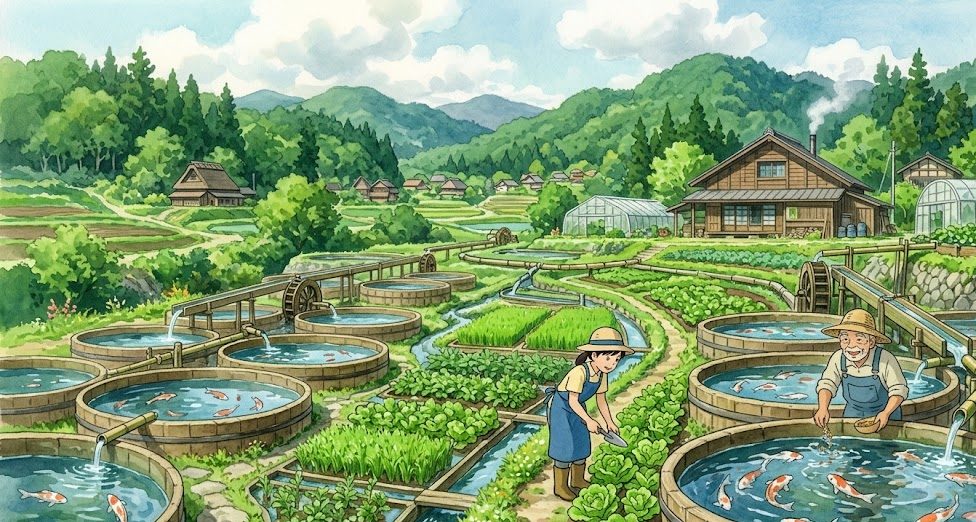
In the current agricultural landscape, water is arguably the most precious commodity a farmer possesses. As droughts become more frequent and the cost of irrigation continues to rise, the traditional model of “flood and drain” farming is becoming increasingly unsustainable—both environmentally and financially.
For the forward-thinking farmer, the solution isn’t just to save water; it is to repurpose it. Integrated farming, specifically the combination of aquaculture (fish farming) and horticulture (crop production), allows you to turn a single drop of water into a double-harvest asset.
The Profitability of Circular Systems
The primary barrier to profitability in small-scale farming is the high cost of inputs—specifically synthetic fertilizers and water management infrastructure. In an integrated fish-and-crop system, you effectively eliminate these costs by creating a circular loop.
When you raise fish, they produce waste. In a traditional fish pond, this waste is a liability that you have to pump out and discard. In an integrated system, that waste is your greatest asset. It is packed with ammonia, which, through the action of beneficial bacteria, is converted into nitrogen—the single most important nutrient for plant growth.
By cycling this “nutrient-rich water” through your crop beds, you are doing two things simultaneously:
- Cleaning the water for the fish, ensuring they grow faster and stay healthier.
- Feeding the plants for free, eliminating the need to purchase expensive, volatile synthetic fertilizers.
This “two-for-one” production strategy dramatically increases your revenue per square foot.
Water: The Asset, Not the Expense
Water is the carrier of value in this system. Instead of applying water to soil where much of it evaporates or drains away unused, you keep it in a contained environment where it circulates continuously.
- Closed-Loop Efficiency: Integrated systems use up to 90% less water than soil-based farming. By minimizing water loss through transpiration and evaporation, you insulate your farm against regional water shortages and utility price hikes.
- Smart Monitoring for Better Yields: Integrating IoT sensors into your water management system can take your profitability to the next level. Sensors that monitor $pH$, temperature, and dissolved oxygen levels in real-time allow you to optimize conditions for both fish and crops. A system running at peak biological efficiency grows plants faster, meaning more harvest cycles per year.
Diversification as Risk Mitigation
One of the biggest risks to a small-scale farm is reliance on a single crop. If a pest outbreak or a weather event hits your primary harvest, your income for the entire season can vanish. Integrated farming provides a natural hedge against this:
- Multiple Income Streams: You have the fish (a high-protein, high-demand commodity) and the plants (a daily-demand, high-margin fresh product). If the market price for fish fluctuates, your vegetable sales provide stability. If a pest affects one crop variety, your fish production continues unabated.
- Premium Market Positioning: Customers are increasingly willing to pay a premium for “sustainably grown” and “water-wise” produce. By marketing your farm as one that uses integrated, zero-waste techniques, you can distance yourself from bulk-commodity competitors and command higher prices in local markets, restaurants, and direct-to-consumer subscription programs (CSAs).
Practical Strategies for Maximizing ROI
To turn this system into a profit engine, you must focus on the “heavy lifters” of the agricultural world.
1. Choose High-Value Crop Varieties
Do not waste your system’s output on low-value crops like basic grain. Focus on high-margin, high-turnover crops. Herbs like basil, mint, and cilantro, or premium leafy greens like arugula and kale, thrive in nutrient-rich water and can be harvested weekly. This provides the constant cash flow needed to keep the system profitable.
2. Master the “Fish-to-Plant” Ratio
Profitability is a game of balance. If your fish-to-plant ratio is off, you will either have nutrient deficiencies (if you don’t have enough fish) or toxic water (if you have too many). Start with a ratio that favors a high volume of water relative to fish density to ensure stability, then scale up your fish density as you master the water chemistry.
3. Monetize the “Clean” Advantage
Because this system cannot tolerate synthetic pesticides (they kill the fish), your produce is organic by necessity. Ensure your branding highlights this. A sign at the farmers’ market that says “Organically grown in a water-saving, integrated system” is a powerful sales tool that justifies a higher price point.
The Future is Closed-Loop
Integrating fish and crop farming is more than just a technique; it is a fundamental shift in how we manage the economics of farming. It moves us away from the “buy-and-use” model of resource management and into an era of stewardship and efficiency.
By treating water as a reusable asset and utilizing natural biological processes to replace expensive inputs, you aren’t just farming; you are managing a high-efficiency production factory.
As you refine your system, your overhead drops, your yields become more predictable, and your resilience to market and climate shocks increases. In a world of tightening resources, those who learn to master these closed-loop, smart water systems will not just survive—they will set the standard for the next generation of agriculture.