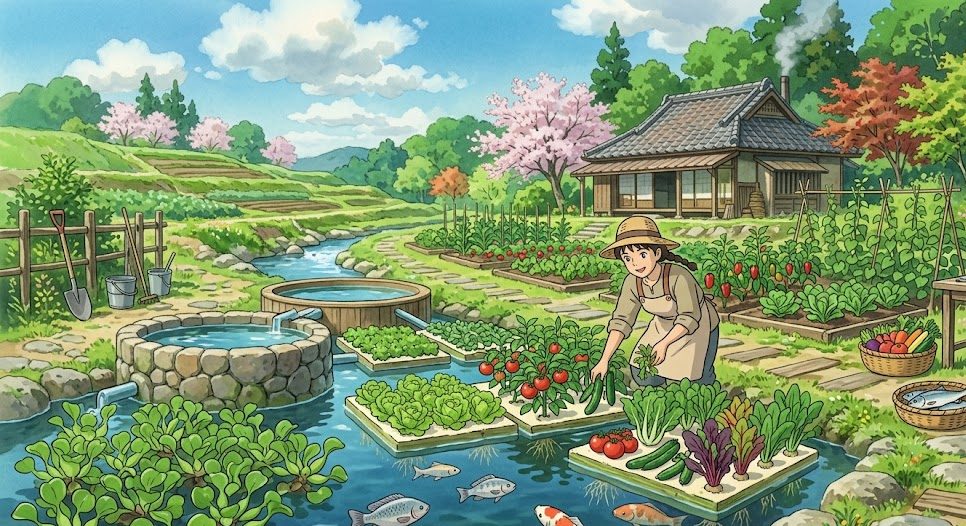
The global food market is shifting. Consumers are no longer satisfied with just staples; there is a massive surge in demand for Exotic Vegetables (like Bok Choy, Kale, and Bell Peppers) and High-Quality Protein (Fish). Integrating these two through Aquaponics or Integrated Agri-Aquaculture (IAA) is not just a farming choice—it’s a high-margin business strategy.
1. Understanding the Integration: The Aquaponic Cycle
The core of this integration is a symbiotic relationship. In a traditional setup, fish waste (ammonia) is a pollutant that must be removed. In an integrated system, this waste becomes the “gold” that feeds the plants.
- The Fish: Produce waste rich in ammonia.
- The Bio-Filter: Beneficial bacteria convert ammonia into Nitrites and then Nitrates.
- The Vegetables: Act as a natural filter, absorbing Nitrates as primary fertilizer and cleaning the water.
- The Result: Purified water is recirculated back to the fish tanks, reducing water consumption by up to 90%.
2. Top Profitable Exotic Vegetables
Exotic vegetables command a premium price in urban markets, hotels, and organic stores. Here are the best candidates for integrated farming:
A. Leafy Greens (High Turnover)
- Kale & Swiss Chard: Superfoods with high market value and fast growth cycles (30–45 days).
- Bok Choy & Tatsoi: Essential for Asian cuisine, these thrive in nutrient-rich water.
- Lettuce (Iceberg/Romaine): The “bread and butter” of aquaponics due to constant demand.
B. Gourmet Herbs
- Basil (Genovese/Thai): High oil content and aroma make it a favorite for restaurants.
- Mint & Oregano: Resilient crops that can be harvested multiple times from a single planting.
C. Vine Crops (High Value)
- Cherry Tomatoes: High sugar content and aesthetic appeal.
- Colored Bell Peppers: While they take longer to grow (90+ days), their market price is often 3x higher than green capsicum.
3. Selecting the Right Fish Species
For maximum profit, the fish must be hardy, fast-growing, and have high market demand.
| Fish Species | Growth Period | Temperature Range | Market Value |
| Tilapia | 6–9 Months | 24°C – 30°C | High (Volume) |
| Catfish (Clarias) | 4–6 Months | 25°C – 32°C | High (Resilience) |
| Barramundi (Asian Sea Bass) | 12 Months | 26°C – 30°C | Premium |
| Koi/Goldfish | Ongoing | Variable | Ornamental Market |
4. Setup and Technical Infrastructure
To build a 1,000-word-level operation, you need a structured layout:
Step 1: Tank Selection
Use food-grade IBC containers or reinforced concrete tanks. For every 1 kg of fish, you can typically support 2–4 square feet of plant growing space, depending on the feeding rate.
Step 2: Grow Bed Systems
- Media Based: Using expanded clay pebbles or gravel. Great for heavy plants like tomatoes.
- Deep Water Culture (DWC): Plants float on rafts with roots submerged in the water. Best for leafy greens.
- Nutrient Film Technique (NFT): Water flows through narrow PVC pipes. Ideal for herbs.
5. The Economics of Profitability
Why is this more profitable than traditional farming?
- Dual Income Stream: You sell both the protein (fish) and the produce (vegetables).
- No Fertilizer Costs: The fish provide all necessary Nitrogen, Phosphorus, and Potassium (NPK).
- Space Efficiency: Vertical integration allows you to grow 5x more food per square foot compared to soil.
- Premium Branding: Integrated products can be marketed as “Pesticide-Free,” “Organic,” or “Hyper-Local,” allowing for a 20–50% price markup.
6. Management and Maintenance
Success in integrated farming requires balance. If the fish get sick, the plants lose their food; if the plants fail, the fish drown in their own waste.
- Water Quality: Monitor pH (ideal 6.8–7.2), Dissolved Oxygen (DO), and Ammonia levels daily.
- Feeding: Use high-quality floating pellets to ensure the fish grow at optimal rates.
- Pest Management: Since you cannot use chemical pesticides (they would kill the fish), use Biological Controls like Ladybugs or Neem Oil.
7. Market Entry Strategy
To ensure your 1,000-word plan translates into cash:
- Direct-to-Consumer (D2C): Use subscription boxes (CSAs) for exotic salads.
- B2B Partnerships: Partner with high-end cafes and sushi bars that require fresh herbs and fish daily.
- Agri-Tourism: Modern farms are beautiful. You can charge for tours and workshops to create a third revenue stream.