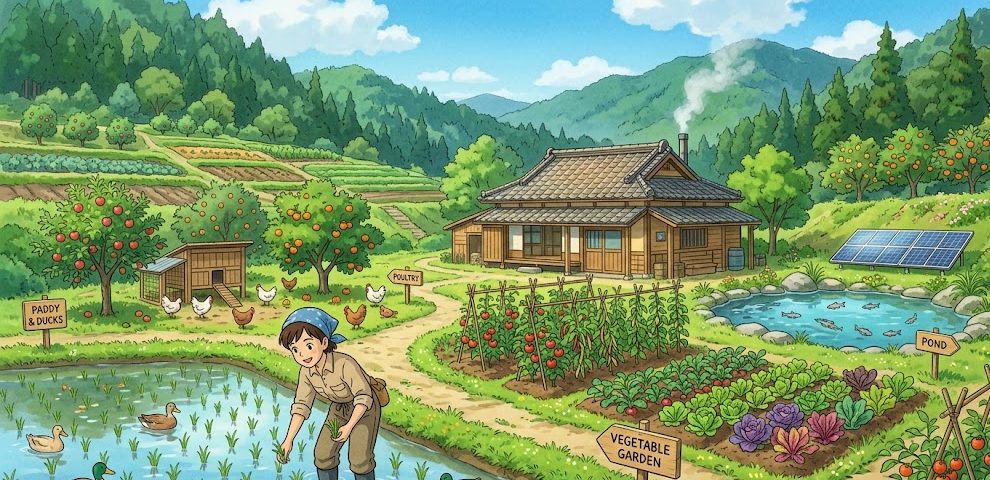
In the traditional agricultural model, a farmer relies on a single source of income—be it a seasonal wheat harvest, a dairy herd, or a fruit orchard. While this “specialized” approach has been the norm for decades, it carries significant financial risk. A single pest outbreak, a drop in market prices, or an unexpected drought can wipe out a year’s worth of profit.
Enter the Integrated Farming System (IFS). This is not just a farming method; it is a strategic business model designed to create a circular economy on your land. By diversifying your operations and allowing different agricultural branches to support one another, you can drastically reduce your input costs and—most importantly—double your monthly cash flow.
1. What is an Integrated Farming System (IFS)?
Integrated Farming is a resource management strategy that combines multiple agriculture-based activities—such as crop production, livestock, poultry, fisheries, and even beekeeping—within the same land unit.
The magic of IFS lies in the synergy. The waste product of one component becomes the high-value input for another. This “closed-loop” system eliminates waste and ensures that your farm is producing something of value every single day of the year, rather than just once or twice a harvest season.
2. The Mechanics of Doubling Income: Diversified Revenue Streams
The primary reason farmers struggle with cash flow is the “gap” between harvests. IFS fills these gaps by providing daily, weekly, and monthly income sources.
- Daily Income (The Cash Flow Engine): Activities like Dairy farming or Poultry (egg production) provide a steady stream of daily cash. Selling milk or eggs ensures you have liquidity to cover daily operational expenses without taking high-interest loans.
- Weekly/Monthly Income: Short-cycle crops like mushrooms, leafy greens, or broiler chickens can be harvested every 30 to 45 days. This provides a “salary-like” structure to your farm’s finances.
- Seasonal Income (The Bonus): Traditional field crops (grains, pulses) or fruit orchards provide large, lump-sum payments twice a year, which can be used for major capital investments or debt repayment.
3. The “Waste-to-Wealth” Equation: Cutting Costs by 40%
Profitability is defined by (Revenue−Cost). IFS focuses heavily on the “Cost” side of the equation. By recycling nutrients on-site, you can slash your dependency on expensive external markets.
- Livestock to Crop: Instead of buying chemical fertilizers, use cow dung and poultry litter to create high-quality organic compost or Vermicompost. This saves thousands on urea and DAP while improving soil health long-term.
- Crop to Livestock: Crop residues (like wheat straw or corn stalks) that are usually burned can be processed into nutritious animal feed or used as bedding for poultry.
- The Pond Synergy: If you have a fish pond, the nutrient-rich water from the pond is “liquid gold” for your crops. Using this water for irrigation reduces the need for supplemental nitrogen.
4. Case Study: A High-Profit 1-Acre IFS Model
To understand how income doubles, let’s look at a realistic integration for a small-to-medium landholding:
- Main Crop (60% of land): High-value vegetables or grains.
- Dairy (2-3 Cows): Provides daily milk sales and manure for the fields.
- Poultry (Small Batch): 100-200 birds for eggs or meat.
- Boundary Planting: Planting fruit trees (Papaya, Lemon, or Drumstick) along the edges of the field. These require zero extra land but provide a massive secondary income.
- Beekeeping: Placing 5-10 bee boxes. Bees increase crop pollination (boosting yields by 20%) while producing honey and wax for sale.
The Financial Result: By adding just the poultry and boundary trees to a traditional dairy/crop farm, the net monthly profit can increase by 80% to 110% because the “maintenance cost” for the new additions is almost zero—they live off the existing farm’s ecosystem.
5. Risk Mitigation: The Ultimate Insurance Policy
In a single-crop system, if the market price for “Tomatoes” crashes, the farmer loses everything. In an Integrated System, you are protected by Market Hedging.
If the price of your main crop falls, the price of milk or honey might be at an all-time high. This diversity acts as a natural insurance policy, ensuring that your monthly bank balance never hits zero, regardless of market volatility or climate shifts.
6. Steps to Transition to an Integrated Model
You don’t need to change everything overnight. The best agropreneurs build their systems in stages:
- Step 1: Audit Your Waste. Identify what you are currently throwing away or burning. Is it straw? Manure? Fruit peels?
- Step 2: Add a “Secondary” Component. If you are a crop farmer, add 50 chickens. If you are a dairy farmer, start a small mushroom shed using the space in your barn.
- Step 3: Master the Nutrient Loop. Ensure the waste from your new component is being used to fuel your old one.
- Step 4: Automate and Scale. Once the loop is working, use small-scale automation (like automated drinkers for poultry or drip irrigation) to manage the increased complexity without increasing labor hours.
The Efficiency Matrix: Traditional vs. Integrated
| Feature | Traditional Farming | Integrated Farming (IFS) |
|---|---|---|
| Income Frequency | 2 times per year | Daily / Weekly / Seasonal |
| Input Costs | High (External buys) | Low (Self-sustaining) |
| Risk Level | High (Single point of failure) | Low (Diversified) |
| Resource Use | Linear (Wasteful) | Circular (Optimized) |
| Net Profit | Baseline | 2x to 3x Baseline |
Export to Sheets
7. Conclusion: The Rise of the Smart Farmer
Doubling your income in agriculture isn’t about working twice as many hours; it’s about making your resources work twice as hard. Integrated Farming Systems represent the pinnacle of modern “Smart Farming.”
By viewing your farm as a single, breathing organism where every part supports the other, you move from being a “price-taker” to a “price-maker.” You reduce your vulnerability, eliminate your waste, and build a resilient business that provides consistent, high-value monthly income for your family.
The future of farming is integrated. Are you ready to double your harvest?