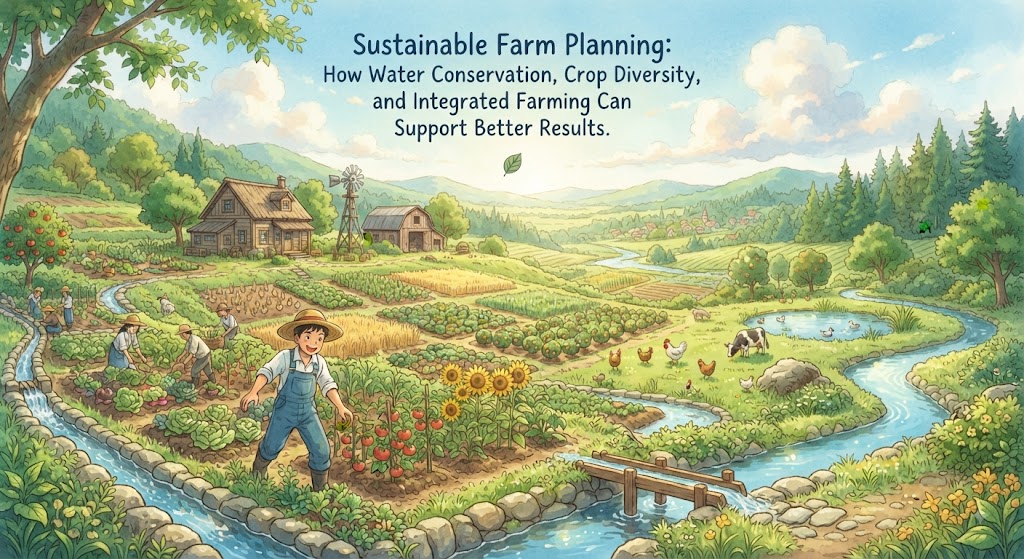
Farming is often romanticized as a simple life of planting seeds and waiting for the sun, but the reality is far more demanding. It is a complex, open-air biological business exposed to drought, market crashes, and soil degradation. Building a sustainable farm isn’t just about being environmentally friendly; it is about building a system so resilient that it can survive the worst seasons and maximize profit during the best ones.
To achieve that, a farm must step away from the fragile model of single-crop, resource-heavy agriculture. The most robust farm plans rely on a three-pillar foundation: Water Conservation, Crop Diversity, and Integrated Farming.
Here is how combining these elements creates a highly efficient, self-sustaining agricultural engine.
Pillar 1: Water Conservation (Precision Over Volume)
Water is the ultimate limiting factor in agriculture. Pumping endless gallons of water onto bare dirt is a fast track to depleted aquifers, washed-away topsoil, and massive electricity bills. Sustainable planning flips the script from watering the field to hydrating the root zone.
- Smart Soil Monitoring: Relying on visual checks is a gamble. Deploying IoT (Internet of Things) soil moisture probes provides real-time data directly to a smartphone. This ensures irrigation systems only run when the root zone actually drops below a specific moisture threshold, cutting water waste by up to 30%.
- Sub-Surface Drip Irrigation: Overhead sprinklers lose massive amounts of water to wind and evaporation. Laying drip tape directly at the base of the plants—and covering it with a thick layer of organic mulch like straw—ensures nearly 100% of the water reaches the plant.
- Biological Sponges: Increasing the soil’s organic matter through compost allows the earth to hold exponentially more water, creating a natural drought buffer that reduces the need to pump water in the first place.
Pillar 2: Crop Diversity (Biological and Financial Insurance)
Growing a single crop (monoculture) across massive acreage is a massive liability. If a specific pest or disease targets that plant, or if the market price for that commodity crashes, the entire season is a total loss.
- Nutrient Cycling: Different plants require different diets. Heavy feeders like corn strip nitrogen from the soil. By rotating corn with legumes (like beans or peas) the following season, the soil is naturally replenished, as legumes pull nitrogen from the atmosphere and fix it back into the dirt.
- Pest Confusion: Massive fields of identical crops act as a neon buffet sign for pests. Mixing plant families and incorporating companion flowers disrupts pest migration patterns and attracts predatory insects, offering natural pest control.
- Market Protection: Staggering different crops ensures multiple revenue streams. If an early heatwave damages the cool-weather greens, the heat-loving peppers and eggplants will thrive, ensuring the farm still generates cash flow.
Pillar 3: Integrated Farming (The Zero-Waste Ecosystem)
The ultimate goal of sustainable farm planning is to close the loop. In a conventional setup, a farmer pays to remove crop waste and then pays again to bring in synthetic fertilizer. Integrated farming links different agricultural activities so that the waste of one system becomes the fuel for another.
- Livestock Integration: Bringing livestock, such as cattle or goats, into the rotation drastically changes the farm’s efficiency. After a cash crop is harvested, the animals can be rotated into the field using smart, portable electric fencing.
- Free Feed and Fertilizer: The livestock graze on the leftover crop residue, turning agricultural waste into high-value protein (meat or milk). In return, their manure is trampled directly into the earth, providing a massive, free injection of organic fertilizer right where it is needed for the next planting season.
- Weed Management: Foraging animals can be used strategically to clear overgrown pastures or cover crops, saving hours of mechanical mowing and diesel fuel costs.
The Synthesis: How the Three Pillars Work Together
When you isolate these practices, they offer incremental improvements. When you combine them, they fundamentally change the economics of the farm.
| Farm Pillar | The Conventional Approach | The Sustainable, Integrated Approach |
| Water | Scheduled overhead watering leading to evaporation and runoff. | Sensor-driven drip irrigation under mulch, saving pumping costs. |
| Crops | Monoculture planting requiring massive synthetic chemical inputs. | Rotational diversity that builds soil health and spreads financial risk. |
| Livestock | Confined feeding operations relying on purchased commercial grain. | Rotational grazing on crop residue, providing free feed and on-site fertility. |
Sustainable farm planning requires stepping back and looking at the land as a single, connected organism. The smart technology monitors the soil, the diverse crops protect the ecosystem, and the livestock manage the waste. By designing a farm to mimic nature rather than fight it, you reduce your input costs, protect your natural resources, and secure a much stronger bottom line.