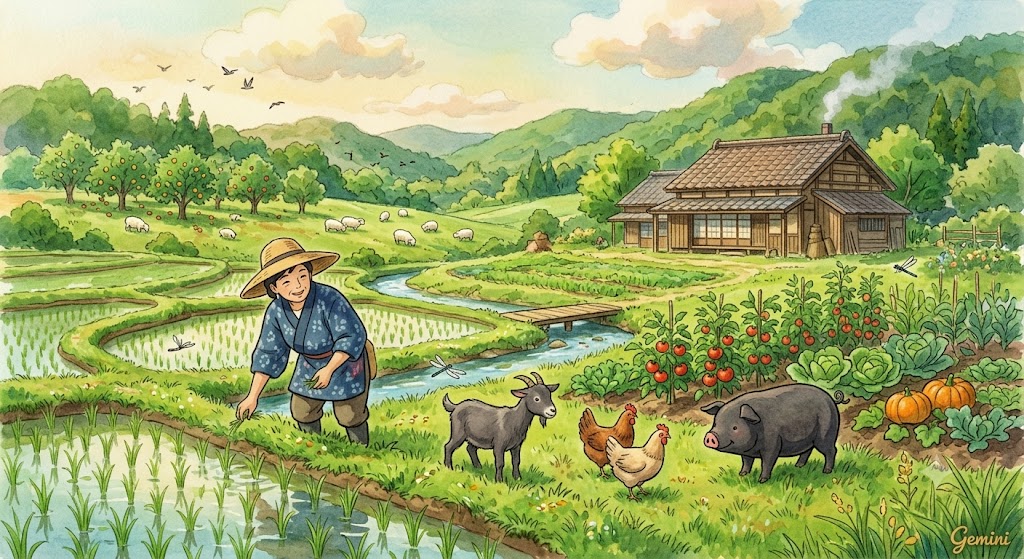
Farmers Build More Productive, Sustainable, and Balanced Agricultural Systems
Modern farming is becoming more challenging as farmers deal with changing weather, rising input costs, soil degradation, water limitations, and uncertain market conditions. One practical way to manage these challenges is through integrated farming.
Integrated farming combines different agricultural activities, such as crop production, livestock, poultry, fisheries, composting, and agroforestry, within a connected system. Instead of treating every activity as a separate business, farmers can design them so that the output from one part of the farm becomes a useful input for another.
When properly planned, this approach can improve resource use, diversify farm income, reduce waste, and create a more balanced agricultural operation.
What Is Integrated Farming?
Integrated farming is a system where two or more farming activities are managed together to create useful connections between them.
For example, crop residues can be used as livestock feed, while livestock manure can be converted into compost or used to improve soil fertility. Farm ponds may provide water for irrigation while also supporting fish production. Trees can provide shade, biomass, fruit, fodder, or additional income.
The exact combination depends on the farm’s size, climate, available resources, and local market opportunities.
The objective is not to add as many activities as possible. Instead, farmers should select complementary activities that can work efficiently together.
Combine Crop Production With Livestock
Crop-livestock integration is one of the most practical forms of integrated farming.
Crops can provide straw, stalks, leaves, and other residues that may have value as livestock feed. In return, livestock produce manure that can be composted and returned to crop fields.
This creates a useful nutrient cycle within the farm.
Farmers can choose livestock according to their available space, labor, feed resources, and local demand. Cattle, buffalo, goats, sheep, and poultry can all play different roles depending on the farming system.
However, livestock should not be added without considering their daily feed, water, housing, veterinary care, and labor requirements.
Integrate Poultry With Crop Farming
Poultry can provide another source of income for diversified farms.
Chicken manure contains nutrients that can contribute to compost production when properly managed. Crop residues may also provide useful materials for bedding or other farm purposes.
Small-scale poultry production can be particularly suitable for farmers who want to diversify without requiring large areas of land.
Good hygiene and proper waste management are essential. Poultry housing should be kept clean and separated appropriately from food storage and other sensitive farm areas.
Add Fish Farming Where Water Resources Permit
For farms with suitable ponds or water bodies, fish farming can complement crop production.
A farm pond can serve several functions, including water storage, irrigation support, and fish production. Some integrated systems also use carefully managed organic nutrients from livestock or crop activities to support pond productivity.
However, water quality must remain a priority. Poorly managed waste entering ponds can create unhealthy conditions and damage fish production.
Farmers should select fish species and stocking levels according to local conditions and technical recommendations rather than overcrowding the pond.
Use Composting to Recycle Farm Waste
Waste management is an important part of integrated farming.
Crop residues, livestock manure, leaves, and other suitable organic materials can be processed into compost. Instead of burning or discarding these materials, farmers can return much of their organic matter to the soil.
Good composting requires the right balance of materials, adequate moisture, oxygen, and sufficient decomposition time.
Finished compost can improve soil structure and contribute organic matter. It can also reduce dependence on purchased soil amendments in some farming situations.
Practice Agroforestry
Agroforestry combines trees with crops, livestock, or other agricultural activities.
Trees can provide fruit, timber, fodder, fuelwood, shade, wind protection, and additional farm products. Their presence can also contribute to greater biological diversity.
The right tree species are extremely important. Farmers should consider root behavior, water requirements, canopy size, growth rate, and compatibility with nearby crops.
Poorly selected trees can compete with crops for sunlight, water, or nutrients. Proper planning is therefore necessary before establishing an agroforestry system.
Improve Soil Health Through Crop Diversification
Growing the same crop repeatedly can create production and soil-management challenges.
Crop rotation and diversification can help break pest cycles, spread workload across seasons, and improve the overall use of available resources.
For example, farmers may rotate cereal crops with legumes or other suitable crops. Legumes can contribute to soil nitrogen through biological processes, although their benefits depend on the species, management practices, and growing conditions.
Cover crops can also help protect soil between major production periods.
Manage Water as a Shared Farm Resource
Water management becomes especially important when several farming activities are connected.
Farmers should estimate the water requirements of crops, livestock, trees, and fish before expanding an integrated system. Efficient irrigation methods such as drip or sprinkler systems may reduce unnecessary water use for suitable crops.
Rainwater harvesting structures, farm ponds, drainage channels, and soil-moisture conservation techniques can also help improve water management.
The goal should be to use available water efficiently rather than simply increasing the number of farm activities.
Reduce Dependence on a Single Source of Income
One major advantage of integrated farming is income diversification.
A farmer who depends entirely on one crop can face significant financial pressure if prices fall or a crop is damaged by weather or disease.
An integrated farm may generate income from several sources, such as vegetables, grains, fruits, eggs, milk, livestock, fish, compost, or other agricultural products.
Not every activity needs to generate equal income. Some activities can primarily reduce farm expenses by supplying feed, manure, or other inputs internally.
Keep Farm Records
Good record keeping is often overlooked but can make integrated farming much more effective.
Farmers should record expenses, labor requirements, production quantities, feed costs, fertilizer use, water consumption, sales, and losses for each activity.
After several production cycles, these records can show which components are profitable and which ones require too many resources.
This makes it easier to modify the farm instead of continuing practices simply because they have always been used.
Start With a Manageable Combination
Integrated farming does not mean starting everything at once.
A farmer could begin with a crop-livestock combination, add composting, and later introduce poultry, fish, or agroforestry if resources allow.
Starting small provides an opportunity to understand how the different components interact. It also reduces the financial risk associated with making large investments immediately.
As experience grows, successful components can be expanded while less useful activities can be reduced or removed.
Final Thoughts
Integrated farming offers a practical way to create a more connected and diversified agricultural system. By linking crops, livestock, poultry, fish, trees, composting, and water management where appropriate, farmers can make better use of resources and reduce unnecessary waste.
The strongest systems are not necessarily the most complicated. They are the ones where each activity has a clear purpose and supports the wider farm operation.
With careful planning, accurate record keeping, responsible resource management, and gradual development, integrated farming can help farmers build agricultural businesses that are more productive, adaptable, and sustainable over the long term.