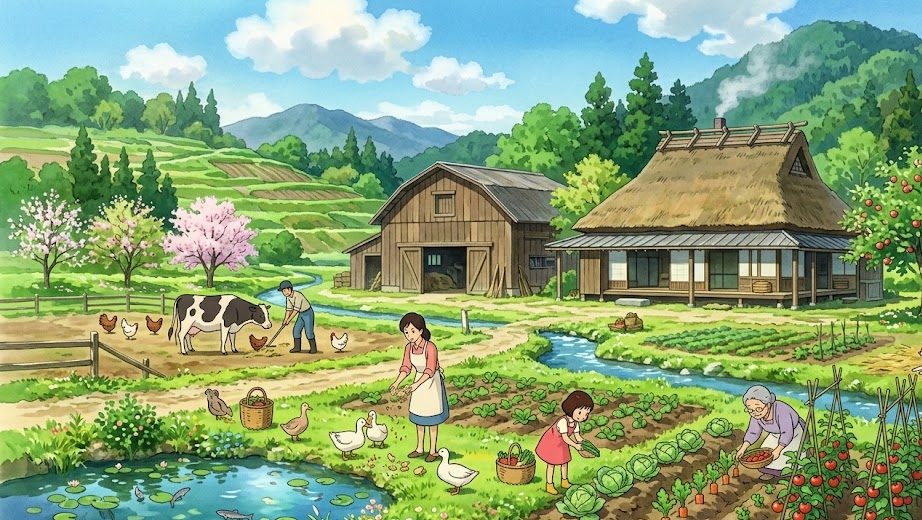
Integrated farming is an approach in which different farm activities are planned to support one another rather than being managed as completely separate operations. Crops, livestock, poultry, composting, water management, trees, and other farm activities can be connected so that resources produced by one part of the farm become useful somewhere else.
For example, crop residues may provide feed or bedding for livestock, while properly managed livestock manure can contribute nutrients and organic matter to crop-growing areas. A farm may also use crop by-products for poultry, collect rainwater for selected activities, or grow forage alongside food crops.
The purpose is not simply to add more activities to a farm. The real goal is to create a better-organized system in which available land, water, labor, nutrients, and other resources are used efficiently.
What Is Integrated Farming?
Integrated farming combines two or more agricultural enterprises within a coordinated farm system.
A farm might include:
- Field crops
- Vegetables
- Fruit trees
- Cattle
- Sheep or goats
- Poultry
- Fish production
- Composting
- Fodder production
- Agroforestry
- Beekeeping
- Water harvesting
- Small-scale processing
Not every integrated farm needs all of these components. The best combination depends on the farm’s size, climate, available resources, market opportunities, labor, and local regulations.
The important principle is connection.
Instead of thinking:
Crop production + livestock production + composting
an integrated farmer considers:
Crop production → crop residues → livestock feed or bedding → manure → compost or soil amendment → crop production
This creates a cycle in which resources are used more than once.
Why Combine Different Farm Activities?
A single-enterprise farm can be relatively simple to manage, but it may also depend heavily on outside inputs.
Integrated systems can provide opportunities to make better use of resources already available on the farm.
For example, a livestock operation produces manure that needs to be handled responsibly. A crop farm needs nutrients and organic matter. Connecting these activities can create a useful relationship, provided manure is managed correctly.
Similarly, crops can provide residues or forage that may have value for livestock.
The benefits can include:
- Better use of farm resources
- More diverse sources of farm income
- Greater use of crop by-products
- Improved nutrient cycling
- Reduced waste
- Better use of available land
- More varied farm production
- Potentially improved resilience to individual crop or livestock problems
However, integration does not automatically make a farm more profitable. Each activity still needs to be economically and practically viable.
The Basic Integrated Farm Cycle
A simple integrated system can be visualized as a series of connected resources.
Crops
↓
Crop residues and by-products
↓
Livestock or poultry
↓
Manure and bedding
↓
Composting or managed nutrient storage
↓
Soil nutrient management
↓
Crop production
This is only one possible model.
Another farm might integrate trees, forage, livestock, and crops:
Trees → shade, fruit, timber, or wind protection
Forage crops → livestock feed
Livestock → manure
Crops → food and residues
The exact design should reflect the farm’s priorities rather than following a fixed formula.
Start With the Farm’s Existing Resources
Before adding a new enterprise, examine what the farm already has.
Consider:
- Available land
- Soil types
- Water supply
- Buildings
- Fencing
- Equipment
- Storage facilities
- Existing animals
- Available labor
- Local markets
- Farm waste streams
For example, a farm that already keeps cattle may have a natural opportunity to grow forage crops.
A vegetable farm may have plant residues suitable for composting, while a farm with unused field edges might be able to establish perennial plants, trees, or pollinator-friendly areas.
Integration works best when it builds on existing resources.
Combining Crops and Livestock
One of the most common forms of integrated farming is crop-livestock integration.
Crops can supply livestock with suitable feed materials, while livestock can contribute manure to the wider farm nutrient cycle.
For example, a farm may grow:
- Hay
- Silage crops
- Grasses
- Legumes
- Cover crops
alongside food crops.
After harvest, certain crop residues may have additional value depending on the crop, animal species, and feed safety requirements.
Farmers should avoid assuming that every crop residue is automatically suitable for livestock. Feed quality, contamination, chemical treatments, storage conditions, and the nutritional needs of the animals must be considered.
Using Manure Responsibly
Manure can be a valuable agricultural resource, but it needs careful management.
Fresh manure should not simply be spread anywhere without considering crop type, timing, soil conditions, water protection, and applicable regulations.
Properly managed manure or compost can contribute organic matter and plant nutrients to soil.
Good management may involve:
- Collecting manure and bedding.
- Storing it in an appropriate location.
- Managing moisture and runoff.
- Composting when appropriate.
- Applying nutrients according to soil and crop needs.
- Keeping manure away from waterways and sensitive areas.
The objective is to turn a potential waste-management problem into a controlled nutrient resource while protecting soil and water quality.
Add Livestock Only When It Makes Sense
Integrated farming does not mean every farm needs animals.
Livestock require:
- Feed
- Water
- Housing or suitable shelter
- Fencing
- Veterinary care
- Labor
- Waste management
- Equipment
- Appropriate handling facilities
These costs can be substantial.
Before introducing cattle, sheep, goats, poultry, or another species, calculate whether the farm has the resources to support them throughout the year.
For a small farm, poultry or a limited number of smaller livestock may be more manageable than a large herd.
Poultry Can Fit Into Small Farm Systems
Chickens and other poultry can sometimes complement crop and garden operations.
Egg production may provide an additional farm product, while properly managed poultry manure can become part of a composting system.
However, poultry should not be allowed to freely enter growing areas simply because their manure is useful. Birds can damage young plants, disturb soil, consume seedlings, and create food-safety concerns.
Separating production areas and controlling animal access can make the system easier to manage.
Integrating Trees and Crops
Trees can provide another layer to a diversified farm.
Depending on the species and farm design, trees may provide:
- Fruit
- Nuts
- Timber
- Wind protection
- Shade
- Habitat
- Additional farm products
Agroforestry systems intentionally combine trees with agricultural production.
However, tree roots and canopies can compete with crops for water, nutrients, and sunlight. Therefore, spacing and species selection are important.
Trees should be positioned according to the long-term design of the farm rather than simply planted wherever there is unused space.
Water Can Connect Different Activities
Water management is another important part of integrated farming.
A farm might combine:
- Rainwater harvesting
- Efficient irrigation
- Storage ponds where appropriate
- Soil moisture conservation
- Drip irrigation
- Water recycling systems where legally and technically suitable
Water should be allocated according to crop requirements, livestock needs, environmental conditions, and local regulations.
Wastewater or recycled water should never be used on crops or animals without understanding its quality, treatment requirements, and applicable food-safety rules.
Composting Farm Materials
Composting can connect several farm activities.
Suitable organic materials may include certain:
- Crop residues
- Plant trimmings
- Animal bedding
- Manure
- Leaves
- Other approved organic materials
A properly managed composting process can transform organic material into a more stable soil amendment.
Good composting requires attention to moisture, aeration, carbon-rich and nitrogen-rich materials, temperature, and time.
A compost pile should also be located where runoff can be controlled.
Diversification Can Spread Farm Risk
Integrated farming can provide multiple sources of products.
Instead of relying entirely on one crop, a farm might produce:
Vegetables + eggs + livestock + fruit + compost
If one crop has a difficult season, another enterprise may still generate useful output.
However, diversification does not eliminate risk. It can also increase management complexity.
Farmers need to consider whether additional enterprises actually improve the overall farm operation or simply create more work.
Design the Farm Around Resource Flows
One useful way to plan an integrated farm is to draw a resource-flow map.
Start with the major farm activities.
For example:
Vegetable fields
→ crop residues
→ composting or suitable livestock use
Livestock
→ manure and bedding
→ managed composting
Compost
→ soil improvement and nutrient supply
Forage fields
→ livestock feed
Livestock
→ food or other farm products
Trees
→ fruit, nuts, shade, or other products
This simple exercise can reveal where resources are being wasted and where connections might be possible.
Don’t Create Unnecessary Complexity
A common mistake is trying to integrate too many activities at once.
A farm may look impressive on paper with ten enterprises, but each additional activity requires time, knowledge, infrastructure, and record keeping.
A simpler system may be easier to manage successfully.
For example, a small farm could begin with:
Vegetables + poultry + composting
After the system becomes stable, it might add fruit trees or a small livestock enterprise.
This gradual approach makes it easier to identify problems before they become expensive.
Keep Separate Areas for Different Activities
Farm layout matters.
Consider creating dedicated zones for:
- Crop production
- Livestock
- Feed storage
- Composting
- Equipment
- Water storage
- Produce handling
- Waste management
Keeping these areas organized can improve workflow and reduce unnecessary movement.
It can also help with biosecurity and food safety.
Produce handling areas should be protected from contamination by livestock, manure, dirty equipment, and other potential sources of contamination.
Plan for Labor and Daily Work
Integrated farms can create more work even when they use resources efficiently.
A farm calendar can help identify periods when several activities become demanding at the same time.
For example, planting vegetables, harvesting crops, caring for livestock, maintaining irrigation, and processing farm products could all require attention during the same week.
Ask practical questions:
- Who will perform the work?
- How many hours are required?
- What happens when someone is unavailable?
- Which activities are seasonal?
- Which tasks require specialized skills?
An efficient farm system should be efficient for people as well as land and resources.
Consider the Economics
Before adding any enterprise, estimate its full costs.
Include:
- Seeds or breeding stock
- Feed
- Fertilizer
- Veterinary costs
- Equipment
- Buildings
- Fencing
- Water
- Electricity
- Labor
- Transportation
- Packaging
- Market fees
- Maintenance
Then compare these costs with realistic expected revenue.
A farm activity may produce something useful without being financially worthwhile.
Integrated farming should therefore be evaluated from both an ecological and economic perspective.
USA and UK Considerations
Integrated farming systems in the USA and UK can look very different because of differences in climate, farm size, regulations, markets, and production systems.
In the USA, a farm may operate across a large range of climates, from dry western regions to humid areas in the Southeast and cold northern states. Local extension services, soil information, and agricultural regulations can help farmers design systems appropriate to their area.
In the UK, farmers must also consider regional weather differences, land availability, drainage, seasonal conditions, livestock management requirements, and environmental rules.
In both countries, local regulations should be checked before establishing livestock facilities, manure storage, water systems, or commercial food-processing activities.
A Practical Starting Model
For someone experimenting with integrated farming, a simple model might look like this:
Step 1 — Choose one main crop enterprise
Start with vegetables, grains, fruit, or another crop that suits the land.
Step 2 — Identify useful by-products
Determine whether crop residues can be composted, used as mulch, or safely incorporated into another farm activity.
Step 3 — Add one complementary enterprise
This could be poultry, a small livestock operation, forage production, or another suitable activity.
Step 4 — Connect the resources
Identify where outputs from one activity can safely and legally become inputs for another.
Step 5 — Measure the results
Track production, costs, labor, waste, and resource use.
Step 6 — Expand only after the system works
Add another enterprise only when the existing system is stable and manageable.
Final Thoughts
Integrated farming is fundamentally about relationships between different parts of a farm.
Crops can provide food, forage, and useful residues. Livestock can contribute products and manure. Trees can provide additional products and environmental functions. Composting can help manage organic materials. Water and land can be planned around several complementary activities.
The strongest systems are not necessarily the ones with the greatest number of enterprises. They are the ones in which different activities have clear purposes and are organized efficiently.
By starting with existing resources, planning resource flows, controlling costs, protecting soil and water, and expanding gradually, farmers can develop an integrated system that is practical rather than unnecessarily complicated.
The key is to treat the farm as one connected system while still managing each enterprise carefully on its own.