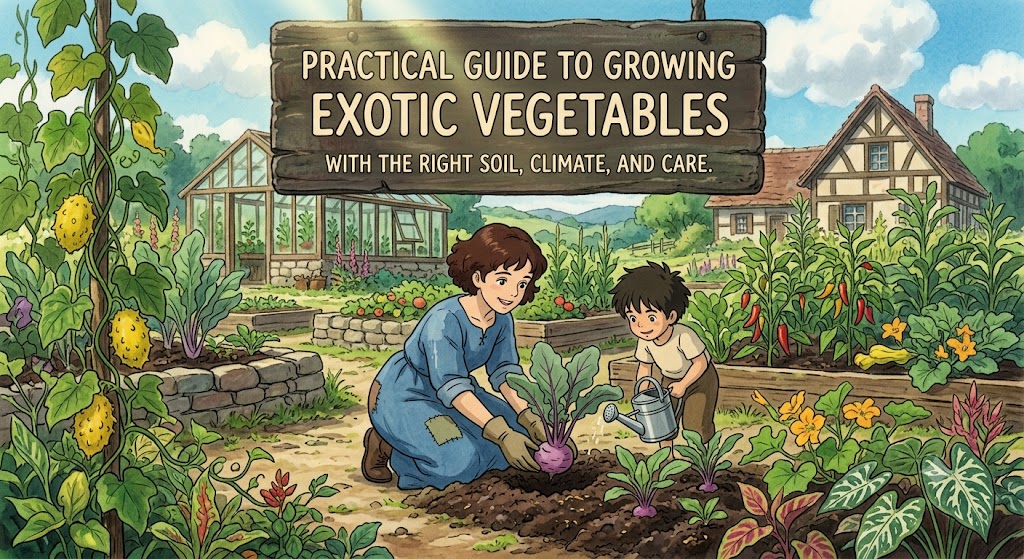
Growing exotic vegetables can be an exciting way to make a home garden or small farm more diverse. Crops such as purple carrots, pak choi, kohlrabi, Romanesco, purple sprouting broccoli, fennel, Asian greens, specialty radishes, and unusual squash can add different colors, textures, and flavors to the garden.
However, unusual vegetables are not always difficult to grow. The biggest challenge is usually matching the crop with the right soil, temperature, sunlight, moisture, and growing season. A vegetable that performs well in a cool British garden may struggle during a hot American summer, while a warm-season crop may need protection in cooler parts of the UK.
The following guide explains how to choose exotic vegetables and create growing conditions that give them a good chance of producing a healthy harvest.
Start by Understanding What “Exotic” Means
The term “exotic vegetable” does not necessarily mean a rare or extremely difficult crop. It often refers to vegetables that are less commonly grown in a particular region.
For example, a gardener in the UK might consider certain Asian greens or unusual squash varieties exotic, while gardeners in parts of the United States may already grow them regularly.
Some interesting choices include:
| Vegetable | Preferred Conditions | Growing Difficulty |
|---|---|---|
| Pak choi | Cool to mild weather | Easy |
| Kohlrabi | Cool to moderate temperatures | Easy |
| Purple carrot | Cool, loose soil | Easy |
| Romanesco | Cool growing season | Moderate |
| Fennel | Mild weather and good drainage | Moderate |
| Asian mustard greens | Cool conditions | Easy |
| Specialty radishes | Cool weather | Easy |
| Purple sprouting broccoli | Cool conditions | Moderate |
| Chayote | Long, warm growing season | Moderate |
| Unusual squash | Warm weather | Moderate |
The best crop is not necessarily the rarest one. It is the vegetable that fits your growing conditions.
Get the Soil Right Before Planting
Good soil is one of the most important factors when growing specialty vegetables.
Many unusual vegetables perform well in fertile soil that drains excess water while retaining enough moisture for steady root growth. Heavy, compacted soil can restrict roots and create poor growing conditions.
Before planting, examine the soil.
Look for these basic characteristics:
- Good drainage
- Reasonable moisture retention
- Plenty of organic matter
- A crumbly structure
- Limited compaction
- Adequate nutrients
Adding mature compost can improve soil structure and provide organic matter. Well-rotted organic material can also help sandy soils retain moisture while improving the structure of heavier soils.
Avoid adding large amounts of fresh manure directly before planting vegetables because it can create nutrient imbalances and may damage young roots.
Match the Crop to the Soil
Different vegetables have different root systems.
Root vegetables such as specialty carrots, radishes, parsnips, and beets need loose soil that allows their roots to expand without obstruction.
If the soil contains stones, hard clumps, or compacted layers, roots may become forked, twisted, or unusually short.
Leafy vegetables generally have less demanding root systems, but they still benefit from fertile soil with consistent moisture.
For crops that require deeper rooting, prepare the soil several inches below the planting depth rather than simply improving the surface.
Check Your Climate Before Choosing Seeds
Climate should influence vegetable selection before you buy seeds.
Some exotic vegetables are adapted to cool seasons, while others need a long period of warmth.
Cool-season vegetables
These include crops such as:
- Pak choi
- Kohlrabi
- Asian mustard greens
- Radishes
- Purple sprouting broccoli
- Many specialty lettuces
They often perform better during spring, autumn, or other periods when temperatures are moderate.
Warm-season vegetables
These can include:
- Specialty squash
- Chayote
- Certain Asian eggplant varieties
- Some unusual beans
- Heat-loving peppers
These crops generally need warmer soil and longer periods of suitable weather.
Trying to grow a warm-season vegetable during a short, cool season can result in slow growth and disappointing harvests.
Use Microclimates to Your Advantage
Your garden may contain several different microclimates.
A sunny wall can be warmer than an exposed part of the garden. A sheltered corner may receive less wind. A raised bed may drain faster than an area of heavy soil.
These small differences can be useful.
For example, a warm-season crop can sometimes be planted in a protected, sunny location, while cool-season greens can be placed somewhere that receives morning sun and some afternoon protection.
Gardeners in cooler parts of the UK can use greenhouses, cold frames, fleece, or sheltered planting locations to extend the growing season.
In parts of the United States with very hot summers, gardeners may instead need shade cloth or afternoon protection for sensitive cool-season vegetables.
Give Vegetables Enough Sunlight
Most vegetables require good sunlight to produce strong growth.
A general target for many vegetable crops is around six or more hours of direct sunlight per day, although the exact requirement varies.
Leafy greens can tolerate somewhat less light than fruiting crops, while vegetables grown primarily for their roots still benefit from adequate sunlight.
Before planting, observe your garden throughout the day.
A location that appears sunny in the morning may become shaded by buildings, fences, or trees later.
Planning the bed around the actual movement of sunlight can make a significant difference.
Start With the Right Variety
One of the easiest mistakes is choosing an unusual vegetable without checking whether the variety suits your climate.
Seed packets and reputable suppliers often provide information about:
- Days to maturity
- Temperature preferences
- Planting dates
- Plant spacing
- Harvest size
- Container suitability
- Disease resistance
Look for varieties recommended for your growing zone or local climate.
If you are experimenting with a new vegetable, growing two varieties can also be useful. If one struggles with your conditions, the other may perform better.
Plant at the Right Time
Timing is especially important for exotic vegetables.
A cool-season vegetable planted during extreme summer heat may bolt quickly, while a warm-season vegetable planted into cold soil may remain almost dormant.
Rather than following a calendar date blindly, consider actual local conditions.
For outdoor planting, pay attention to:
- Soil temperature
- Expected frost
- Daytime temperatures
- Night temperatures
- Rainfall
- Length of the growing season
Gardeners in the UK often need to pay close attention to late frosts and short growing windows.
In the United States, planting schedules vary dramatically between regions, so a vegetable-growing calendar for a specific state or growing zone is usually more useful than a nationwide date.
Water Consistently, Not Constantly
Exotic vegetables still need the basics of good watering.
The goal is generally to keep the root zone adequately moist without leaving the soil permanently saturated.
Young seedlings need particular attention because their small root systems can dry out quickly.
As plants become established, watering should depend on:
- Soil moisture
- Weather
- Plant size
- Soil type
- Container size
- Stage of growth
Watering deeply when needed is often more useful than repeatedly applying tiny amounts to the surface.
Mulch can also help reduce evaporation and keep soil temperatures more stable.
Organic mulch should be kept slightly away from the plant stem to reduce the risk of excessive moisture around the base.
Feed According to the Crop
Fertilizer should support growth rather than replace good soil preparation.
Leafy vegetables generally need sufficient nitrogen for healthy foliage, while crops producing roots, stems, or heads have different nutrient requirements.
Too much fertilizer can create excessive leafy growth without producing the desired harvest.
A soil test can provide useful information about nutrient levels and pH, particularly if you plan to grow specialty vegetables repeatedly in the same area.
Follow the instructions on commercial fertilizers carefully and avoid assuming that more fertilizer will automatically produce better vegetables.
Protect Young Plants
Young exotic vegetables can be vulnerable to pests, wind, temperature changes, and competition from weeds.
Simple protection can make establishment easier.
Depending on the crop and location, gardeners may use:
- Fine mesh
- Row covers
- Fleece
- Greenhouses
- Cold frames
- Supports
- Windbreaks
- Temporary shade
The goal is not necessarily to create a completely controlled environment. Instead, protection should reduce the most serious environmental stresses during vulnerable growth stages.
Keep Weeds Under Control
Weeds compete with vegetables for water, nutrients, light, and growing space.
Small weeds are generally easier to remove than established ones, so regular short maintenance sessions can be more effective than occasional major cleanups.
Mulching can also reduce weed emergence.
When cultivating around young plants, avoid damaging shallow roots. A small hand tool or careful hand weeding is often sufficient for a home vegetable bed.
Watch for Common Problems
Unusual vegetables can experience the same basic problems as familiar crops.
Yellow leaves
Possible causes include:
- Overwatering
- Poor drainage
- Nutrient deficiencies
- Root problems
- Natural aging of older leaves
Slow growth
Possible causes include:
- Cold temperatures
- Poor sunlight
- Compacted soil
- Insufficient nutrients
- Incorrect planting time
Bolting
Bolting occurs when certain vegetables rapidly produce a flower stalk instead of continuing vegetative growth.
It is particularly common in some leafy vegetables when temperatures rise or plants experience stress.
Choosing bolt-resistant varieties and planting during suitable seasons can help.
Misshapen roots
This may result from compacted or rocky soil, inconsistent moisture, or physical restrictions in the growing area.
Improving soil structure before planting can make a noticeable difference.
Try Container Growing for Smaller Crops
You do not need a large farm to experiment with unusual vegetables.
Containers can work well for:
- Specialty radishes
- Small carrots
- Leafy greens
- Kohlrabi
- Some herbs
- Compact squash varieties
Choose containers with drainage holes and enough depth for the crop.
Container plants generally dry out faster than plants in the ground, so moisture needs should be checked more frequently, especially during warm weather.
Create a Simple Exotic Vegetable Bed
If you are new to specialty vegetables, avoid planting ten different crops at once.
A small experimental bed can provide better information.
For example:
Section 1: Purple or specialty carrots
Section 2: Kohlrabi
Section 3: Pak choi
Section 4: Specialty radishes
Record when you planted each crop, how quickly it germinated, how much watering it needed, and when it was harvested.
The following season, you can replace crops that performed poorly and expand the ones that suited your conditions.
Keep a Growing Record
A simple notebook or digital spreadsheet can become one of your most useful gardening tools.
Record:
- Variety name
- Seed source
- Planting date
- Germination date
- Weather conditions
- Fertilizer applications
- Watering observations
- Pest problems
- Harvest date
- Approximate yield
- Taste and quality
This information becomes increasingly valuable over several growing seasons.
You may discover, for example, that one variety performs exceptionally well during your spring season but struggles during midsummer.
Harvest at the Right Stage
Many specialty vegetables are best harvested before they become oversized.
Young kohlrabi, radishes, carrots, leafy greens, and similar crops can often have a more desirable texture than plants left in the ground for too long.
However, the ideal harvest stage depends on the vegetable and variety.
Check the seed packet for expected maturity and use the plant’s appearance as an additional guide.
Harvesting regularly can also encourage continued production for certain crops.
A Simple Approach for USA and UK Gardeners
There is no single growing schedule that works across the USA and UK.
A gardener in southern England may have a different planting window from someone in northern Scotland. Likewise, conditions in Florida can be dramatically different from those in Minnesota or Oregon.
A practical approach is to work backward from your local climate:
1. Identify your growing conditions.
Understand your approximate growing zone, frost dates, average temperatures, rainfall, and sunlight.
2. Choose vegetables suited to those conditions.
Do not select crops simply because they look unusual.
3. Prepare the soil first.
Improve drainage, structure, and organic matter where necessary.
4. Start with a small number of crops.
Learn how each one behaves before expanding.
5. Record the results.
Use your own garden data to improve future planting decisions.
Final Thoughts
Growing exotic vegetables is less about creating perfect conditions and more about understanding what each plant needs.
Start with the soil, choose varieties that match your climate, provide suitable sunlight and moisture, and pay attention to planting and harvest timing. A small experimental garden can introduce you to unusual crops without requiring a major investment.
The most successful approach is usually a gradual one. Grow a few specialty vegetables, observe how they respond to your local conditions, keep useful records, and improve your methods each season.
With the right combination of soil, climate, timing, and regular care, many vegetables that initially seem unusual can become practical and rewarding additions to an everyday garden.