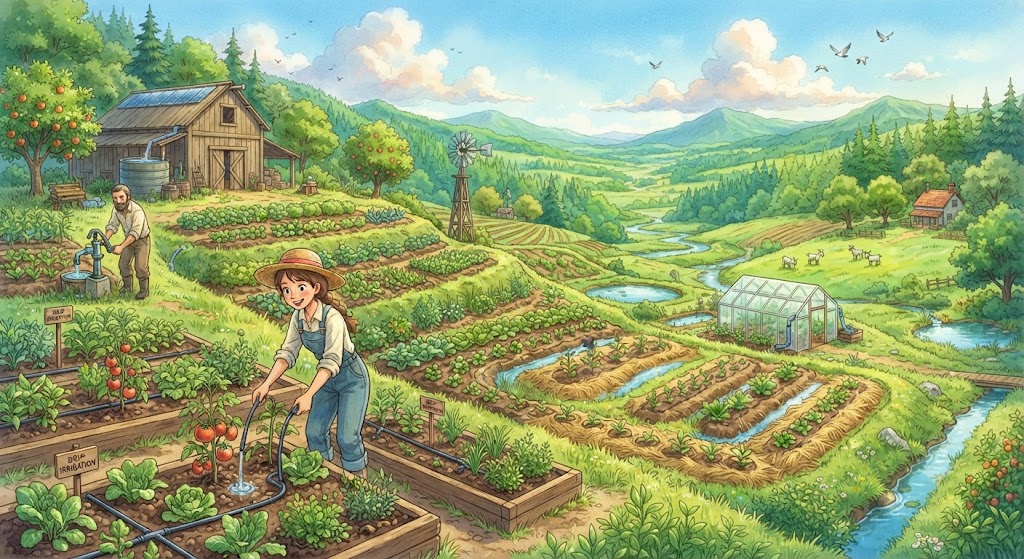
Why Water Management Matters in Modern Farming
Water is one of the most important resources in crop production, but efficient farming is not simply about giving plants as much water as possible.
Crops need enough moisture to germinate, develop roots, produce leaves, flower, and form a harvest. At the same time, excessive irrigation can waste water, increase energy costs, contribute to nutrient movement, and create unfavorable conditions around plant roots.
For farmers facing dry weather, higher irrigation costs, limited water supplies, or unpredictable rainfall, improving water efficiency can make a meaningful difference.
Water-saving agriculture focuses on one central principle:
Put the right amount of water in the right place at the right time.
The best approach depends on soil, climate, crop type, field size, irrigation equipment, and local water availability.
1. Understand How Much Water the Crop Actually Needs
Different crops have different water requirements.
A shallow-rooted vegetable crop may need more frequent irrigation than a deeper-rooted crop growing in suitable soil. A newly planted crop can also have different requirements from an established crop.
Water demand can change according to:
- Crop type
- Growth stage
- Temperature
- Wind
- Humidity
- Soil type
- Plant density
- Rainfall
- Root depth
This is why a fixed irrigation schedule is not always the most efficient solution.
A better system adjusts irrigation according to actual field conditions whenever practical.
2. Improve Soil So It Holds Moisture Better
Water efficiency begins with the soil.
Healthy soil with good structure can store and release water more effectively to plant roots.
Organic matter can contribute to improved soil structure in many agricultural systems. Compost, suitable crop residues, and other organic materials may help increase the soil’s ability to retain moisture, depending on the soil type and management approach.
At the same time, excessive soil disturbance can damage soil structure and increase the risk of erosion.
Farmers should therefore consider long-term soil health rather than viewing irrigation efficiency as only an equipment problem.
3. Use Mulch to Reduce Evaporation
Bare soil can lose considerable moisture through evaporation, particularly during hot and dry weather.
Mulching creates a protective layer over the soil surface.
Depending on the production system, farmers may use materials such as:
- Straw
- Crop residues
- Leaves
- Compost
- Suitable organic materials
- Agricultural films where appropriate
Mulch can help:
- Reduce evaporation
- Moderate soil temperature
- Suppress some weeds
- Protect soil from heavy rainfall
- Reduce erosion
However, mulch should be selected and managed carefully. Some materials can introduce unwanted seeds or create pest and disease-management concerns if poorly handled.
4. Consider Drip Irrigation
Drip irrigation delivers water close to the crop’s root zone rather than distributing water broadly across the entire soil surface.
This can be particularly useful for crops grown in rows or permanent beds.
Potential benefits include:
- More targeted water application
- Reduced wetting between crop rows
- Better control of irrigation timing
- Reduced evaporation in some conditions
- Compatibility with automation
Drip systems can be used in many vegetable, fruit, and specialty crop operations.
However, they require proper design and maintenance. Blocked emitters, leaks, poor pressure management, or incorrect placement can reduce performance.
Efficient equipment still needs good management.
5. Use Soil Moisture Monitoring
Farmers do not always need to guess when irrigation is required.
Soil moisture sensors can provide information about the amount of moisture available in the soil.
Depending on the system, sensors can help monitor:
- Moisture near the root zone
- Changes after rainfall
- Irrigation effectiveness
- Drying rates
- Differences between field areas
This information can help farmers avoid irrigating simply because a calendar says it is time.
Sensors should be installed and interpreted appropriately for the soil and crop. One sensor cannot necessarily represent an entire large or highly variable field.
6. Irrigate at the Right Time of Day
The timing of irrigation can affect water efficiency.
During periods of high heat, strong sunlight, and dry winds, water can be lost more rapidly from exposed surfaces.
In many situations, irrigating during cooler periods can reduce some evaporation losses.
However, the ideal timing depends on the irrigation system, crop, local weather, disease considerations, and farm schedule.
The important principle is to avoid unnecessary irrigation during conditions where water is likely to be lost before reaching the crop’s root zone.
7. Control Weeds Before They Consume Water
Weeds are competing plants.
They use water that could otherwise be available to crops.
A field with heavy weed pressure can therefore require more water to maintain crop growth.
Water-efficient weed management can include:
- Mulching
- Mechanical cultivation
- Hand removal
- Crop rotation
- Cover crops
- Competitive crop establishment
- Appropriate herbicide use where suitable
Early control is especially useful because small weeds generally consume fewer resources and are easier to manage than mature plants.
8. Choose Crops and Varieties Carefully
Crop selection can have a major influence on water requirements.
If water availability is limited, farmers may consider crops and varieties that are well suited to the local climate and growing season.
The objective is not simply to choose the crop with the lowest water requirement.
Farmers should also consider:
- Yield potential
- Market demand
- Soil suitability
- Growing season
- Temperature
- Disease pressure
- Labor
- Expected revenue
A water-efficient crop that has no suitable market may not make economic sense.
The best crop is one that fits the farm’s overall conditions.
9. Improve Irrigation Scheduling
Irrigation should be based on crop demand rather than habit whenever possible.
Farmers can consider information from:
- Soil moisture
- Recent rainfall
- Weather forecasts
- Crop growth stage
- Local temperature
- Evaporation conditions
- Historical field observations
For example, after substantial rainfall, irrigation may be unnecessary for a period of time.
Similarly, a crop entering a water-sensitive growth stage may require closer monitoring than it did earlier in the season.
Good scheduling prevents both under-irrigation and unnecessary watering.
10. Use Rainfall More Effectively
Rainfall is free water, but farms do not always capture and retain it efficiently.
Healthy soil structure, appropriate ground cover, and erosion control can help water enter the soil instead of running away from the field.
Depending on local conditions, farms may use:
- Contour-based practices
- Vegetative ground cover
- Terracing in suitable landscapes
- Improved drainage design
- Rainwater collection
- Small-scale water storage
- Conservation practices
The appropriate approach depends heavily on topography, soil, rainfall patterns, and local regulations.
The goal is to keep useful water available to crops while preventing destructive runoff and erosion.
11. Reduce Soil Compaction
Compacted soil can interfere with root development and water movement.
Heavy machinery repeatedly traveling through the same soil can contribute to compaction, particularly when fields are worked under unsuitable moisture conditions.
Compaction can create two problems at once.
Water may have difficulty moving into some areas, while roots may have difficulty accessing water deeper in the soil.
Good traffic management, appropriate field conditions, and practices that support soil structure can help.
In some systems, controlled traffic farming may reduce the area exposed to repeated machinery passes.
12. Maintain Healthy Root Systems
A strong root system allows plants to explore a larger volume of soil for available moisture and nutrients.
Root development is affected by:
- Soil structure
- Compaction
- Water availability
- Nutrient balance
- Soil biology
- Crop genetics
- Soil temperature
Avoiding unnecessary root damage is therefore part of water management.
A crop with a healthy and well-developed root system may be better positioned to tolerate short periods of limited rainfall than a crop with restricted roots.
13. Consider Conservation Tillage
Tillage can be useful for specific farming operations, but unnecessary soil disturbance can affect soil structure and expose soil to environmental conditions.
Reduced-tillage or conservation-tillage systems can help retain crop residues on the surface and reduce soil disturbance.
Potential benefits may include:
- Reduced evaporation in some systems
- Better protection from erosion
- Improved soil structure over time
- Increased residue cover
Results vary by soil, climate, crop, and management system.
Conservation practices should therefore be adapted to local conditions rather than copied without modification.
14. Use Cover Crops Strategically
Cover crops can contribute to water management in several ways.
Living plants can protect the soil from direct exposure to rain and wind, while plant residues left on the surface can reduce evaporation and erosion.
Cover crops can also contribute to soil structure and organic matter.
However, cover crops themselves consume water.
This creates an important management question:
Does the cover crop improve the overall system enough to justify the water it uses?
In dry regions, termination timing and species selection can be particularly important.
Water-saving agriculture requires looking at the entire cropping system rather than assuming that every conservation practice is automatically beneficial in every situation.
15. Reduce Water Loss From Leaks
Sometimes the simplest water-saving opportunity is in the irrigation infrastructure.
Leaks in:
- Pipes
- Valves
- Connectors
- Pumps
- Drip lines
- Sprinkler systems
can waste significant amounts of water over time.
Regular inspections can identify problems before they become expensive.
Farmers should also check whether irrigation equipment is distributing water evenly.
A system that applies too much water in one area and too little in another is not operating efficiently even if total water use appears reasonable.
16. Improve Irrigation Uniformity
Efficient irrigation is not only about reducing total water use.
Uniformity matters.
If one part of a field receives significantly more water than another, farmers may compensate by increasing total irrigation.
This can result in waterlogging in one area while another remains too dry.
Regular equipment checks can help identify:
- Blocked emitters
- Damaged sprinklers
- Uneven pressure
- Clogged filters
- Leaking lines
- Poorly positioned equipment
Fixing these problems can improve the effectiveness of water already being applied.
17. Use Smart Irrigation Technology
Modern farms can combine irrigation systems with digital tools.
A smart irrigation setup may use:
Soil moisture + weather data + crop stage + irrigation equipment
to support more informed watering decisions.
Some systems can automatically change irrigation schedules based on environmental conditions.
This can be particularly useful on farms where manual monitoring is difficult.
However, automation should not mean ignoring the field.
Farmers should continue checking whether the system is actually producing the desired results.
18. Manage Water During Critical Growth Stages
Not every stage of crop development has exactly the same sensitivity to water stress.
Some crops are particularly sensitive during:
- Germination
- Early establishment
- Flowering
- Pollination
- Fruit development
- Grain filling
Understanding these stages can help farmers prioritize available water.
If water supplies become temporarily limited, knowing when the crop is most sensitive can support better allocation decisions.
The exact sensitive stages vary by crop, so crop-specific information should guide management.
19. Harvest Rainfall Information From Technology
Weather data can help farmers anticipate changes in water demand.
Useful information may include:
- Rainfall forecasts
- Temperature
- Wind
- Humidity
- Recent rainfall
- Soil moisture
- Short-term weather trends
A weather station located on or near a farm can provide local measurements.
This information can help farmers decide whether irrigation should be delayed, increased, or adjusted.
Forecasts are never perfect, so they should be treated as one source of information rather than a guarantee.
20. Keep Records of Water Use
You cannot improve what you do not measure.
Where practical, farmers can record:
- Irrigation dates
- Irrigation duration
- Estimated water volume
- Rainfall
- Soil moisture
- Crop stage
- Yield
- Major weather events
After the season, these records can reveal relationships between water use and crop performance.
For example, a farmer may discover that a particular irrigation schedule used significantly more water without producing a measurable improvement in marketable yield.
That information can guide future decisions.
A Simple Water-Saving Farm Plan
Farmers looking for a practical starting point can work through five stages.
Before planting
Test the soil, choose an appropriate crop, inspect irrigation equipment, and plan for rainfall and water availability.
During establishment
Focus on uniform emergence, weed control, and consistent moisture without overwatering.
During crop development
Monitor soil moisture, weather, crop growth, and irrigation performance.
During reproductive growth
Pay closer attention to water-sensitive stages such as flowering, pollination, and fruit or grain development where relevant.
After harvest
Review water use, yield, crop quality, and irrigation performance.
Then use the information to improve the next season.
Avoid the Trap of “Less Water Is Always Better”
Water-saving agriculture does not mean starving crops of water.
A crop that receives too little water may suffer reduced growth, poor flowering, smaller harvests, and lower quality.
The objective is water efficiency, not simply water reduction.
For example, using 20% less water but losing 30% of marketable production would not necessarily represent a successful outcome.
A better measure is how efficiently water is converted into useful crop production.
This is why water management should always be evaluated alongside crop yield and quality.
Water Conservation Looks Different Around the World
Farming conditions vary widely.
A grower in a dry region of the western United States may be primarily concerned with irrigation availability and prolonged periods without rainfall.
A farmer in a wetter part of the UK may instead focus on storing rainfall in the soil, preventing runoff, improving drainage, and managing periods of excessive moisture.
Even neighboring farms can have different water-management requirements because of differences in soil, crops, topography, and irrigation systems.
There is therefore no universal water-saving formula.
Local conditions should always guide the final approach.
Final Thoughts
Water-efficient farming is about making every unit of water work as effectively as possible.
Farmers can improve water management through healthier soils, mulching, appropriate crop selection, efficient irrigation, moisture monitoring, weed control, improved irrigation infrastructure, conservation practices, and better scheduling.
Technology can make these practices more precise, but many useful improvements are relatively simple.
Fixing leaks, protecting soil, checking moisture before irrigating, controlling weeds early, and understanding crop water requirements can all contribute to better water management.
The strongest approach combines these methods rather than relying on one solution.
When farmers understand how water moves through the soil, how crops use it, and where losses occur, they can make more informed decisions that support both healthy crop growth and responsible use of one of agriculture’s most valuable resources.