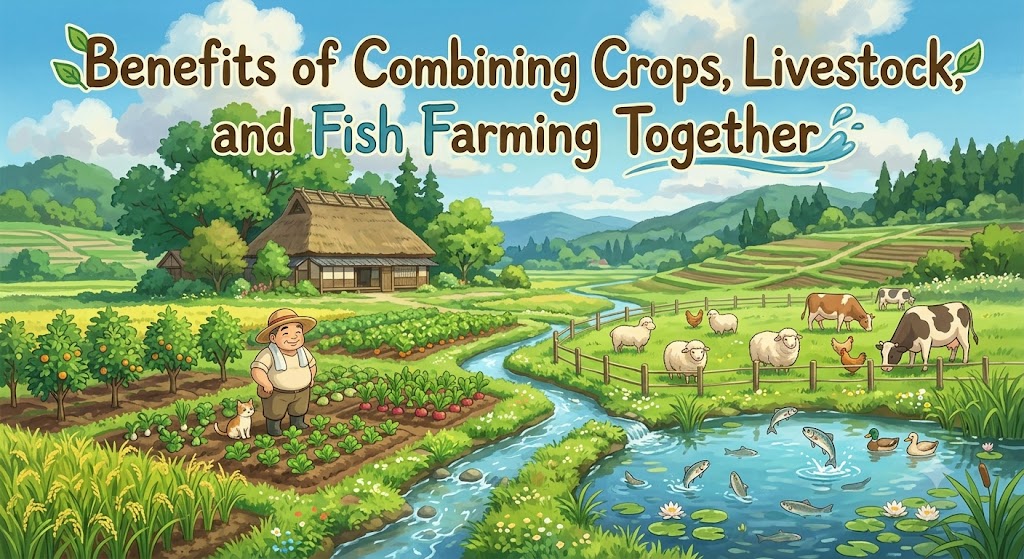
Modern agriculture is no longer limited to growing crops alone. Farmers around the world are adopting integrated farming practices that combine crop cultivation, livestock rearing, and fish farming into one efficient system. This approach makes better use of land, water, labor, and organic resources while creating multiple income opportunities throughout the year.
Instead of treating each farming activity as a separate business, integrated farming connects them so they support one another. Crop residues become animal feed, livestock manure enriches the soil and fish ponds, while nutrient-rich pond water helps irrigate crops. This natural cycle reduces waste, lowers production costs, and improves overall farm productivity.
For both small and large farms, combining crops, livestock, and fisheries can increase profitability while promoting sustainable agriculture. This guide explores the major benefits of this farming model and explains why it is becoming an increasingly popular choice for farmers worldwide.
Understanding an Integrated Crop–Livestock–Fish System
An integrated farming system combines three major agricultural enterprises:
- Crop production
- Livestock farming
- Fish farming
Each component contributes to the success of the others through efficient resource sharing.
For example:
- Crop residues feed cattle, goats, or sheep.
- Livestock manure fertilizes crop fields and fish ponds.
- Fish pond water irrigates vegetables and fruit trees.
- Crop by-products become compost for future planting.
The result is a productive farming cycle where very little goes to waste.
Higher Farm Income Throughout the Year
One of the biggest advantages of combining multiple farm enterprises is income diversification.
Instead of depending on one harvest, farmers generate revenue from several sources.
Possible income streams include:
- Grains
- Vegetables
- Fruits
- Milk
- Meat
- Eggs
- Fish
- Fingerlings
- Compost
- Organic fertilizer
If one enterprise performs poorly due to weather or market conditions, the others continue providing income.
This creates greater financial stability for farming families.
Better Use of Available Land
Integrated farming helps maximize every portion of the farm.
Examples include:
- Fish ponds in low-lying areas
- Vegetable beds around pond edges
- Fruit trees along field boundaries
- Livestock sheds near crop fields
- Fodder crops grown between orchards
Instead of leaving areas unused, every section contributes to farm productivity.
This increases output without requiring additional land.
Efficient Recycling of Farm Resources
One of the most valuable features of integrated farming is resource recycling.
Rather than discarding organic materials, farmers reuse them productively.
Crop Residues
After harvesting crops, remaining stalks and leaves can be:
- Used as livestock feed
- Made into silage
- Applied as mulch
- Composted
This reduces waste while improving soil quality.
Livestock Manure
Animal manure provides valuable nutrients.
After composting, it can:
- Improve soil fertility
- Increase organic matter
- Enhance water retention
- Support beneficial soil microorganisms
Manure can also fertilize fish ponds, encouraging the growth of natural fish food.
Fish Pond Nutrients
Fish naturally produce nutrient-rich waste.
This benefits farms by:
- Supporting plankton growth
- Fertilizing pond ecosystems
- Providing nutrient-rich irrigation water
- Reducing fertilizer requirements
Proper pond management improves both fish production and crop performance.
Reduced Fertilizer Costs
Chemical fertilizers represent a major expense for many farmers.
Integrated farming lowers these costs through the use of:
- Farmyard manure
- Compost
- Vermicompost
- Poultry litter
- Green manure
- Fish pond sludge
These natural fertilizers improve soil fertility while reducing dependence on purchased inputs.
Improved Soil Health
Healthy soil is essential for long-term productivity.
Organic matter produced within an integrated farming system improves:
- Soil structure
- Nutrient availability
- Moisture retention
- Earthworm activity
- Root development
- Beneficial microbial populations
Healthier soils produce stronger crops and reduce erosion.
Better Water Management
Water conservation is becoming increasingly important in agriculture.
Integrated farms often use water more efficiently through:
- Farm ponds
- Rainwater harvesting
- Drip irrigation
- Pond water recycling
- Mulching
- Efficient drainage systems
Water used for fish farming can later irrigate crops, maximizing every drop.
Increased Biodiversity
Growing different crops while raising animals and fish creates a more balanced agricultural ecosystem.
Benefits include:
- Natural pest control
- Improved pollination
- Reduced disease outbreaks
- Greater ecological stability
- Better resilience to climate change
Biodiversity strengthens the overall health of the farm.
Reduced Production Risks
Every farming enterprise carries some level of risk.
Poor weather may affect crops.
Disease may reduce livestock production.
Market prices may fluctuate unexpectedly.
Integrated farming spreads these risks across multiple enterprises.
If crop yields decline, farmers may still earn income from:
- Milk
- Fish
- Eggs
- Meat
- Fruits
Diversification provides greater financial security.
Continuous Employment Opportunities
Traditional farming often provides seasonal employment.
Integrated farming creates year-round work through activities such as:
- Feeding livestock
- Managing fish ponds
- Harvesting vegetables
- Milking dairy animals
- Compost preparation
- Marketing produce
- Pond maintenance
Continuous employment improves labor efficiency and supports rural livelihoods.
Lower Environmental Pollution
Integrated farming encourages recycling instead of waste disposal.
Organic waste is transformed into valuable resources rather than becoming pollutants.
Environmental benefits include:
- Reduced chemical fertilizer use
- Less burning of crop residues
- Lower greenhouse gas emissions
- Improved soil carbon storage
- Better water quality
Sustainable farming practices help protect ecosystems for future generations.
Stronger Farm Resilience
Climate change is creating more uncertainty in agriculture through droughts, floods, and changing weather patterns.
Integrated farming improves resilience by:
- Diversifying income
- Conserving water
- Building healthier soils
- Increasing biodiversity
- Reducing dependence on external inputs
A resilient farm can recover more quickly from unexpected challenges.
Practical Examples of Farm Integration
Many successful farms combine enterprises in simple but effective ways.
Example 1
Rice fields produce straw.
The straw feeds cattle.
Cattle manure fertilizes vegetable crops.
Vegetables generate income throughout the year.
Example 2
Fish ponds provide nutrient-rich irrigation water.
Vegetables grow around pond edges.
Poultry manure fertilizes the pond.
Fish production improves naturally.
Example 3
Fruit orchards provide shade.
Goats graze beneath the trees.
Goat manure enriches the soil.
Bees pollinate fruit blossoms.
Honey becomes an additional source of income.
These examples demonstrate how one enterprise strengthens another.
Technologies Supporting Integrated Farming
Modern agriculture offers many tools that improve integrated farming systems.
Useful technologies include:
- Soil testing equipment
- Drip irrigation
- Solar-powered pumps
- Automatic livestock drinkers
- Weather monitoring apps
- Smart irrigation controllers
- Water quality testing kits
- Farm management software
Technology helps farmers make better decisions while improving efficiency.
Challenges to Consider
Although integrated farming offers many advantages, proper planning is essential.
Some common challenges include:
- Initial investment
- Technical knowledge
- Disease management
- Labor organization
- Market access
- Infrastructure development
Starting with a few enterprises and expanding gradually is often the most practical approach.
Tips for Successful Integration
Farmers can improve results by following a few important principles:
- Select enterprises that naturally complement one another.
- Recycle every possible farm resource.
- Maintain healthy livestock.
- Keep fish ponds clean and well managed.
- Practice crop rotation.
- Use quality seeds.
- Monitor water usage carefully.
- Keep accurate production records.
- Build relationships with reliable buyers.
- Continue learning new farming techniques.
Consistent management is the foundation of long-term success.
Future of Integrated Farming
As global demand for sustainable food production continues to rise, integrated farming is expected to play an increasingly important role. Governments, agricultural researchers, and consumers are recognizing the value of farming systems that conserve resources while improving profitability.
Innovations such as precision agriculture, renewable energy, digital monitoring, and climate-smart farming will further strengthen integrated farming systems. Farmers who combine traditional knowledge with modern technology will be well-positioned to achieve long-term success in an increasingly competitive agricultural sector.
Conclusion
Combining crops, livestock, and fish farming creates a balanced agricultural system that benefits both farmers and the environment. Through efficient resource recycling, better land use, reduced production costs, improved soil fertility, and diversified income sources, integrated farming provides a practical pathway to sustainable agriculture.
Rather than relying on a single enterprise, farmers build a resilient business capable of adapting to changing weather, market conditions, and production challenges. By making full use of available resources and minimizing waste, integrated farming supports higher profitability while protecting natural resources for future generations.
Frequently Asked Questions (FAQs)
1. Why should farmers combine crops, livestock, and fish farming?
Combining these enterprises improves resource efficiency, creates multiple income sources, reduces waste, and increases overall farm profitability.
2. How does livestock benefit crop production?
Livestock provide manure that improves soil fertility, increases organic matter, and reduces the need for chemical fertilizers.
3. Can fish farming improve crop yields?
Yes. Nutrient-rich pond water can be used for irrigation, supplying crops with additional nutrients while conserving water.
4. Is integrated farming suitable for small farms?
Yes. Even small farms can successfully combine vegetables, livestock, and fish farming to improve productivity and financial stability.
5. What is the biggest advantage of integrated farming?
Its greatest advantage is creating a self-sustaining farming system where resources are efficiently recycled, waste is minimized, production costs are reduced, and multiple income opportunities are generated throughout the year.