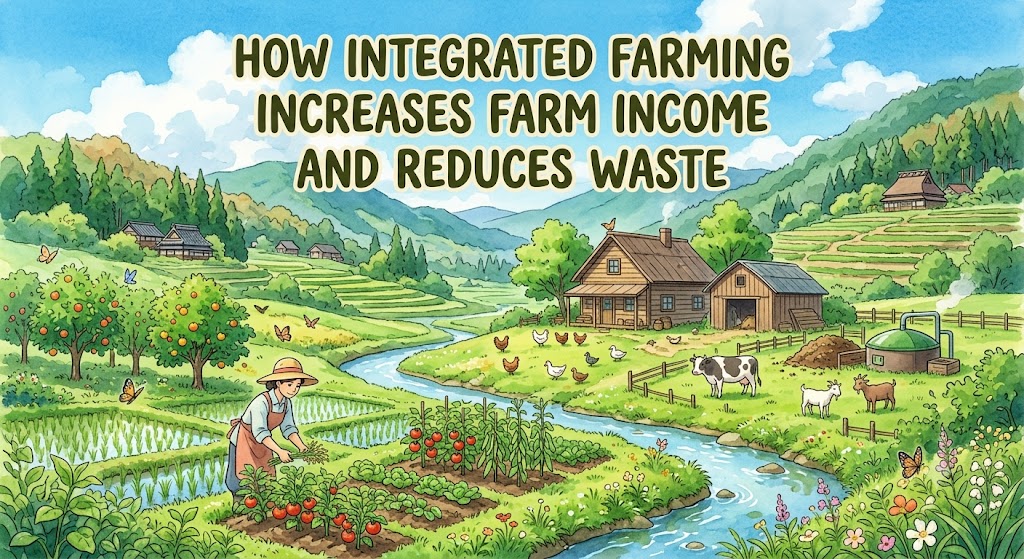
For many farmers, one of the biggest challenges is earning a stable income while keeping production costs under control. Depending on a single crop often means that bad weather, pest attacks, or falling market prices can significantly reduce profits. At the same time, valuable farm resources such as crop residues, livestock manure, and organic waste are often discarded instead of being put to productive use.
Integrated farming offers a practical solution to these problems. Rather than treating different farming activities as separate businesses, this approach connects them so that each enterprise supports the others. Crop waste becomes animal feed, animal manure enriches the soil, fish ponds provide nutrient-rich water for irrigation, and crop diversity creates multiple opportunities for income throughout the year.
This interconnected system not only improves farm productivity but also reduces waste, lowers production costs, and builds a more resilient agricultural business. Whether you operate a small family farm or manage a larger commercial enterprise, integrated farming can help create a more profitable and sustainable future.
Understanding the Concept of Integrated Farming
Integrated farming is a production system that combines two or more agricultural enterprises on the same farm. Instead of relying solely on crop cultivation, farmers integrate activities such as dairy farming, poultry, fish farming, fruit cultivation, beekeeping, compost production, and agroforestry.
The key principle is simple: nothing goes to waste. Every by-product generated by one activity becomes a valuable resource for another.
For example:
- Vegetable residues feed livestock.
- Livestock manure becomes organic fertilizer.
- Compost improves soil fertility.
- Fish pond water irrigates crops.
- Bees pollinate fruit trees and vegetables.
This natural cycle helps farmers maximize every available resource while reducing dependence on expensive external inputs.
Multiple Income Streams Create Financial Stability
One of the greatest strengths of integrated farming is income diversification.
Instead of waiting for a single harvest, farmers earn revenue from different enterprises throughout the year.
Typical income sources include:
- Grain crops
- Vegetables
- Fruits
- Milk
- Eggs
- Meat
- Honey
- Fish
- Compost or vermicompost
- Seedlings and nursery plants
When one enterprise experiences lower returns, others continue generating income, helping stabilize the farm’s cash flow and reducing financial risk.
Reducing Waste Through Resource Recycling
Traditional farming often produces large amounts of unused organic waste. In an integrated farming system, these materials become valuable inputs rather than disposal problems.
Examples of resource recycling include:
Crop Residues
After harvest, stalks, leaves, and other plant materials can be:
- Fed to livestock
- Used as mulch
- Converted into compost
- Processed into silage
This reduces waste while improving soil health.
Livestock Manure
Animal manure is one of the most valuable farm resources.
Properly composted manure:
- Supplies nutrients to crops
- Improves soil structure
- Enhances water retention
- Supports beneficial microorganisms
Using organic manure also reduces spending on chemical fertilizers.
Poultry Litter
Poultry waste contains valuable nutrients that support crop production.
After proper composting, it can be applied safely to fields, reducing fertilizer costs while improving soil fertility.
Fish Pond Water
Water from fish ponds contains natural nutrients that benefit crops.
Instead of discarding it, farmers can use it to irrigate vegetables and fruit trees, conserving both water and fertilizers.
Lower Production Costs Mean Higher Profits
Increasing income is important, but reducing unnecessary expenses is equally valuable.
Integrated farming lowers production costs by reducing dependence on purchased inputs.
Savings often come from:
- Organic fertilizers produced on the farm
- Homegrown livestock feed
- Natural pest management
- Efficient water use
- Recycling crop residues
- Reduced waste disposal
When input costs decline while productivity remains high, overall profitability improves.
Better Land Utilization
Integrated farming ensures that every part of the farm contributes to production.
Examples include:
- Fruit trees planted along field boundaries
- Fish ponds in low-lying areas
- Poultry sheds near crop fields
- Vegetable gardens beside irrigation sources
- Beehives around flowering crops
This thoughtful use of available space increases the farm’s overall productivity without requiring additional land.
Improving Soil Fertility Naturally
Healthy soil forms the foundation of productive agriculture.
Integrated farming continuously returns organic matter to the soil through compost, manure, crop residues, and green manures.
Benefits include:
- Better soil structure
- Increased microbial activity
- Improved nutrient availability
- Higher moisture retention
- Reduced erosion
- Stronger root development
Healthier soil supports stronger crops year after year.
Efficient Water Management
Water is becoming an increasingly valuable resource in agriculture.
Integrated farming encourages water conservation through practices such as:
- Drip irrigation
- Rainwater harvesting
- Farm ponds
- Mulching
- Reuse of pond water
- Proper drainage
Efficient water management reduces waste while supporting consistent crop growth, especially during dry periods.
Creating Year-Round Employment
Seasonal farming often leaves workers with limited employment outside planting and harvest periods.
Integrated farming creates continuous work through activities such as:
- Livestock care
- Poultry management
- Vegetable harvesting
- Fish feeding
- Compost preparation
- Fruit picking
- Honey collection
Steady farm activities improve labor utilization and provide more stable income for farming families.
Improving Biodiversity on the Farm
Growing a variety of crops and raising different farm enterprises creates a healthier agricultural ecosystem.
Greater biodiversity offers several advantages:
- Improved pollination
- Natural pest control
- Reduced disease outbreaks
- Better soil health
- Increased ecological balance
Diverse farms are generally more resilient to environmental changes than monoculture systems.
Protecting Farmers from Market Risks
Prices for agricultural products can fluctuate significantly throughout the year.
Integrated farming reduces this risk by offering multiple products for sale.
For example:
If grain prices decline, farmers may still earn income from:
- Milk
- Eggs
- Vegetables
- Fruits
- Fish
- Honey
Diversification provides greater financial security during uncertain market conditions.
Practical Examples of Waste Reduction
A successful integrated farm often functions as a closed-loop system where very little is wasted.
| Farm Resource | Productive Use |
|---|---|
| Crop straw | Animal feed or mulch |
| Vegetable waste | Compost production |
| Animal manure | Organic fertilizer |
| Poultry litter | Soil nutrient source |
| Fish pond sludge | Field fertilizer |
| Fallen leaves | Compost or mulch |
| Kitchen waste | Vermicomposting |
These recycling practices reduce environmental pollution while improving overall farm efficiency.
Technology Can Improve Integrated Farming
Modern technology makes integrated farming even more productive.
Useful innovations include:
- Soil testing kits
- Drip irrigation systems
- Solar-powered pumps
- Moisture sensors
- Weather forecasting apps
- Farm management software
- Compost shredders
- Automatic livestock watering systems
Combining traditional farming knowledge with modern technology helps optimize resource use and improve profitability.
Challenges Farmers May Face
While integrated farming offers many benefits, successful implementation requires planning and management.
Some common challenges include:
- Initial investment in infrastructure
- Learning to manage multiple enterprises
- Labor requirements
- Disease management
- Finding reliable markets
- Record keeping
Starting with a few complementary enterprises and expanding gradually can help farmers overcome these challenges more effectively.
Tips for Building a Successful Integrated Farm
To maximize income and minimize waste, farmers should:
- Select enterprises that complement one another.
- Recycle as much organic waste as possible.
- Maintain healthy livestock and crops.
- Rotate crops regularly.
- Produce compost on the farm.
- Monitor water use carefully.
- Keep detailed production records.
- Diversify marketing channels.
- Continue learning modern farming practices.
Small improvements in resource management often lead to significant long-term gains.
The Future of Integrated Farming
As agriculture faces increasing pressure from climate change, rising input costs, and limited natural resources, integrated farming is becoming an essential model for sustainable food production. Governments, agricultural institutions, and consumers are increasingly supporting farming practices that conserve resources while maintaining productivity.
Future integrated farms are likely to incorporate renewable energy, precision agriculture, digital monitoring systems, and climate-smart technologies alongside traditional resource recycling. Farmers who adopt these practices today will be better prepared to meet future challenges while protecting the environment and strengthening their livelihoods.
Conclusion
Integrated farming is more than a method of combining different agricultural activities—it is a strategy for building a resilient, efficient, and profitable farm. By recycling resources, reducing waste, improving soil health, conserving water, and generating multiple sources of income, farmers can increase profitability while lowering production costs.
Instead of viewing waste as a problem, integrated farming transforms it into a valuable asset that supports crop growth, livestock production, and overall farm sustainability. Whether practiced on a small family farm or a larger commercial operation, this approach provides a practical path toward long-term agricultural success and environmental responsibility.
Frequently Asked Questions (FAQs)
1. How does integrated farming increase farm income?
It creates multiple income streams from crops, livestock, poultry, fisheries, fruits, honey, and other farm enterprises, reducing dependence on a single source of revenue.
2. Why is waste recycling important in integrated farming?
Recycling crop residues, manure, and organic waste reduces input costs, improves soil fertility, and minimizes environmental pollution.
3. Is integrated farming suitable for small farms?
Yes. Small farms can successfully integrate vegetables, poultry, composting, beekeeping, and small livestock to improve productivity and profitability.
4. Can integrated farming reduce fertilizer expenses?
Yes. Compost and livestock manure provide valuable nutrients, reducing the need for synthetic fertilizers.
5. What is the biggest advantage of integrated farming?
Its greatest advantage is creating a self-sustaining farming system that increases income, reduces waste, conserves resources, and improves long-term farm resilience.