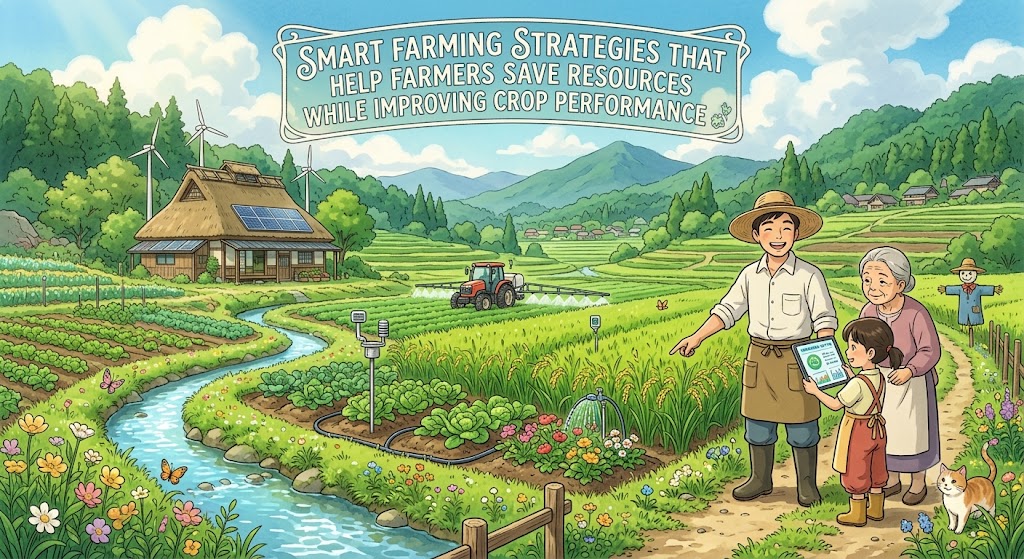
Modern farming requires farmers to balance two goals that can sometimes seem difficult to achieve at the same time: producing strong crops and using resources efficiently.
Water, fertilizer, fuel, seed, labor, machinery, and land all have a cost. At the same time, crops need the right conditions to develop throughout the growing season.
Smart farming provides a practical way to connect these two objectives. Instead of applying the same amount of every input everywhere, farmers can use field data, weather information, soil testing, precision equipment, and regular scouting to understand where resources are actually needed.
For American farmers, this approach can be particularly useful across large and diverse operations. A farm does not have to become completely automated to benefit from smart agriculture. Even small improvements in irrigation timing, fertilizer placement, equipment use, or crop scouting can add up over an entire season.
The goal is simple: use the right resource, in the right place, at the right time, while maintaining healthy crop growth.
Start With a Clear Picture of the Farm
Smart farming begins with information.
Before changing management practices, farmers should understand what is happening across their fields.
Useful information can include:
- Soil-test results
- Historical yields
- Crop rotations
- Irrigation records
- Weather conditions
- Input costs
- Field maps
- Pest observations
- Equipment records
Fields are rarely uniform.
One area may have excellent drainage while another remains wet. One section may consistently produce high yields while another struggles.
Treating every acre exactly the same can sometimes lead to unnecessary inputs.
Understanding these differences allows farmers to focus resources where they can provide the greatest benefit.
Use Soil Testing to Guide Nutrient Decisions
Fertilizer is an important farm input, but applying more does not automatically produce better crops.
Soil testing can provide useful information about nutrient availability and pH.
Farmers can use these results alongside crop requirements and realistic yield goals to develop nutrient-management plans.
This can help avoid applying nutrients simply because a crop appears weak.
In some cases, a weak area may be suffering from compaction, poor drainage, pests, disease, or water stress rather than nutrient deficiency.
Accurate diagnosis can therefore prevent unnecessary fertilizer expenses.
Apply Water More Precisely
Water can be one of the most important resources on a farm.
Smart irrigation systems can combine soil-moisture sensors, weather information, crop growth stages, and irrigation records.
This allows farmers to make decisions based on actual conditions rather than relying only on fixed schedules.
For example, if recent rainfall has provided sufficient moisture, irrigation may not be necessary immediately.
On the other hand, if soil moisture is declining and weather forecasts indicate continued dry conditions, timely irrigation may help prevent crop stress.
The objective is not simply to use less water.
It is to use water where and when crops need it.
Protect Soil Moisture With Cover
Soil management and water conservation are closely connected.
Bare soil can lose moisture more quickly and may be more vulnerable to erosion.
Crop residue can provide surface protection, while suitable cover crops can keep living roots in the soil between cash crops.
Depending on local conditions, farmers may use crops such as cereal rye, oats, wheat, clover, or other suitable species.
Cover-crop decisions should consider planting windows, water availability, termination, equipment, and the following crop.
A successful cover-crop system should provide practical benefits without creating new management problems.
Reduce Unnecessary Field Passes
Every trip across a field consumes fuel, requires labor, and places machinery weight on the soil.
Farmers can look for opportunities to combine operations or eliminate passes that provide little value.
GPS guidance can help equipment follow accurate paths and reduce unnecessary overlap.
For large farms, even small reductions in overlapping passes can become significant over hundreds or thousands of acres.
Reduced field traffic can also help limit unnecessary soil compaction.
The idea is simple:
If a field operation does not solve a meaningful problem, consider whether it is necessary.
Use Precision Planting
Seed is another major production expense.
Precision planting technology can help farmers maintain more consistent seed placement, spacing, and population.
Uniform emergence can improve crop competition and make field management more predictable.
Farmers can also compare planting performance between fields.
If one section consistently produces poor emergence, the cause can be investigated.
Possible factors might include soil conditions, planting depth, residue, compaction, moisture, or equipment performance.
Improving the cause is more valuable than simply increasing seed rates everywhere.
Manage Inputs According to Field Variation
Modern fields can contain significant differences in soil type, fertility, moisture, and yield potential.
Variable-rate technology allows farmers to adjust certain input applications based on digital maps or other information.
For example, fertilizer rates can sometimes be adjusted according to soil-test results and expected crop requirements.
Seed populations may also be adjusted in suitable systems.
The key is to use reliable information.
Precision agriculture should not mean changing application rates simply because technology makes it possible.
Every change should have an agronomic reason behind it.
Use Crop Rotation to Improve Efficiency
Crop rotation can improve the overall efficiency of a farming system.
Different crops have different nutrient requirements, root structures, planting windows, and pest relationships.
Rotating crops can help diversify the demands placed on soil.
It can also provide opportunities to manage weeds and pests using different approaches.
A good rotation can reduce reliance on a single crop while spreading production risk.
However, the rotation must still make financial sense.
Farmers should consider markets, equipment, labor, storage, and expected returns when selecting crops for rotation.
Monitor Weeds Before They Become Expensive
Weed management can consume considerable amounts of labor and crop-protection products.
Regular scouting helps farmers identify problem areas early.
Technology can make this process more targeted.
Satellite imagery, drones, cameras, and AI-assisted systems can identify areas with unusual vegetation patterns.
Farmers can then inspect those areas directly.
Instead of treating every part of a large field with the same level of attention, resources can be focused where weed pressure is actually significant.
This can potentially reduce unnecessary applications while maintaining effective control.
Improve Pest Management Through Monitoring
Smart pest management starts with observation.
Farmers should monitor crops regularly and determine whether pest populations are actually reaching levels that justify intervention.
Integrated pest management can combine:
- Resistant varieties
- Crop rotation
- Biological controls
- Field sanitation
- Cultural practices
- Targeted crop-protection treatments
The goal is to manage economically important pests rather than automatically treating every insect found in a field.
Technology can support this process by improving monitoring and helping farmers identify changes sooner.
Use Weather Data for Better Timing
Weather affects nearly every farm operation.
Planting, spraying, irrigation, cultivation, and harvesting all depend partly on weather conditions.
On-farm weather stations can provide localized information about temperature, rainfall, humidity, and wind.
Farmers can combine this information with forecasts and field observations.
This can help improve timing.
For example, avoiding a field operation when conditions are unsuitable can prevent wasted fuel, poor application results, or unnecessary soil disturbance.
Better timing can sometimes be just as valuable as using more inputs.
Maintain Equipment Efficiently
Farm machinery represents a major investment.
Poorly maintained equipment can consume more fuel, operate inefficiently, or fail during critical periods.
Modern machinery can provide information about engine performance, operating hours, fuel use, and other conditions.
Farmers can use this information to plan maintenance.
Regular inspections remain essential.
However, digital equipment data can provide another layer of information that helps identify unusual patterns before they become major problems.
Preventing one expensive breakdown during planting or harvest can provide substantial value.
Use Yield Data to Improve Next Season
Harvest is not the end of the data cycle.
Yield monitors can record production while crops are being harvested.
Yield maps can then show how different areas of the field performed.
If a section repeatedly produces lower yields, farmers can investigate.
Possible causes could include:
- Drainage
- Soil fertility
- Compaction
- Water availability
- Pests
- Disease
- Weed pressure
The important point is that yield data should lead to questions.
A low-yield area should not automatically receive more fertilizer.
First determine why performance is lower.
Keep Digital Farm Records
Good records can reveal opportunities that are difficult to see during a busy season.
Track:
- Planting dates
- Seed varieties
- Input applications
- Irrigation
- Weather
- Field operations
- Crop yields
- Labor
- Fuel
- Equipment costs
- Selling prices
After several years, this information can help farmers compare actual performance.
A field that appears profitable at first glance may have unusually high input costs.
Another field may produce moderate yields but generate stronger returns because it requires fewer inputs.
Good records make these differences easier to identify.
Use AI as a Decision-Support Tool
Artificial intelligence is becoming increasingly useful in agriculture.
AI can process large quantities of information and identify patterns in crop images, weather data, soil measurements, equipment records, and historical farm information.
Potential uses include:
- Crop stress detection
- Weed identification
- Pest monitoring
- Irrigation recommendations
- Yield forecasting
- Equipment monitoring
- Farm-record analysis
AI should not replace farmer judgment.
A computer can identify that one area of a field looks unusual, but the farmer still needs to determine what is causing the problem.
The strongest approach is to combine AI analysis with field experience.
Focus on Resource Efficiency, Not Just Cost Cutting
Saving resources does not mean using the smallest possible amount of everything.
For example, reducing fertilizer too aggressively can hurt crop performance.
Reducing irrigation below crop requirements can create stress.
Cutting labor without considering timing can cause harvesting losses.
Smart farming is about finding the right level of resource use.
The objective is to avoid waste while giving crops what they need.
This distinction is important because efficiency and cost cutting are not always the same thing.
Create a Simple Smart-Farming Workflow
Farmers can organize the season around a straightforward process:
1. Measure
Collect soil, weather, yield, moisture, and field information.
2. Analyze
Look for differences, trends, and problem areas.
3. Decide
Choose the management action based on the information.
4. Apply
Use the appropriate amount of seed, water, fertilizer, labor, or crop protection.
5. Monitor
Check whether the decision produced the expected result.
6. Record
Save the information for future seasons.
This creates a continuous improvement cycle.
Example of Smart Resource Management
Consider a farm where one field has historically received the same irrigation schedule every week.
After installing soil-moisture sensors, the farmer discovers that certain sections remain adequately moist for longer than expected.
Instead of irrigating the entire field on the same schedule, the farmer can investigate whether irrigation timing or application amounts can be adjusted.
The result may be less unnecessary water use while maintaining appropriate moisture for the crop.
The important lesson is not the sensor itself.
It is the decision made because better information became available.
Start Small and Measure Results
Farmers do not need to transform their entire operation overnight.
Choose one meaningful problem.
For example:
- Excessive irrigation
- High fertilizer costs
- Too many field passes
- Poor weed scouting
- Equipment downtime
- Uneven crop emergence
Introduce one practical improvement.
Then measure the result.
Did it save time?
Did it reduce input use?
Did crop performance remain stable or improve?
Did the investment pay for itself?
If the answer is positive, the same approach can gradually be expanded.
Final Thoughts
Smart farming is ultimately about making better decisions with the resources already available.
For American farmers, precision equipment, GPS systems, soil sensors, weather stations, satellite imagery, yield monitors, AI tools, and digital farm records can provide a much clearer understanding of what is happening across the operation.
But technology is only part of the equation.
Strong farming still depends on healthy soil, good crop selection, proper planting, timely scouting, responsible nutrient management, effective water use, and experienced judgment.
The most successful approach is to combine both.
Measure what matters. Use resources where they are needed. Monitor the results. Learn from each season.
By following that cycle, farmers can improve efficiency without sacrificing crop performance—and build a farming system that is more productive, practical, and resilient over the long term.