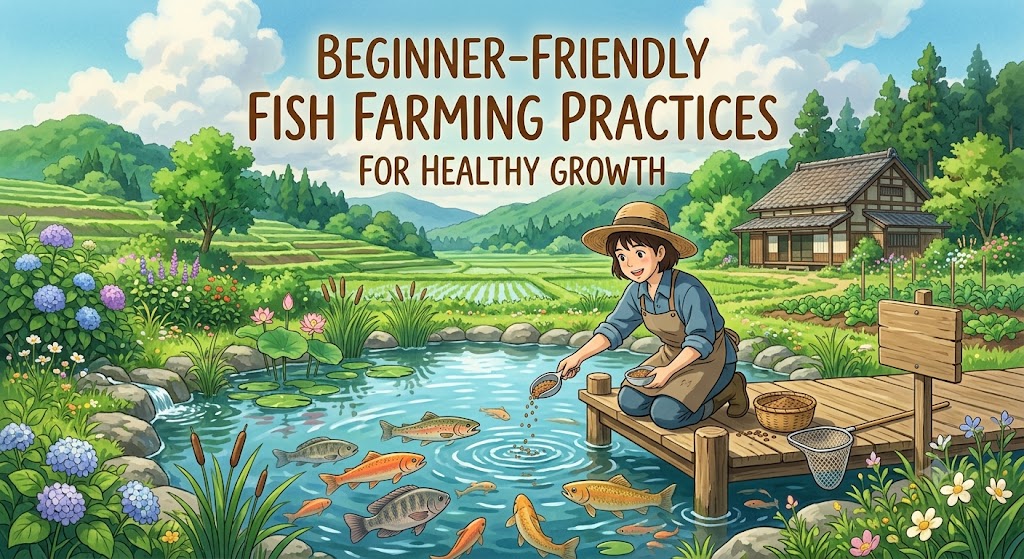
Fish farming can be an interesting opportunity for farmers who want to diversify their agricultural operations or develop a dedicated aquaculture business. From small ponds to larger commercial systems, successful fish production depends on understanding the relationship between fish health, water quality, feeding, stocking, equipment, and daily management.
For beginners in the United States, the biggest mistake is often focusing only on the fish. In reality, water is the foundation of the entire production system. Fish live in their water, eat within that environment, and depend on it for oxygen and stable conditions.
A practical fish-farming system does not have to begin with expensive technology. Good observation, regular water testing, appropriate stocking, proper feeding, and consistent record keeping can provide a strong foundation.
As the operation grows, farmers can add aerators, automatic feeders, sensors, monitoring systems, and other modern aquaculture tools.
Start With the Right Fish for Your System
Not every fish species is suitable for every farm.
Before purchasing fingerlings or constructing a pond, farmers should research species that are appropriate for the local climate, water conditions, production system, and market.
Commonly farmed species in the United States include:
- Catfish
- Trout
- Tilapia
- Bass
- Carp
- Various species used in specialized aquaculture systems
Each species has different requirements for temperature, oxygen, feed, stocking density, and water quality.
A beginner should select a species based on the entire production system rather than simply choosing the fish with the highest market price.
Choose a Suitable Production System
Fish can be raised in several different types of systems.
Pond Farming
Ponds can be suitable for farmers with sufficient land and appropriate water conditions.
They may require relatively simple infrastructure compared with intensive indoor systems.
Tank Systems
Tanks provide greater control over water conditions and can be useful where land or natural ponds are limited.
Recirculating Aquaculture Systems
Recirculating systems reuse water through filtration and treatment equipment.
They can provide greater environmental control but generally require more equipment, electricity, technical knowledge, and monitoring.
Beginners should choose a system that matches their budget, skills, available water, and management capacity.
Water Quality Comes First
Healthy fish require suitable water conditions.
Important parameters can include:
- Temperature
- Dissolved oxygen
- pH
- Ammonia
- Nitrite
- Water clarity
- Alkalinity
- Salinity where relevant
The ideal range depends on the fish species.
Water should therefore be tested regularly rather than managed according to a single universal number.
A basic water-testing kit can provide useful information for small operations.
Larger systems may use digital sensors that continuously monitor conditions.
Maintain Adequate Dissolved Oxygen
Oxygen is one of the most important factors in fish production.
Fish require dissolved oxygen to survive, and oxygen levels can change throughout the day.
Warm water generally holds less dissolved oxygen than cooler water, while high fish densities can increase oxygen demand.
Aerators can help maintain oxygen levels in ponds and tanks.
Farmers should pay particular attention during hot weather, cloudy periods, algae problems, or other conditions that can cause oxygen levels to decline.
Fish gathering near the surface or behaving unusually can be warning signs that require immediate investigation.
Avoid Overstocking
Stocking too many fish into a pond or tank can create problems quickly.
Higher stocking densities increase:
- Oxygen demand
- Waste production
- Feeding requirements
- Disease risk
- Water-quality challenges
Beginners may be tempted to maximize the number of fish because more fish appear to mean more revenue.
But if the system cannot support that population, production can suffer.
A slightly lower stocking density that produces healthy, well-growing fish can be more reliable than an overloaded system.
Follow species-specific recommendations and local aquaculture guidance when determining stocking rates.
Buy Healthy Fingerlings
The quality of the fish entering the system can influence the entire production cycle.
When purchasing fingerlings, farmers should work with reputable suppliers and understand the health history of the stock.
Look for active, appropriately sized fish without obvious signs of disease or injury.
New fish should be introduced carefully.
Where appropriate, quarantine procedures can help reduce the chance of introducing problems into an established production system.
Feed Fish Carefully
Feed is often one of the largest operating expenses in aquaculture.
Overfeeding creates two problems.
First, it wastes money.
Second, uneaten feed breaks down and can reduce water quality.
Fish should receive an appropriate amount of feed based on species, size, water temperature, growth stage, and production conditions.
Observe feeding behavior.
If fish consistently leave large amounts of food uneaten, the feeding rate may need to be reviewed.
Automatic feeders can improve consistency in larger systems, but they still need to be monitored.
Automation should not become an excuse to stop observing the fish.
Use Feed Efficiently
Feed conversion is an important measure in fish farming.
It essentially compares the amount of feed used with the amount of fish growth achieved.
Efficient feeding can improve profitability while reducing waste.
Farmers should keep records of:
- Feed quantity
- Feeding frequency
- Fish growth
- Mortality
- Water conditions
Over time, these records can reveal whether the feeding program is performing as expected.
Monitor Fish Growth Regularly
Fish should be sampled periodically to determine whether growth is progressing normally.
Farmers can estimate average weight and compare it with previous measurements.
Growth records can help answer important questions.
Are fish growing consistently?
Is feed being used efficiently?
Are some groups significantly smaller?
Is water quality affecting growth?
Is the stocking density appropriate?
Regular measurement turns general observation into useful production information.
Watch for Signs of Stress
Fish cannot tell farmers when something is wrong, so behavior becomes an important source of information.
Warning signs can include:
- Reduced feeding
- Unusual swimming
- Gasping near the surface
- Fish gathering in one area
- Loss of balance
- Visible injuries
- Unexpected mortality
- Sudden changes in activity
These signs do not always indicate the same problem.
Poor oxygen, temperature changes, water-quality issues, disease, or other stressors can produce similar symptoms.
The correct response is to investigate the underlying cause rather than immediately treating the fish.
Manage Waste and Water Quality
Fish produce waste, while uneaten feed can add additional organic material.
If waste accumulates faster than the system can process it, water quality can deteriorate.
Ponds, tanks, and recirculating systems require different management approaches.
Depending on the system, farmers may use:
- Aeration
- Filtration
- Water exchange
- Sediment management
- Biological filtration
- Appropriate stocking levels
The objective is to maintain a stable environment rather than repeatedly reacting to severe water-quality problems.
Be Careful With Water Changes
Water changes can be useful in some fish-farming systems, but replacing water too quickly can create stress if the incoming water has significantly different temperature, pH, or other characteristics.
Water quality should therefore be monitored before major changes.
The appropriate approach depends heavily on the species and production system.
Farmers should follow system-specific aquaculture guidance rather than assuming that frequent large water changes are always beneficial.
Control Algae Carefully
Algae can be a natural part of pond ecosystems.
Some algae can contribute oxygen during daylight and form part of the aquatic food chain.
However, excessive algae growth can create problems.
Large algae populations can contribute to significant oxygen changes, particularly when algae die and decompose or during nighttime periods.
Sudden changes in pond appearance or fish behavior should be investigated.
Farmers should avoid applying treatments without understanding the cause of the algae problem because rapidly killing large quantities of algae can sometimes create additional water-quality stress.
Keep Equipment in Good Condition
Reliable equipment can make fish farming much easier.
Important equipment may include:
- Aerators
- Pumps
- Filters
- Feeders
- Water-testing equipment
- Backup power systems
- Nets
- Storage containers
Equipment should be inspected regularly.
A failed aerator during a critical period can create serious problems quickly.
For larger operations, backup systems can provide additional protection against equipment failures and power interruptions.
Use Sensors as the Farm Grows
Modern aquaculture increasingly uses sensors to monitor water conditions.
Digital systems can measure parameters such as temperature, dissolved oxygen, and other water-quality indicators.
Some systems can send alerts when conditions move outside selected ranges.
This can be particularly valuable when farmers cannot physically inspect the facility continuously.
However, sensors should be calibrated and maintained properly.
A faulty sensor can create a false sense of security.
Technology works best when combined with physical observation and routine testing.
Keep Detailed Production Records
Good records can reveal problems before they become obvious.
Track:
- Stocking dates
- Number of fish
- Fingerling source
- Feed quantities
- Water-quality measurements
- Fish growth
- Mortality
- Treatments
- Equipment problems
- Harvest weights
- Selling prices
After several production cycles, these records can help farmers identify which management practices produce the best results.
Records can also help calculate the real cost of production.
Calculate the Real Cost of Fish Production
A fish farm can appear profitable if only the selling price is considered.
Farmers should calculate expenses such as:
- Fingerlings
- Feed
- Electricity
- Water
- Aeration
- Pumps
- Labor
- Equipment
- Maintenance
- Transportation
- Harvesting
- Processing
- Losses
For example, an operation producing 10,000 pounds of fish at an average selling price of $3.50 per pound would generate:
Gross revenue: $35,000
If total production and operating costs were $27,500:
Estimated operating return: $7,500
These are illustrative figures only. Actual economics vary significantly depending on species, location, production system, feed prices, energy costs, labor, mortality, and market conditions.
The important point is to calculate the complete production cost before expanding.
Plan the Market Before Stocking
One of the biggest beginner mistakes is producing fish without a clear marketing plan.
Before stocking, identify potential buyers.
Depending on the operation, markets may include:
- Seafood distributors
- Restaurants
- Grocery businesses
- Local markets
- Direct customers
- Specialty buyers
- Processors
Market requirements can influence fish size, harvest timing, packaging, and transportation.
Knowing what buyers want can make production planning much easier.
Start Small and Learn the System
Beginning with a manageable production size can reduce financial risk.
A smaller operation allows farmers to learn:
- How quickly fish grow
- How much feed they consume
- How water quality changes
- How equipment behaves
- How much labor is required
- What customers want
After completing one or more production cycles, the farmer can use actual records to decide whether expansion makes sense.
This is usually safer than investing heavily before understanding the system.
Follow Local Regulations
Aquaculture operations may be subject to state, federal, environmental, water-use, animal-health, food-safety, and business regulations.
Requirements vary depending on the location and type of operation.
Farmers should check the applicable rules before constructing ponds, sourcing fish, moving aquatic animals, discharging water, or selling harvested products.
Regulatory planning should be part of the business plan from the beginning.
Build a Simple Daily Routine
A consistent routine can prevent small problems from becoming major ones.
Every Day
- Observe fish behavior.
- Check feeding response.
- Inspect aerators and pumps.
- Look for dead or stressed fish.
- Check important water parameters.
Every Week
- Review growth.
- Inspect equipment.
- Check feed inventory.
- Review water-quality records.
- Look for unusual changes.
Every Production Cycle
- Calculate feed efficiency.
- Review mortality.
- Compare growth.
- Calculate production costs.
- Evaluate the market.
- Identify improvements for the next cycle.
Consistency is one of the most valuable management tools in aquaculture.
Final Thoughts
Fish farming can become a productive agricultural business when the production system is carefully managed.
For beginners, the most important principles are straightforward: choose an appropriate species, maintain good water quality, avoid excessive stocking, feed carefully, monitor fish behavior, maintain equipment, keep accurate records, and understand the market before expanding.
Modern technology can make these tasks easier.
Sensors can monitor water conditions. Automated feeders can improve consistency. Digital records can track production. AI and data-analysis tools may eventually help farmers identify patterns in growth and water quality.
But technology should support basic management rather than replace it.
The foundation remains healthy fish and stable water.
Start with a manageable system, learn how the fish respond to changing conditions, record everything important, and expand only when the numbers support it.
With careful management and consistent observation, even a beginner can build the knowledge needed to develop a more reliable and efficient fish-farming operation.