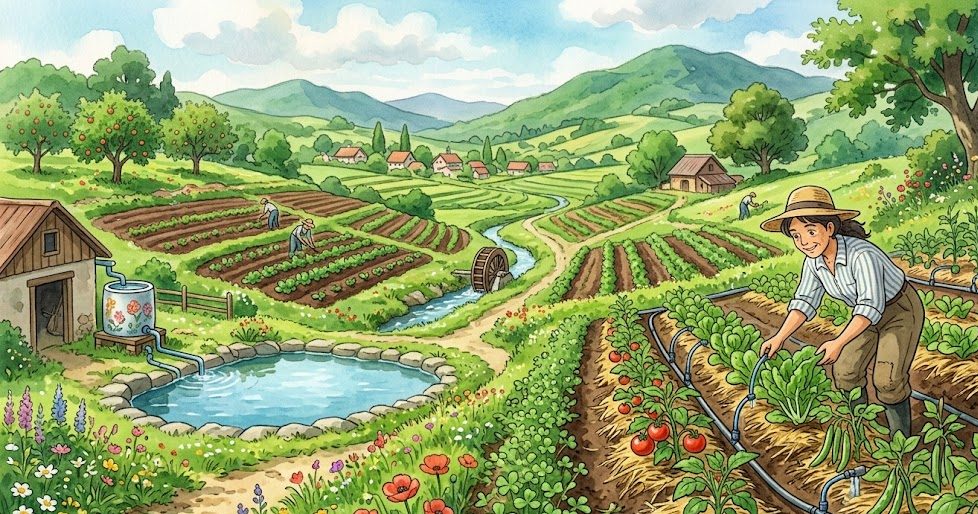
Water is the lifeblood of agriculture, yet it is fast becoming one of our most insecure resources. Changing weather patterns, prolonged droughts, and over-extracted aquifers are forcing farmers worldwide to face a harsh reality: the old ways of unrestricted flood irrigation are no longer sustainable.
When fields are over-irrigated, water does not just evaporate into the air; it washes away vital topsoil, leaches expensive fertilizers deep past the root zone, and suffocates plant roots by cutting off their oxygen supply.
Achieving maximum yields today does not require dumping more water onto crops. Instead, it requires mastering smart moisture management.
By applying advanced water-saving techniques, you can turn your farm into a highly efficient ecosystem. These strategies protect your crops against seasonal dry spells, lower your pumping and energy costs, and maximize your total harvest output using every single drop of water.
Changing the Focus: Watering the Plant, Not the Soil
Traditional irrigation methods, such as open flood channels, typically lose 40% to 60% of their water to evaporation and deep seepage before the crop can ever use it. This creates a wasteful cycle that damages the soil structure and leaves crops vulnerable to sudden heatwaves.
Traditional Flood Irrigation:
[Massive Water Volume] ──> [Surface Evaporation & Runoff] ──> [Leached Nutrients & Root Rot] ──> [Unstable Yields]

Precision Water-Saving Farming:
[Pinpoint Delivery] ──> [Soil Mulch Moisture Retention] ──> [Deep Root Vigor & Nutrient Uptake] ──> [Maximum Stable Yields]
Shifting to precision water-saving techniques changes this dynamic entirely. Instead of simply saturating open fields, these methods treat water as a highly targeted input. Delivering water exactly where and when the plant needs it keeps the root zone consistently moist, prevents soil compaction, and creates an ideal environment for your crops to thrive.
1. Precision Irrigation Delivery Systems
The foundation of efficient on-farm water management begins with how water is physically delivered to your fields. Moving away from gravity-fed flooding to pressurized precision networks dramatically cuts water waste.
- Subsurface Drip Irrigation (SDI): This technique buries flexible drip lines 6 to 18 inches below the soil surface, delivering water and liquid nutrients directly into the plant root zone. Because the water remains entirely underground, surface evaporation is practically zero, and weed seeds in the dry surface soil struggle to germinate.
- Intelligent Micro-Sprinklers: For orchards and high-density row crops, micro-sprinklers provide a targeted, low-volume mist over specific management zones. This approach maintains optimal humidity around delicate fruit crops during intense summer heatwaves without wasting water on open lanes or walkways.
2. Rebuilding the Organic Soil Sponge
Your irrigation equipment is only as good as the soil’s ability to hold onto the moisture it receives. Sandy, depleted, or heavily plowed soils act like a sieve, allowing water to drain away out of reach. To save water efficiently, you must actively improve your soil’s natural holding capacity.
- Increasing Soil Organic Matter (SOM): Think of organic matter—such as decomposed crop residue, manure, and stable compost—as a natural, underground sponge. For every 1% increase in soil organic matter, an acre of topsoil can hold an estimated 20,000 gallons of additional fresh water. This extra storage acts as a vital safety buffer that keeps your crops hydrated during extended mid-season dry spells.
- Integrating Biochar: Biochar is a highly porous, carbon-rich material produced by baking agricultural waste without oxygen. When mixed into your fields, biochar creates a permanent network of microscopic pockets that lock in moisture and protect beneficial soil bacteria, ensuring your soil stays fertile and resilient for decades.
3. Protective Surface Shields: Mulching and Cover Crops
Once you deliver water to your soil, you must prevent the sun and wind from stripping it away. Leaving your topsoil completely bare invites rapid evaporation and seals the surface layer, making it harder for future rain to soak in.
| Soil Protection Method | Practical Field Application | Primary Water-Saving Benefit | Management Considerations |
| Organic Crop Residue Mulching | Leaving corn stalks, wheat straw, or shredded orchard clippings directly on the field surface. | Lowers soil surface temperatures by up to 10°F, cutting evaporation losses by 20% to 35%. | Requires specialized seed drills to plant cleanly through thick surface residue. |
| Living Cover Crop Blankets | Seeding fast-growing, low-lying plants like clover or cowpeas during open fallow periods. | Prevents heavy rains from compacting the topsoil, allowing water to soak in smoothly. | Must be properly terminated before the cash crop is planted to prevent moisture competition. |
| Reflective Plastic Mulch Film | Laying down thin, specialized plastic sheets over raised planting beds for high-value vegetable crops. | Completely seals in soil moisture while warming the root zone for faster early-season growth. | Requires proper collection and recycling plans at the end of the harvest season to prevent field waste. |
4. Alternate Wetting and Drying (AWD) in Rice Cultivation
Rice is traditionally grown in continuously flooded paddies, making it one of the most water-intensive crops in global agriculture. However, a proven water-saving technique known as Alternate Wetting and Drying (AWD) is changing this practice without sacrificing yields.
The Mechanics of AWD: Instead of keeping rice fields permanently submerged under 2 to 5 inches of water, farmers allow the field to dry out naturally for a few days until the water table drops roughly 6 inches below the soil surface. Once the soil develops shallow surface cracks, the field is re-flooded. This managed cycle cuts total water consumption by up to 30% and significantly reduces methane emissions, all while maintaining or even boosting final grain yields.
A Step-by-Step System to Optimize On-Farm Water Use
Upgrading your farm’s water management does not have to be an overwhelming or expensive all-at-once project. You can achieve excellent results by implementing changes in clear, manageable steps.
1.Step 1: Mapping Field Texture and Irrigation Uniformity:Timeframe: Pre-Season Assessment.
Walk your fields to identify distinct soil zones, noting sandy areas that drain too fast and clay pockets prone to waterlogging. Check your existing pumps, valves, and pipelines for leaks, and use simple catch-cans to ensure your current sprinklers are distributing water evenly across the entire crop area.
2.Step 2: Transitioning to Conservation Tillage and Mulching:Timeframe: Seedbed Preparation.
Stop deep plowing and adopt zero-till or strip-tillage practices to keep old crop residues on the surface. If you are growing high-value vegetables, install drip lines and lay down organic or plastic mulch over your planting beds to seal in moisture before seeding.
3.Step 3: Monitoring Real-Time Soil Moisture Data:Timeframe: Active Growing Season.
Place affordable, manual tensiometers or digital soil moisture probes at varying root depths within your primary crop zones. Use these real-time readings to guide your irrigation choices, watering only when the root zone drops below a specific moisture threshold rather than following a rigid calendar schedule.
4.Step 4: Incorporating Drought-Resilient Crop Varieties:Timeframe: Multi-Year Rotation Planning.
Adjust your long-term crop rotation to include deeper-rooting varieties or short-duration crops that mature quickly. This strategic adjustment minimizes your farm’s total water requirements during the hottest, driest months of the year, taking the pressure off your water reserves.
Frequently Asked Questions (FAQs)
Will using less water reduce my final crop yields?
No. Water-saving techniques focus on eliminating water waste, not depriving the plant. When you stop over-watering, you prevent root rot, reduce weed growth, and stop nutrients from leaching deep into the ground. Providing the right amount of targeted moisture actually improves root health and leads to higher, more stable yields.
How deep should I place soil moisture sensors?
For most standard row crops and vegetables, it is best to place sensors at two distinct depths. Position the shallow sensor around 6 to 12 inches deep to track active moisture uptake in the primary root zone, and place a deeper sensor at 18 to 24 inches to monitor deep drainage and ensure you are not over-watering.
Is drip irrigation practical for large-scale grain crops like corn or wheat?
Yes, Subsurface Drip Irrigation (SDI) is increasingly used on large-scale commercial grain farms. While the initial setup requires an upfront investment, the system lasts for over 15 to 20 years. The long-term savings from reduced water use, lower pumping costs, and precise liquid fertilizer delivery quickly offset the starting costs.
Can clay soils benefit from organic mulches?
Absolutely. Clay soils compact very easily when exposed to heavy rain and bake into hard crusts under the hot sun. Adding a protective layer of organic mulch shields the clay surface, prevents cracking, and allows water to soak in smoothly rather than pooling on top and running off.
Conclusion
Mastering water-saving farming techniques is no longer just an environmental ideal; it is a fundamental pillar of modern farm profitability and survival. Continuing to rely on outdated, high-volume flooding methods wastes valuable resources, increases your operational costs, and degrades long-term soil health.
By upgrading to precision delivery networks, building an organic soil sponge, and keeping your fields protected with surface mulches, you can break free from water scarcity risks. These practical, proven techniques do more than just conserve water—they build a highly resilient, cost-effective farming operation that can deliver maximum, high-quality yields even in the toughest climates.