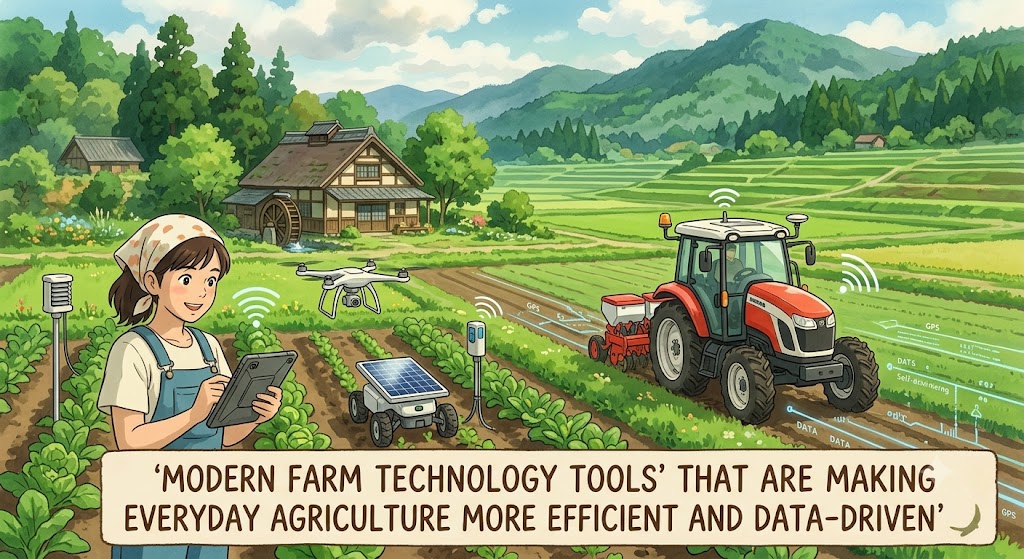
Modern farming is becoming increasingly connected. A tractor can collect field information while working, a soil sensor can report moisture conditions, satellites can monitor crop growth, and farm-management software can organize years of production records.
For American farmers, this shift is creating new opportunities to save time, improve field decisions, reduce unnecessary inputs, and understand what is happening across large areas of farmland.
The most useful agricultural technology is not necessarily the most complicated. A practical GPS guidance system, a reliable weather station, or a good yield monitor can sometimes provide more value than an expensive system that produces information nobody has time to use.
The real goal of modern farm technology is simple: turn useful information into better decisions while making everyday farm work more efficient.
GPS Guidance Systems
GPS technology has become one of the most practical tools in modern agriculture.
Guidance systems can help tractors and other equipment follow accurate paths across fields.
This can reduce unnecessary overlaps during planting, spraying, fertilizing, and other operations.
For large farms, even small reductions in overlapping passes can become meaningful over hundreds or thousands of acres.
GPS can also help create repeatable traffic patterns.
When equipment follows similar paths, farmers may be able to reduce unnecessary soil compaction in areas outside established traffic lanes.
The technology can therefore provide both operational and soil-management benefits.
Precision Planting Technology
Planting equipment has become much more sophisticated.
Modern planters can monitor seed placement, spacing, population, and other planting conditions while equipment is operating.
Some systems can provide information about skips, doubles, or changes in planting performance.
Uniform planting is important because plants that emerge at significantly different times may compete unevenly.
Technology that improves seed placement can therefore contribute to more consistent crop establishment.
Farmers can also use planting data to compare performance across different fields and seasons.
Soil-Moisture Sensors
Water management is a major concern for many American farms.
Soil-moisture sensors can provide information about conditions beneath the surface.
Instead of relying entirely on visual observation, farmers can use sensor readings to understand whether water is available in the root zone.
This information can support irrigation decisions.
The objective is not simply to irrigate less.
It is to apply water when crops actually need it and avoid unnecessary applications.
For farms facing high pumping costs or limited water availability, better information can be particularly valuable.
Automated Weather Stations
Weather affects nearly every agricultural decision.
Farmers need to consider temperature, rainfall, humidity, wind, and other conditions when planning irrigation, spraying, planting, and harvesting.
On-farm weather stations can provide localized information that may differ from data collected farther away.
Some systems can connect weather information to farm-management platforms.
This allows farmers to review current conditions and historical records in one place.
Weather stations can also help farmers understand how conditions differ between fields.
Satellite Crop Monitoring
Satellite imagery has become increasingly accessible to agricultural operations.
Farmers can use satellite images to monitor crop development across large areas without physically walking every acre.
Changes in vegetation patterns may highlight areas that deserve closer attention.
For example, a section of a field showing weaker growth could indicate a possible issue with water, nutrients, pests, disease, or soil conditions.
Satellite imagery does not automatically identify the cause.
Instead, it helps farmers decide where to investigate.
This makes scouting more targeted.
Agricultural Drones
Drones can provide highly detailed images of fields.
Compared with satellite imagery, drones can sometimes provide more localized information at a very fine scale.
Farmers may use drones to inspect crop development, drainage patterns, irrigation systems, field damage, or other conditions.
The biggest advantage can be speed.
Instead of physically walking a large field, a farmer or agricultural professional can capture imagery and identify areas that require attention.
Drones are particularly useful when the information they provide leads to a practical action.
Yield Monitors
Yield monitors can record crop production while harvesting equipment moves through the field.
The information can later be used to create yield maps.
These maps can reveal differences across a field.
Some areas may consistently produce strong yields, while others may repeatedly underperform.
When combined with soil tests, field history, and other information, yield maps can help farmers investigate the reasons behind these differences.
Over multiple seasons, yield data can become an important resource for crop planning.
Variable-Rate Technology
Not every part of a field necessarily needs the same amount of seed, fertilizer, or other inputs.
Variable-rate technology allows equipment to change application rates according to digital field maps or sensor information.
For example, areas with different soil characteristics may receive different nutrient rates when supported by appropriate agronomic information.
This can help farmers move toward more targeted input management.
The important part is having reliable information behind the prescription.
Variable-rate technology works best when farmers understand why different areas require different treatment.
Farm Management Software
Modern farm-management platforms can bring many types of information together.
Instead of keeping planting records, input applications, field maps, yields, and financial information in separate locations, farmers can organize them digitally.
This makes historical analysis easier.
A farmer can compare fields, crops, varieties, yields, and input costs across several seasons.
Good software can also reduce administrative work.
However, simplicity matters.
A system with dozens of features is not useful if it takes too much time to operate.
The best platform is one that fits the farm’s actual workflow.
Artificial Intelligence in Agriculture
Artificial intelligence is becoming another important part of agricultural technology.
AI systems can analyze large amounts of information and identify patterns.
Potential applications include:
- Crop monitoring
- Weed identification
- Pest detection
- Disease recognition
- Yield forecasting
- Irrigation planning
- Equipment maintenance
- Weather analysis
- Farm record organization
AI can be particularly useful for identifying unusual patterns that may be difficult to spot manually.
However, farmers should treat AI recommendations as decision-support information rather than unquestionable answers.
Field verification remains important.
Smart Irrigation Systems
Modern irrigation technology can automate portions of water management.
Sensors can measure soil conditions, while controllers can adjust irrigation schedules based on available information.
Some systems can incorporate weather forecasts and crop requirements.
This can reduce unnecessary irrigation and save labor.
Smart irrigation can be particularly useful for farms where water management requires frequent monitoring.
The system should still be configured appropriately for the crop and local conditions.
Automation is valuable only when the underlying information is reliable.
Connected Farm Equipment
Agricultural equipment is becoming increasingly connected.
Modern tractors, combines, sprayers, and other machines can collect information about operating conditions and performance.
Some systems can send information to farm-management platforms in real time.
This creates opportunities for better equipment monitoring.
Farm managers can potentially track machine hours, fuel consumption, field progress, and maintenance information without relying entirely on handwritten records.
Connected equipment can also improve coordination between different parts of the farm.
Predictive Equipment Maintenance
Equipment failure during planting or harvest can be extremely expensive.
Modern machines can generate data about engine performance, operating conditions, and component activity.
AI and data-analysis systems can use these records to identify unusual patterns that may indicate a developing problem.
This can support predictive maintenance.
Instead of waiting for a major failure, farmers may receive an indication that equipment should be inspected.
Predictive maintenance does not replace regular servicing.
Oil changes, inspections, cleaning, lubrication, and manufacturer-recommended maintenance remain essential.
Technology simply provides another source of information.
Digital Crop Scouting
Traditional field scouting remains important, but digital tools can make it more organized.
Farmers can record field observations using smartphones or tablets.
They can attach photographs, GPS locations, notes, and dates to specific observations.
Over time, this creates a searchable history.
If a particular section of a field repeatedly develops pest problems, drainage issues, or weak crop growth, the farmer can review previous observations before deciding what to do.
This turns individual field visits into long-term farm intelligence.
Robotics and Automated Machinery
Agricultural robotics is developing rapidly.
Depending on the application, automated machines may assist with tasks such as:
- Weed control
- Crop monitoring
- Harvesting
- Soil sampling
- Specialized cultivation
Robotics may be especially valuable for repetitive tasks that require significant labor.
However, cost, reliability, field conditions, and maintenance requirements must be considered.
For many farms, robotics will likely be adopted gradually as the technology becomes more practical for specific tasks.
Digital Irrigation and Water Mapping
Water-management technology is becoming increasingly data-driven.
Farmers can combine soil-moisture sensors, field maps, weather information, and irrigation records to understand how water moves across a field.
This can reveal areas that receive too much or too little water.
Correcting these differences can improve crop consistency.
In regions where water is expensive or limited, better water information can have significant financial value.
Cloud-Based Farm Data
Cloud technology allows farm information to be stored and accessed from different devices.
A farmer can potentially review records from a computer in the office, a tablet in a tractor, or a phone while walking a field.
This can improve coordination.
Farm managers, agronomists, equipment operators, and other authorized users can work from the same information.
Security remains important.
Farmers should understand how their data is stored, who can access it, and how it may be used by technology providers.
Use Technology to Identify Profitable Opportunities
Technology is not only useful for production.
It can also support financial planning.
Farmers can compare crop yields, input costs, selling prices, labor, and equipment expenses across seasons.
This can help identify which crops and fields consistently produce stronger returns.
For example, if one crop produces high yields but requires unusually high input costs, the farm may discover that another crop provides a better net return.
Data makes these comparisons easier.
Don’t Buy Technology Just Because It Is New
Modern agriculture offers an enormous number of technology products.
That does not mean every farm needs every tool.
Before investing, ask:
- What problem does this technology solve?
- How much time could it save?
- Can it reduce input waste?
- Does it improve decision-making?
- Does it work with existing equipment?
- Is the data easy to understand?
- What are the subscription and maintenance costs?
- Will someone on the farm actually use it?
The answers matter more than how advanced the product sounds.
A simple technology that saves several hours every week may provide greater value than a sophisticated platform that rarely gets used.
Combine Different Technologies
The biggest benefits often come when technologies work together.
Imagine a farm using:
GPS + soil sensors + satellite imagery + yield monitors + farm-management software
Each tool provides different information.
GPS shows where equipment operates.
Soil sensors provide moisture information.
Satellite imagery shows crop-development patterns.
Yield monitors show actual harvest performance.
Farm software brings the information together.
The result is a much more complete picture of what is happening across the farm.
A Practical Modern Farm Technology Setup
A farmer does not need to adopt everything immediately.
A practical starting system might include:
Basic Level
- Smartphone
- Digital farm records
- GPS guidance
- Local weather information
Intermediate Level
- Soil-moisture sensors
- Yield monitoring
- Satellite imagery
- Farm-management software
Advanced Level
- Variable-rate application
- Drone scouting
- AI analysis
- Connected machinery
- Automated irrigation
- Predictive maintenance
Farmers can move between these levels gradually based on their needs and budget.
Final Thoughts
Modern farm technology is changing how agriculture is managed across the United States.
GPS guidance can improve field operations. Soil sensors can support irrigation decisions. Satellites and drones can improve crop scouting. Yield monitors can reveal field variation. Farm-management software can organize years of information. AI can help analyze complex data and identify patterns.
But technology itself does not guarantee better farming.
The real value comes when information leads to a better decision.
A farmer who uses technology to identify a drainage problem, reduce unnecessary fertilizer, avoid equipment downtime, improve irrigation timing, or target scouting more efficiently is turning data into a practical advantage.
The smartest approach is to start with real farm problems rather than technology trends.
Choose tools that save time, reduce waste, improve visibility, or support better financial decisions.
Modern agriculture is becoming more data-driven, but the farmer’s experience remains essential. The strongest future will likely combine human agricultural knowledge with accurate data, practical technology, and smarter decision-making.